

Ducati Panigale V4 S (42202): the gearbox is the point
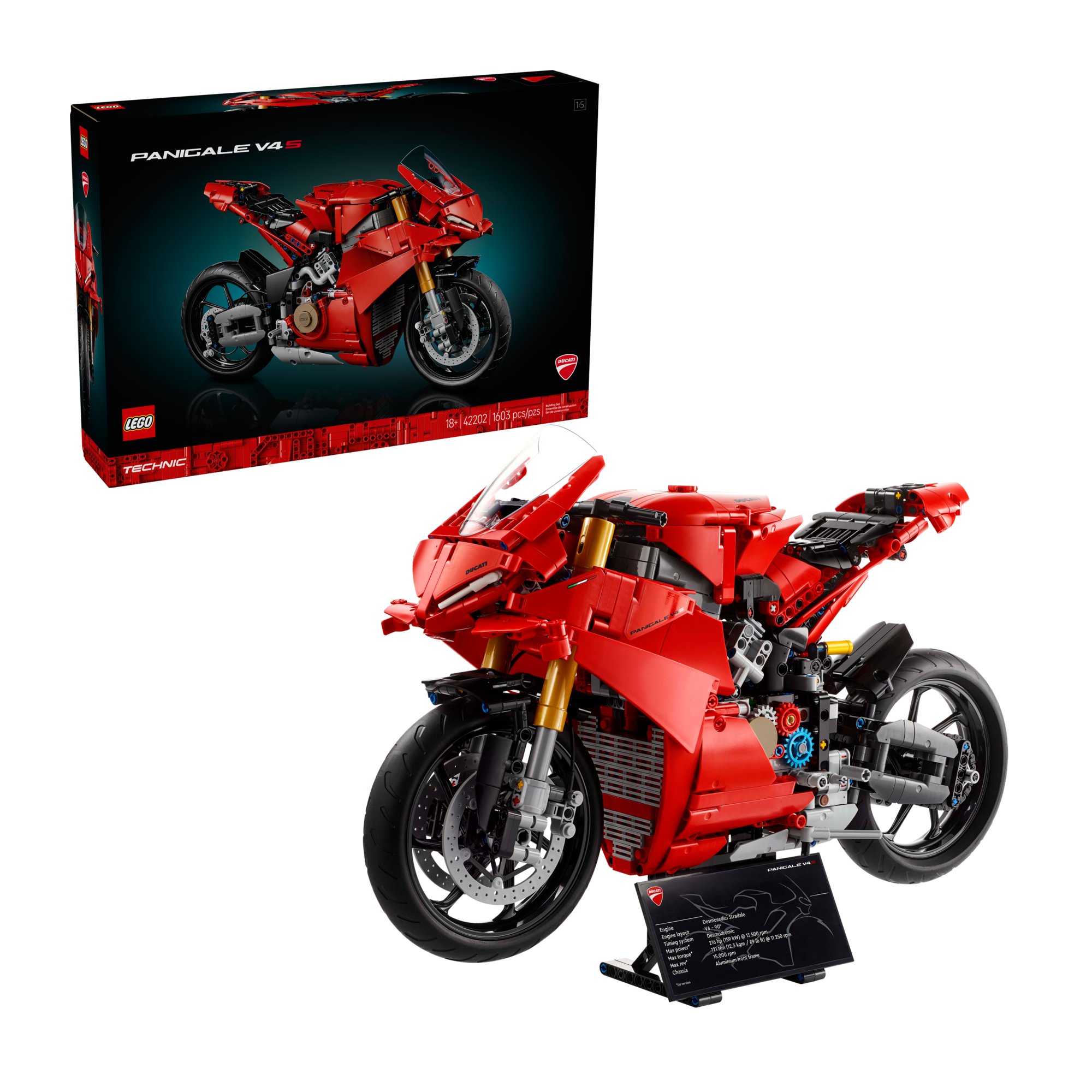
This is the third of LEGO’s 1:5 scale Technic superbikes and the second go at the Panigale, five years after the 646-piece V4 R (42107). It is 1,603 pieces and 43 cm long, and the reason to want it is what sits under the red panels: a three-speed gearbox with neutral, worked from the foot pedal, feeding a 90-degree V4 whose pistons run off the rear wheel through a chain.
It is in the Brick Club library. No member has written this one up yet, so the build notes below come from the reviews rather than from our own diaries.

Why this one over the other bikes
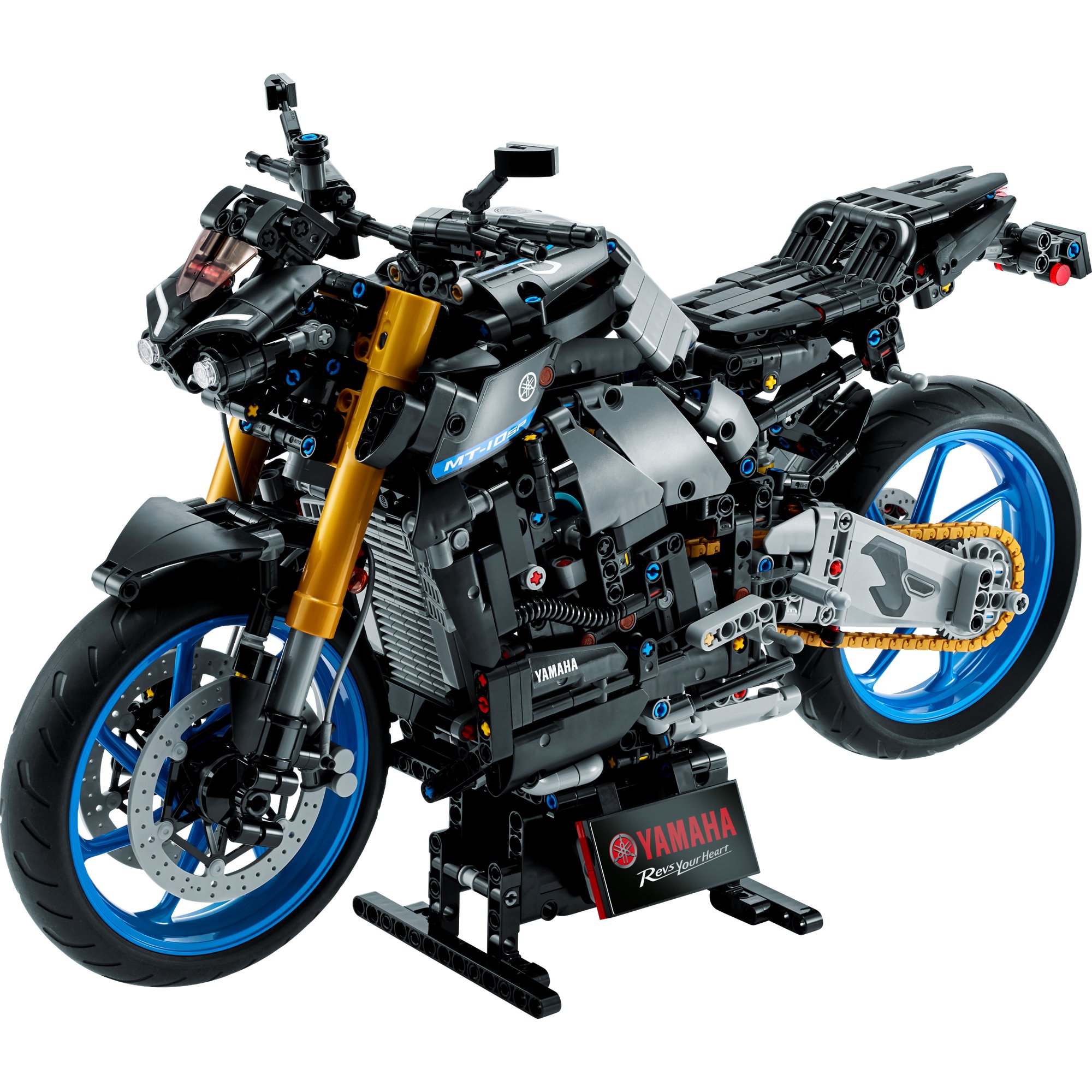
LEGO has done three of these big bikes: the BMW M 1000 RR (42130) from 2022, the Yamaha MT-10 SP (42159) from 2023, and this. Huw at Brickset called the Ducati the best of the series, for builder’s reasons. The sticker sheet is small, so the red is red panels rather than decals. The cylinder tops show through the fairings. And the gearbox can be seen from underneath once the bike is finished, so you can test it and watch it work, which is not always the case on Technic models with complex gearboxes.
The gearbox uses the parts LEGO introduced for the Yamaha: orange changeover forks on the driving rings, ball pins in the grooves of the changeover cylinders, a yellow ratchet gear and rubber bands. If you have built the Yamaha you will recognise it. If you have not, this is the cheaper way in: the same size, 125 more pieces, and £169.99 at launch against the Yamaha’s £199.99.
It is not perfect. The foot pedal pivots in the wrong place and swings the wrong way for a down-shift. A blue gear sits in plain view on the left-hand side. The new moulded windscreen leaves a gap to the panels around it. None of that stops it being the bike to pick if you want a gearbox you can see.
What it actually does
Nothing here is motorised. LEGO’s own list is a three-speed transmission with neutral, front and rear suspension, and a chain drive from the gearbox to the V4. The reviews fill in how each is done.
Push the pedal on the left of the bike and the yellow ratchet gear turns the changeover cylinders. Ball pins on the orange forks ride in the grooves cut into those cylinders, and the forks slide the driving rings along to pick a gear. Rubber bands are part of the shift mechanism. The order is down for first, then up through neutral to second and third, which is right, though Huw points out it is only right because the pedal moves the wrong way: on the real bike the pivot sits by the footrest and a down-press swings it anticlockwise. Each change lands with a positive clunk.
The engine sits directly above the gearbox with its two banks at 90 degrees. Instead of the old crankshaft pieces it uses two crank discs with off-centre axle holes and the newer fork-pin pistons, first seen on the Kawasaki Ninja earlier in 2024. Pull the chain and all four pistons rise and fall, and the cylinder tops stay visible through the fairings once the bodywork is on.
Once the wheels are on, the chain from the rear wheel drives the gearbox and the pistons, so pushing the bike along turns the engine, faster or slower depending on the gear. VaderFan2187 at Jay’s Brick Blog found that a little underwhelming with no motor behind it, and is fair to say the transmission is more interesting to build than to operate.
The front wheel hangs on two gold shock absorbers with a pair of brake discs behind them. The rear wheel is on a swingarm with a single yellow shock absorber in the middle. Both ends are springy with plenty of travel, and neither sags under the bike’s own weight.
The brick-built handlebars turn the front wheel through the forks. There is no knob on top and none is needed.
The black stand is built in bag 3 and the bike sits on it for the rest of the build. It locates loosely on four Technic axles; the bike is a touch front-heavy on it but balances. A kickstand folds out so the bike can stand on its own, which is how Huw prefers it. The stand carries the 8 x 16 specification plaque, and that sticker is the worst one in the box.
How the build goes
Twelve numbered paper bags, a polybag of large parts, and the wheels and tyres loose in the box. The instructions and stickers come in a paper wrapper rather than a cardboard sleeve. No reviewer gave a build time; our estimate is two or three evenings, with most of the thinking in the first two bags.
Gearbox
Bag 1 is the transmission: driving rings, orange forks, changeover cylinders, the yellow ratchet gear and the rubber bands. It looks as though it should shift at the end of the bag, and it does not quite. The Brothers Brick review says it struggles to engage until bag 2 wraps the frame around it. So do not diagnose a fault at the end of bag 1. Build bag 2, then click through first, neutral, second and third and watch the rings move.
Engine and stand
Bag 3 puts the fork-pin pistons on the two crank discs and builds the display stand; the bike sits on it from here on. Bag 4 starts the belly panels and the first sticker. Pull the chain by hand before the panels close in and check all four pistons move.
Radiator, suspension and wheels
Bag 5 is the radiator cover, a block of 1 x 2 grille pieces between two angled panels. Bag 6 hangs the gold forks and the rear swingarm. Bag 7 is the wheels, where Jay’s Brick Blog went wrong: the front and rear tyres are different sizes, and The Brothers Brick warns they are a pain to take off again. Check both before you push them home.
Seat, tail and side panels
The red panels go on, including the new concave panels with the hole on top rather than the side. The seat is connectors and panels at odd angles, the part of the build Jay’s Brick Blog rated for its geometry. This is the fast part.
Front, tank and plaque
The windscreen is a new mould in its own packet. Then the fuel tank and the handlebars; the stickered 2 x 4 dash tile goes on with the panels just before the screen. The last step is the specification sticker on the 8 x 16 tile for the stand.
No member diary yet, so these come from the three full reviews.
- Do not judge the gearbox at the end of bag 1. It will feel as if it is not engaging. It needs the frame from bag 2. Build on, then test.
- Tyres: two sizes, and a direction. Jay’s Brick Blog fitted front and rear the wrong way round and did not notice until after the build. The Brothers Brick calls them a royal pain to take off again. Huw was not sure the treads match even as drawn, so fit them as the instructions show.
- The 8 x 16 plaque sticker. The Brothers Brick got bubbles under it and every fix made it worse; Jay’s Brick Blog called it the only tricky sticker. Do it last, tile flat, from one short edge.
- The windscreen gap. There is daylight between the new screen and the panels around it. Both The Brothers Brick and Jay’s Brick Blog found the same gap, so it is not your build; do not force it. The Ducati logo behind it is a sticker on a 1 x 1 tile.
- The blue gear. A blue gear sits in full view on the left-hand side. Huw swaps it for a black bevel gear of the same size. The kit goes out as LEGO packs it, so ours stays blue.
On the shelf
Finished, it is 43 cm long, 30 cm tall and 15 cm wide, about the same shelf as the other two big bikes. The right-hand side is the one LEGO put on the box: the round tan cover, the exhaust and unbroken red. The left is the working side, with the gear lever, the kickstand and the exposed gears. Decide which faces the room before you pick the shelf.
Off the stand, on the kickstand, it looks more like the real bike, and Huw thinks it looks much better that way. The headlights are two white bars; Huw did not find them convincing, though Jay’s Brick Blog thought they work well.
It is the one for you if you want a gearbox you can watch working and you have built at least one gear-heavy Technic set before. The Brothers Brick would not make it a first Technic build and I agree: bags 1 and 2 need patience. Allow two or three evenings, sort the tyres before bag 7, and save the plaque sticker for last.
If you like this one, try
Three more Technic bikes in the library. The V4 R is the smaller, earlier Panigale, the Yamaha shares its gearbox parts, and the BMW has the busy sticker sheet.


The Ducati Panigale V4 S is in the library
Technic Fan gets up to 6 kits a year, Master Builder up to 12. Delivery both ways is included and the prepaid return label is in the box.