

Extreme Adventure (42069): the 4×4 that runs on tracks
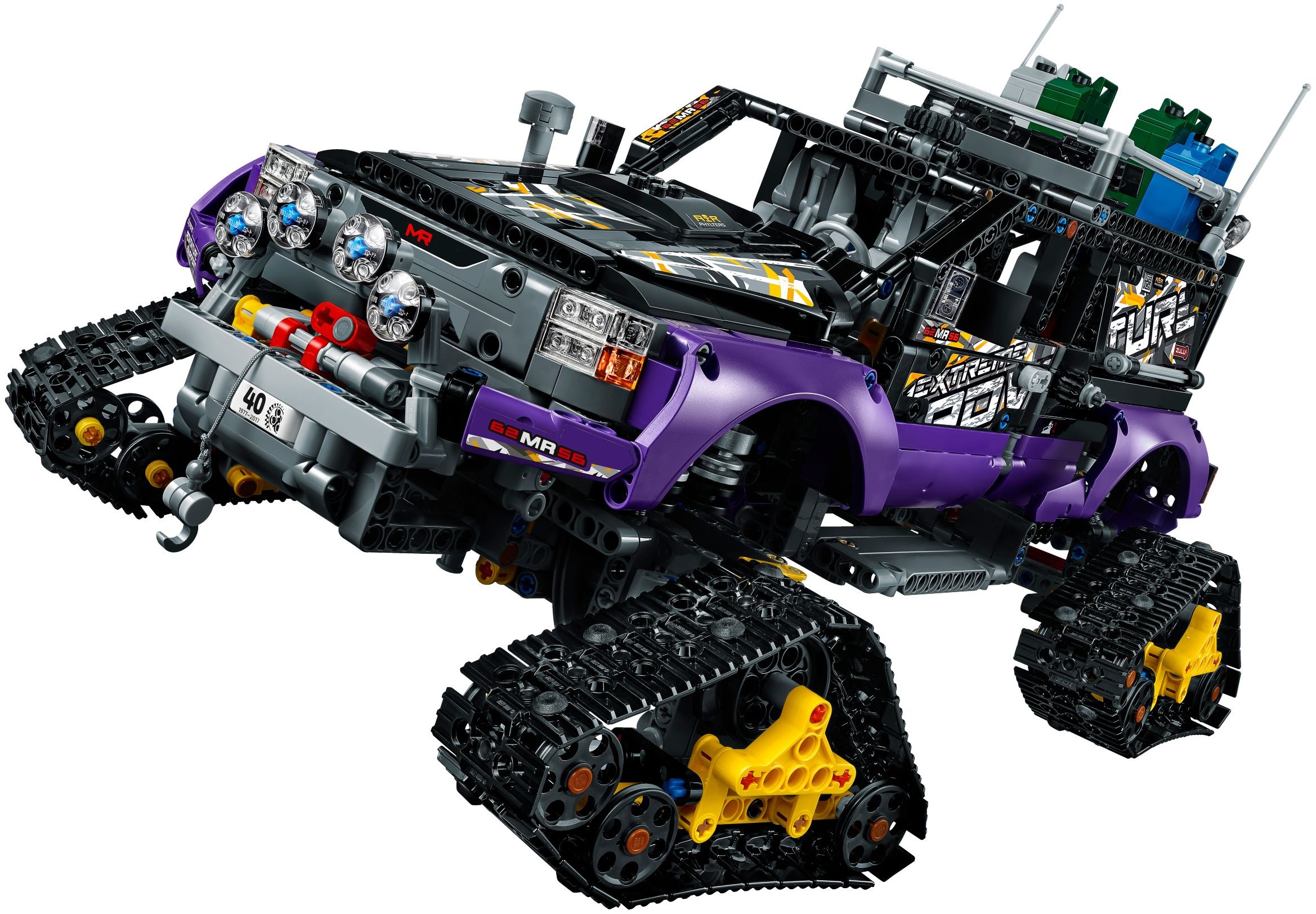
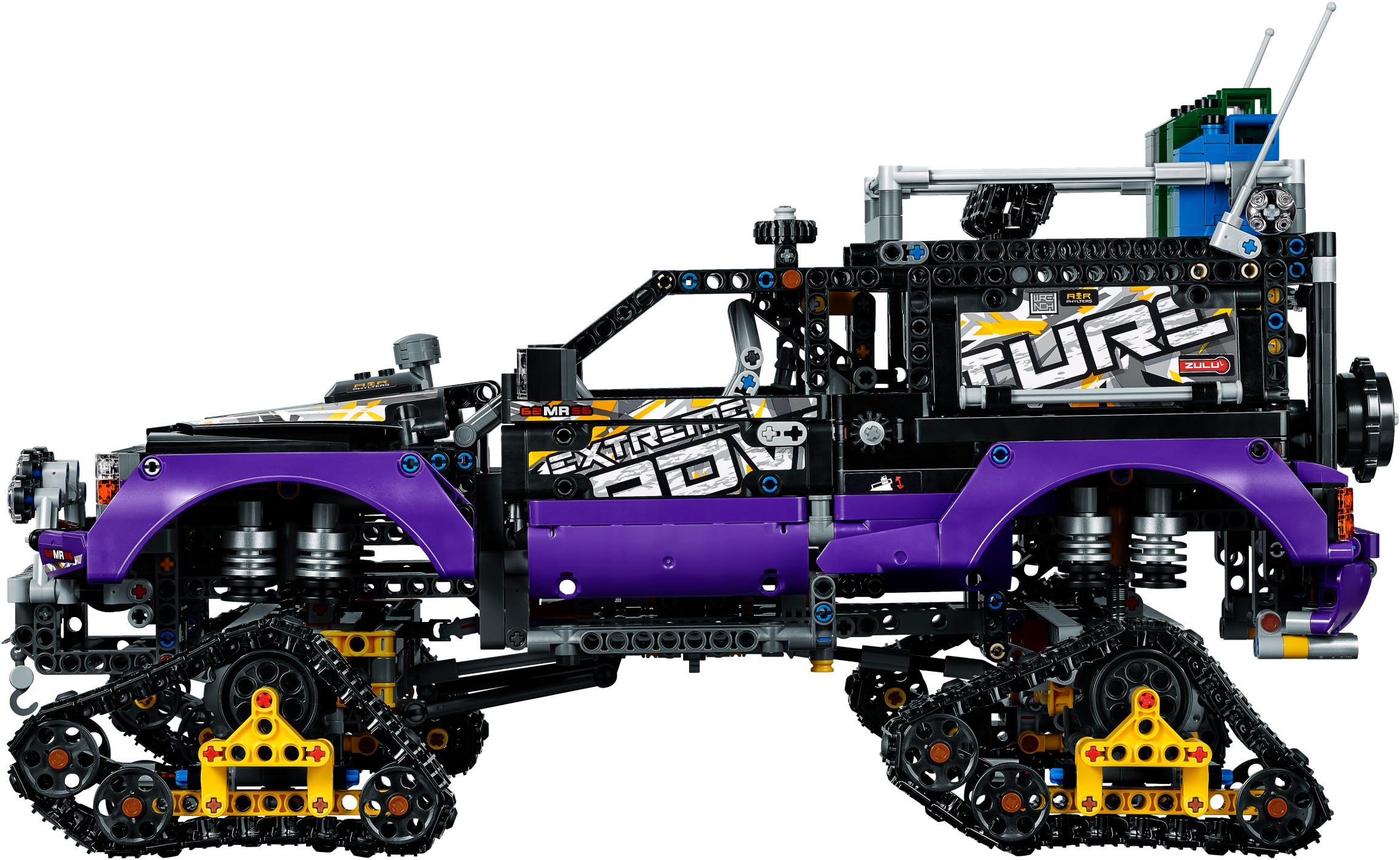
Every other off-roader in the library sits on tyres. This one sits on four tracks hung from two live axles, each with its own differential, under a body Jim at Eurobricks describes as a Land Rover with a modified undercarriage. It came out in August 2017, Technic’s fortieth anniversary year, designed by Milan Reindl, who later did the Mercedes-Benz G 500 (42177). Black and purple, a V8 under the bonnet, a winch on the nose and a tent that lifts out of the roof.
It is in the Brick Club library. Below is what it does, how a 395-page book and twenty unnumbered bags split the build, and where the two full reviews say to slow down.

Why this one is different
It was the last of the big 2017 sets and it wears the anniversary: the printed 40-year liftarm sits in the front bumper next to the winch. The designer’s initials are all over the stickers, MR for Milan Reindl, a Eurobricks member before LEGO hired him. Nobody in our file could work out what the 62MR56 on the wings refers to.
The numbers are odd for a non-flagship: 2,382 pieces against 1,862 in the 6×6 tow truck (42070), the flagship that year, or as FlagsNZ at Brickset put it, thirty per cent more parts for thirty per cent less money. A fair few were new: Technic panels and beams in medium lilac, eight silver rims used as dummy dampers rather than wheels, and the first Technic appearance of the small rubber attachments that clip onto track links, 52 of them in their own bag.
Two full reviews sit behind this post: Jim’s on Eurobricks, July 2017, and FlagsNZ’s on Brickset, August 2017. Jim started out no fan of tracks and ended up preferring them; FlagsNZ liked the drivetrain and wanted a third differential.
What it actually does
Everything is manual and there is no provision in the instructions for adding Power Functions. Where neither review says how a function is worked, I have left the path out.
Push it along and each axle drives its pair of tracks through a differential, with the two axles tied straight together and nothing between them, so this is 4×4 in the simple sense: everything turns at once. The set has ten universal joints, four of them in the middle of the chassis early on. At the front the drive turns a V8 whose pistons rise and fall as you roll it, with a brick-built turbo intake on top under the bonnet. FlagsNZ would have liked a third differential between the axles, a fair point, but he still rated the axles and drivetrain, and Jim called the live-axle suspension nicely done.
A gear on the roof turns the front axle through a rack and pinion, and the linkages are built heavy. The geometry is Ackermann, so the inside track turns tighter than the outside one, which Jim notes hardly any Technic set bothers with now. Two caveats from him: the model is heavy enough that steering it at a standstill is hard work, and the roof gear pulls off easily. Steer it while it rolls.
Turn the small gear on the right-hand side and the drum on the nose winds in the silver string. The lock is a rubber double axle connector (Brickset calls it a 2M damper) used as a ratchet: pull it back to free the drum, let go and it springs home. The string is the metallic type new in 2017, 1 mm thick and 1.5 m long, and Jim preferred it to the old cord. One catch about which way it winds is in the fiddly list.
The matching gear on the left-hand side works a mini linear actuator connected to liftarms under the rear roof. Turn it and the roof lifts and a white panel folds out as a tent; Jim liked that the white marks it out as a different material. The compartment under the tent holds the spade.
The cab doors do not hinge like car doors. Each opens by moving its upper half up and its lower half down, and the axles they pivot on are tied to soft shock absorbers, two of the six in the box. You push against the spring to start the door moving and past a certain point it eases itself open. Jim called it a mechanism nobody had seen before and hard to beat; FlagsNZ, harder to please, called it very clever and easy to work.
No independent suspension here. Both axles are solid live axles sprung against the chassis. FlagsNZ lists two extra hard yellow shocks at the rear and two hard grey at the front; Jim counts six in the box, four soft and two hard, with two soft ones in the doors, so the reviews do not quite agree on the grades. The silver rims sit behind each arch as dummy air-bag dampers. Each track unit is built as part of its axle rather than bolted on, and Jim noticed the model’s weight bows the tracks slightly.
The rear door opens by pulling the tread wheel on it, after turning the wheel to unlock it. Side lockers hold a fire extinguisher each and a first aid kit with two syringes on the left. A drawer slides out under the rear tray with a stop so it cannot fall out, and the rack carries four jerry cans, two green, one grey and one blue, plus spare track. The children Jim tested it on drove it through the living room and kitchen, and he put their liking for it down to these extras.
How the build goes
One book of 395 pages and twenty bags that are not numbered, so there are no stages in the modern sense. FlagsNZ sorted the lot on a large table first and felt the build had to be finished in one sitting. Neither review gives a time; a long day or two evenings is our estimate. The step numbers below are the ones the Brickset review photographed.
Sort, then the chassis and the V8
Tip every bag out and sort by type and colour before anything else. The chassis goes together first, with the four universal joints in the middle and the drive axles running fore and aft, then the V8 goes on. Turn the drive by hand here and watch the pistons; you will not see them again until the bonnet is on and open.
Winch, cab and the door mechanism
The winch and its ratchet build onto the nose. The cab takes shape with the pivot axles for the doors and their springs, the first purple panels arrive on the rear body and the drawer goes in under the tray. Test the door springs before the panels close them in.
Doors, lockers, roof and tent
Side doors and the two lockers with their extinguishers and first aid kit, then the linear actuator and liftarms for the tilting roof and the white tent panel. Run the roof gear through its full travel before the rack goes on.
Rear axle, then front axle
The undercarriage comes last, which is unusual for Technic. The rear axle has its differential and two shocks; the front adds the rack and pinion steering and the heavier linkages. Each axle is built with its two track units and fixed under the nearly finished body. Keep the rubber attachments for the very end.
Bonnet, roof rack, cans and stickers
The bonnet, the roof rack, four jerry cans, spare track and the antennas finish it. Then the stickers, a job in itself: three large ones each side make up the Extreme Adventure lettering across three separate panels.
Two full reviews and one member diary so far. These are the points to slow down for.
- Nothing is numbered. Twenty bags, no stages. Sort first or you will be hunting through 2,382 pieces at every step. Give yourself a big table.
- The winch string runs the wrong way. FlagsNZ found the string needed reeving the other way round for the ratchet to work as designed. If the lock will not hold the drum, unwind it and wind it on the other way.
- The big side stickers. Three per side, spanning three separate parts, and the sheet starts to curl the moment it leaves its bag. Dry-fit all three so the lettering lines up before pressing any down.
- The roof gear pulls off. The hand-of-god gear comes away easily and the steering is heavy at a standstill. Steer with the model rolling, and press the gear back on before you hand it over.
- Rubber track attachments. There are 52, not enough for one on every link, so the tracks still slide on a smooth floor. Space them evenly round all four tracks; the model’s weight does more for grip than you would expect.
On the shelf
LEGO puts the length at 44.6 cm on the box, and it stands tall on its tracks, so check the height between shelves as well as the length. The black and purple is dark in a dim room; in daylight the lilac shows and the yellow track frames lift it. With the panels and stickers on it looks, as FlagsNZ put it, remarkably like an SUV.
Leave the tent up for display; folded down the roof looks like any other Technic roof. Jim tried the model on seven different wheel and rim setups for his review and went back to the tracks: they are what stop it being just another 4×4.

Members who have built it
One member has built this one and sent photos. The diary is linked under the picture.

This is the one for you if you want a Technic build that ends up as something you can hand to anyone in the house. The drivetrain and axles are properly done, the doors and the winch ratchet are clever, and the tracks make it unlike anything else on our off-road shelf. Allow a long day or two evenings, sort the bags first, check which way the winch string winds, and do the side stickers in one careful go. If you would rather have the same designer’s later, more polished 4×4, the Mercedes-Benz G 500 (42177) is in the library.
If you like this one, try
The other off-road kits in the library. The Arctic Truck is the closest in spirit; the Defender is the polished road-going 4×4; the Zetros and the X-treme Off-Roader are app-controlled if you want the drivetrain to move under its own power.




The Extreme Adventure is in the library
Technic Fan gets up to 6 kits a year, Master Builder up to 12. Delivery both ways is included and the prepaid return label is in the box.