

Ford F-150 Raptor (42126): a three-hour truck with a live axle
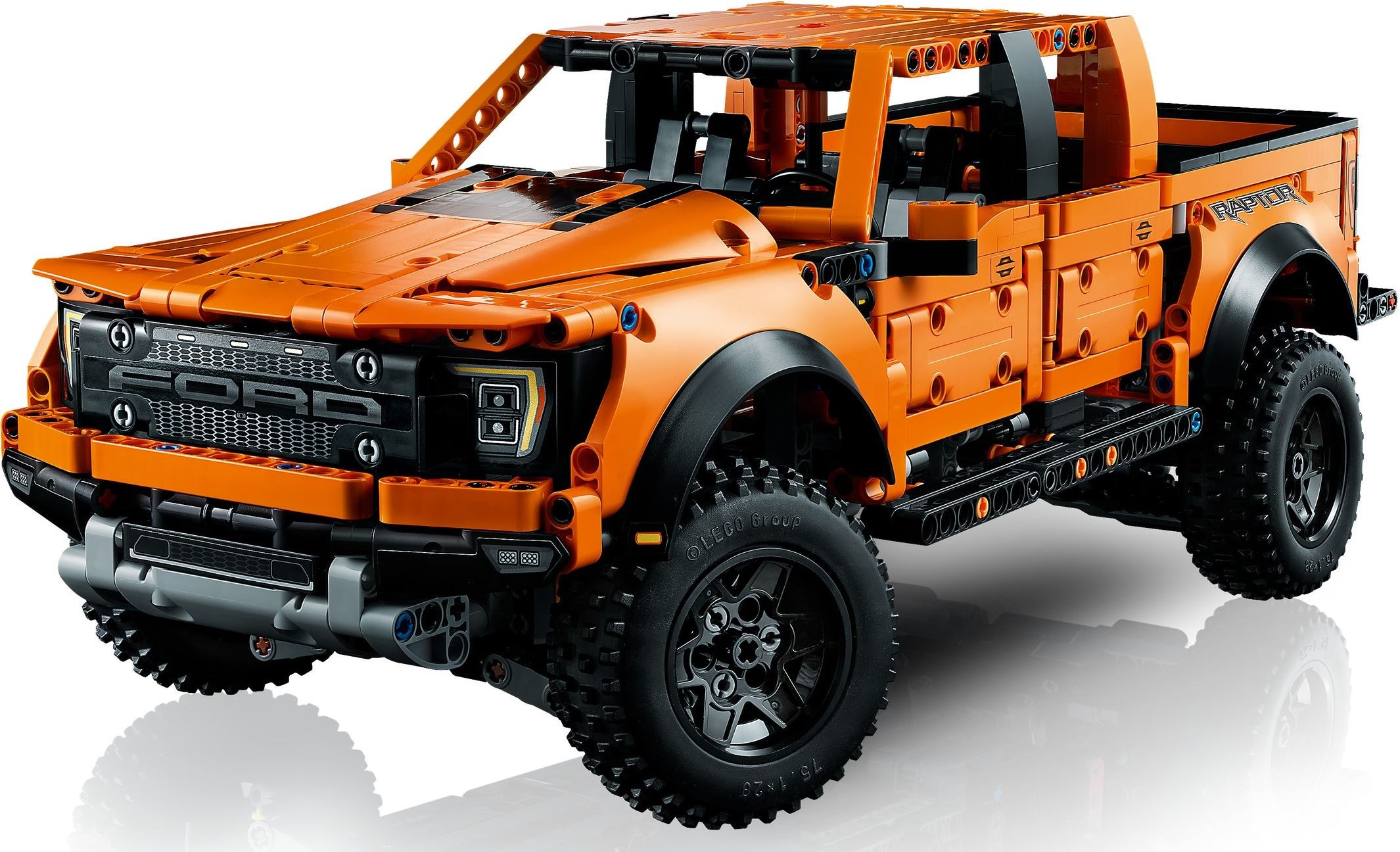
This is the quick one. Huw at Brickset built the Raptor in about three hours and found that once the axles were in, the rest was straightforward bodywork. For those three hours you get a 42 cm pickup in orange and black with a live rear axle, independent front suspension, a V6 that turns when you push it, four opening doors, a bonnet, a drop tailgate and a steering gear on the roof that lifts off for display.
It is in the Brick Club library. Below is what it does, how the seven bags split the build, and where the four reviewers in our file, all of whom built it in 2021, say to slow down. Where a fact rests on LEGO’s own description rather than on someone who built it, I say so.

Why this one is different
It was the first Ford of any kind in Technic, and it is the 2021 Raptor, the one launched in North America that year. New Elementary puts it in the mid-scale car line with the Porsche 911 RSR (42096) and Dom’s Charger (42111). Our own listing, which follows LEGO’s description, calls it 1:10 and names the engine a V6 EcoBoost. Huw measured the finished model at 41 by 17 cm against the real truck’s 5.5 by 2.1 m and got roughly 1:13, and I trust the tape measure.
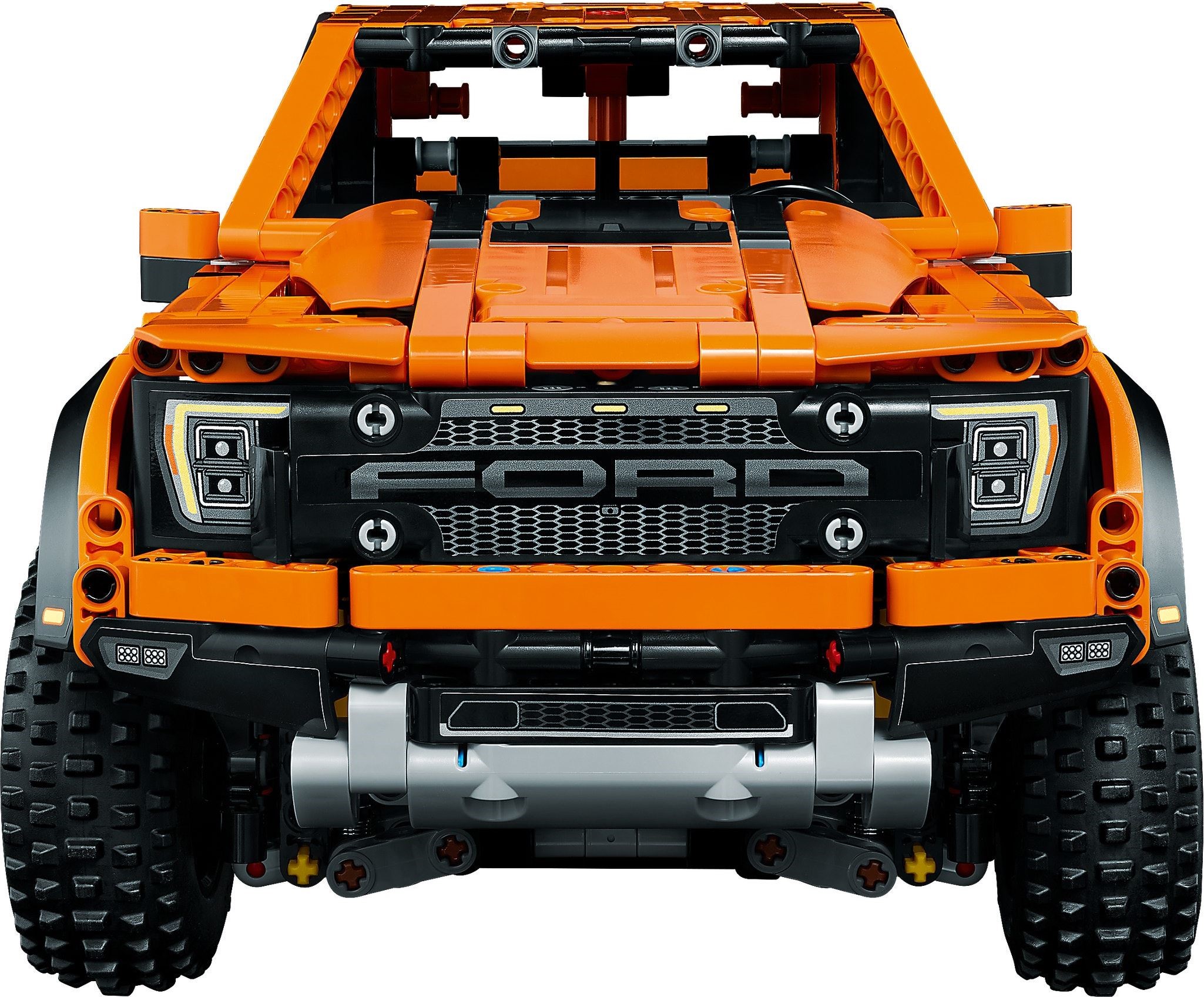
Huw found no new parts in the box, though New Elementary counts the 11-long beam with alternating holes as a new length; mostly it is a lot of orange that had not existed before: the 13-module mudguard panel that had only been white in the Porsche, two of them printed RAPTOR and two plain, plus the black half-circle extension, whose own groove fits neatly inside the mudguard. There are also three of the then-new 11-long beams with alternating holes and one 15-long. The tyres are the knobbly off-road ones from the 42124 buggy. Instructions come in a single book, 266 pages by Huw’s count and 432 steps, with two pages on the generations of the F-150 and a page showing two prototypes, one of them in dark blue.
What it does not have explains the mixed reviews. There is no gearbox. The front wheels are steered and sprung but not driven, so the model is rear-wheel drive where the real truck has four-wheel drive, and the steering wheel in the cabin does nothing. Jim, New Elementary and Hothbricks raised both; Huw raised only the missing four-wheel drive. Jim at Eurobricks scored the build as okay but nothing special; Huw’s view was that with no motor in it none of that matters. The box says 18+, which Jim and Hothbricks both questioned. Brickset lists the UK price as £124.99; the launch reviews quoted £129.99 against $99.99 in the States, and that gap coloured a lot of what was written.
What it actually does
Everything is manual. Four reviewers built this set and all four describe the same functions, so the list below is settled. Where nobody says how a function is driven, I have left the path out.
The steering is worked from a gear on top of the cab, not from the wheel in the cabin. Turn it and the front wheels swing. Pull it off and the roof is flat apart from one axle end, which Hothbricks noticed is red in the middle of an orange roof. New Elementary traced the linkage to a grey 16-tooth gear under the floor, close enough to the dashboard that they reckoned connecting the steering wheel would be an easy modification. As built, the wheel turns nothing, and with the roof gear off there is no way to steer.
Push it along and the rear wheels turn the differential, a shaft runs forward through the pivot of the rear axle, and six pistons under the bonnet go up and down. Huw calls it the time-honoured arrangement. It is a V6 rather than a V8 because the real Raptor of this generation has a 3.5 litre twin-turbo V6; Jim noted that you might expect a V8. Lift the bonnet while you roll it.
The whole rear axle rocks side to side around a central pivot, with grey springs, softer than the ones at the front, holding it level. The drive shaft passes through that pivot and the axle joins the chassis through a ball joint. Jim liked that the attachment points are picked out in blue. Press one rear wheel down and the other rises while the body stays put, which is what a real solid axle does.
Double wishbones on each front corner with the hard yellow springs. Nothing drives the front wheels. The real truck is four-wheel drive and every reviewer pointed out that this one is not; New Elementary called it a grave omission for a model of this size. Huw’s answer is that in an unpowered vehicle it does not matter, and I am with Huw, but know it before the box arrives.
All four doors open, each on two hinge points, so there is very little slack in them. The bonnet lifts for the engine. The bed is built as its own assembly that slides into the back of the chassis and is pinned in, and the tailgate drops on a tow-ball catch that Jim called quite neat. The bed floor is filled in with almost no gaps.
How the build goes
One unnumbered bag and seven numbered ones, and the instruction book splits the build into three sections: front suspension, rear suspension, bodywork. Huw’s total was about three hours. Allow an evening.
Front suspension and steering
Construction begins at the front: double wishbones, the yellow springs, the steering and the first of the chassis. Jim expected a grey 2×4 liftarm off the suspension to connect to one of the new perpendicular beams next to it. It does not, and there is some slack there. That is how the instructions have it, so do not go looking for a missing pin.
Rear axle, engine and the front of the body
The live axle with its grey springs and ball joint, then the shaft forward to the V6. This is the one place New Elementary found the build unusual: the ball joint and a lower L-beam sit half a module off the rest of the chassis, and the instruction book itself mentions the difficulty of getting the rear wheels to sit correctly in their arches. Follow the pictures exactly here. Bag 2 also brings the seats and the front bodywork; the front bumper and part of the bonnet end the section, and by then you can roll it and watch the pistons.
Doors, arches and bonnet
Front and rear doors go on, two hinge points each, then the plain front arches with their black extensions, then the bonnet. The grille and headlight stickers go onto black panels at this stage, and if the sheet arrived bent this is where it shows. Jim liked the A-pillars and was less keen on the B and C pillars, which use System bricks rather than Technic parts.
Bed, tailgate, wheels
The bed is a separate assembly that slides into the back of the chassis and pins in. The tailgate catch uses tow balls. The printed RAPTOR arches, the tail-light stickers and the four off-road tyres on their black rims complete the truck. Huw says the bodywork is straightforward and the model takes shape in no time.
No member diary for this one yet. These points come from the four 2021 reviews.
- The half-module offset at the back. The ball joint and the lower grey 3×5 L-beam sit half a module away from the rest of the chassis. It is deliberate, it is what lines the rear wheels up in their arches, and it is the only structurally odd step in the set. Compare your build to the picture before pinning the axle on.
- Slack at the front is deliberate. The grey liftarm off the front suspension does not connect to the perpendicular beam beside it. Jim expected it to and it does not. Leave it.
- Tail lights are three stickers a side. Hothbricks called lining them up the most demanding step in the whole build. Apply them with the part flat and unfitted, then put it on the truck.
- Headlights and grille are stickers on curved black panels. There is not a single transparent piece in the set, so the lights only exist as stickers. Dry-fit the panel, peel, place from one edge, and do not press until it sits straight.
- The sticker sheet ships loose. The book and the sheet sit in the box with no protection. Jim’s arrived folded, New Elementary’s had one sticker lifted and another slid off, and Hothbricks said to check on arrival. A library kit has already been through this once; if you ever buy one new, check the sheet before you start.
On the shelf
Brickset gives it as 42 cm long, 18 cm wide and 15 cm tall, so it takes about half the shelf of a 1:8 supercar. Huw called it an eye-catching display model, partly because of the orange, and the black arches and grille stop it looking like a toy. Take the roof gear off for display and there is a red axle end left in the middle of the orange roof; leave it on and you can steer it.
The tyres divide people. They are the spiky ones from the 42124 buggy, and New Elementary thought they belonged on a dune buggy, but Jim could not name a better fit in LEGO’s range. New Elementary also noted there is enough empty space in the chassis for a pair of motors if you ever fancied making it remote controlled.
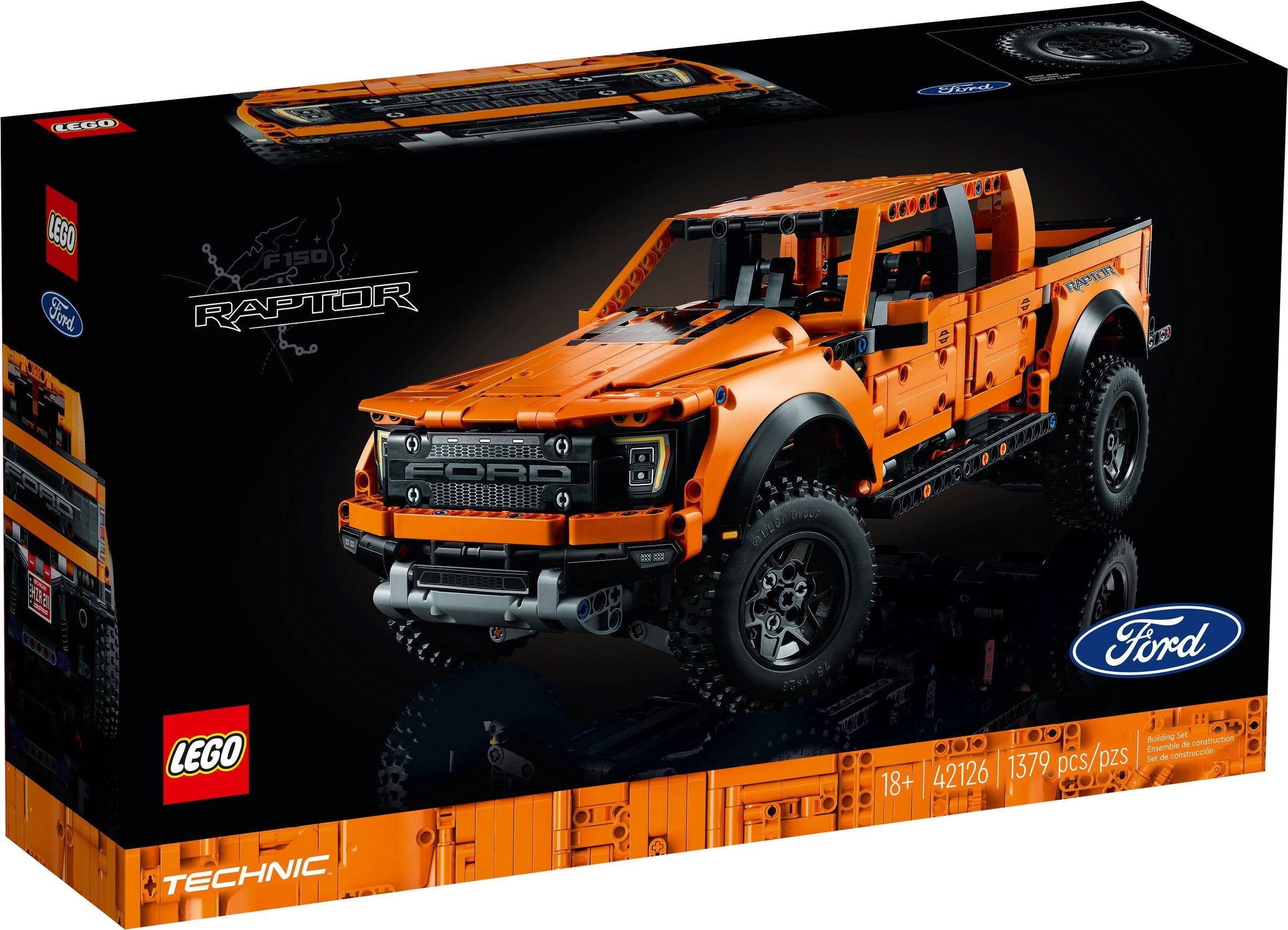
Have this one sent as a one-evening build, or as the first Technic car for a member who has not done one before. Hothbricks said the assembly is within reach of anyone and that nobody should keep a younger builder away from it because of the 18+ on the box. It is not the one for gearbox people: there is no gearbox, the front wheels are not driven and the steering wheel does nothing. What you get is a good-looking truck that steers from the roof, a live axle you can feel working, four doors and a tailgate with a clever catch. Allow three hours, read the rear axle pages twice, and lift the bonnet while you push it.
If you like this one, try
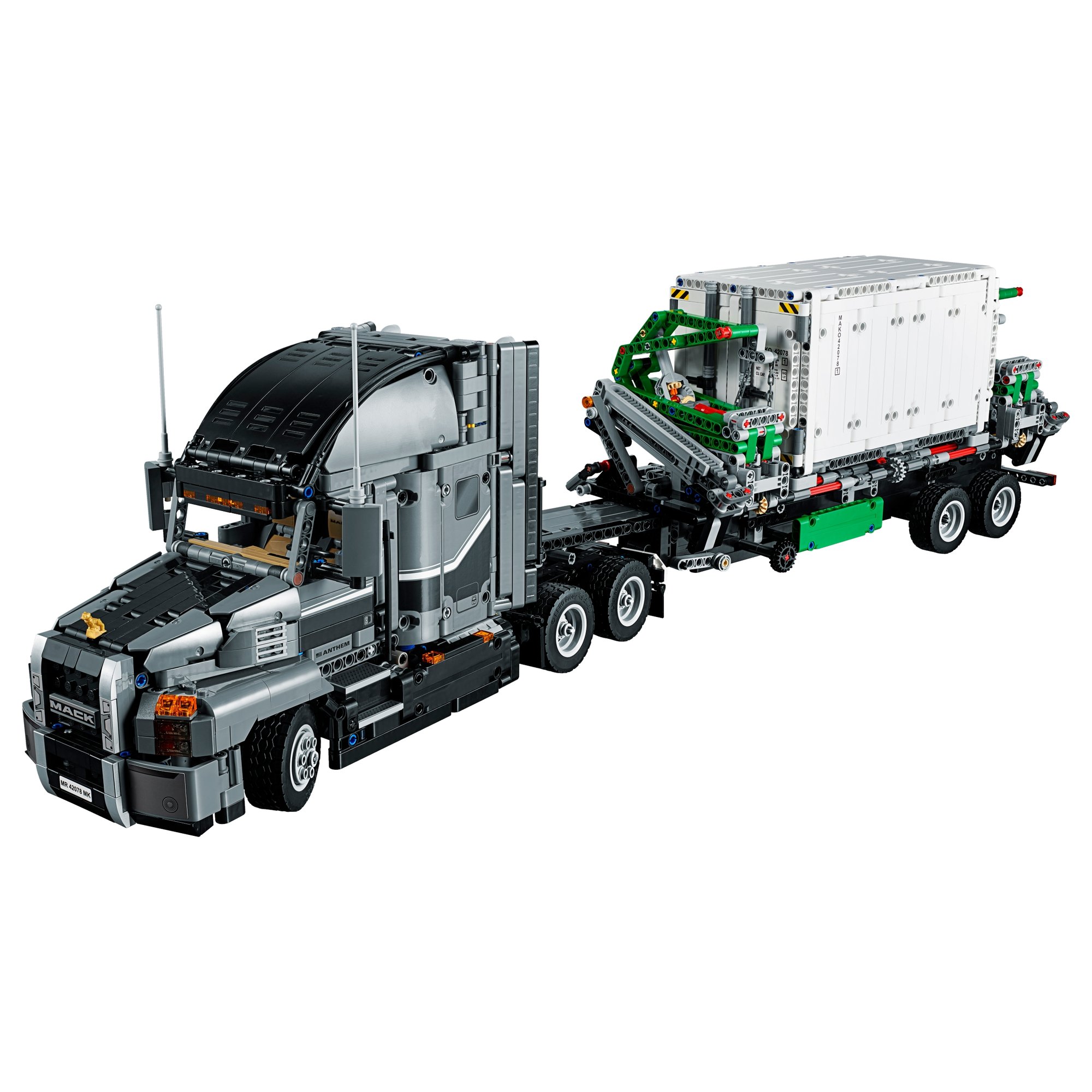
The other pickups and trucks in the library. The Customized Pick Up Truck is closest in size and spirit; the Mack Anthem is the other licensed American truck; the two tow trucks are for anyone who wants a drivetrain with more going on.



The Ford F-150 Raptor is in the library
Technic Fan gets up to 6 kits a year, Master Builder up to 12. Delivery both ways is included and the prepaid return label is in the box.