

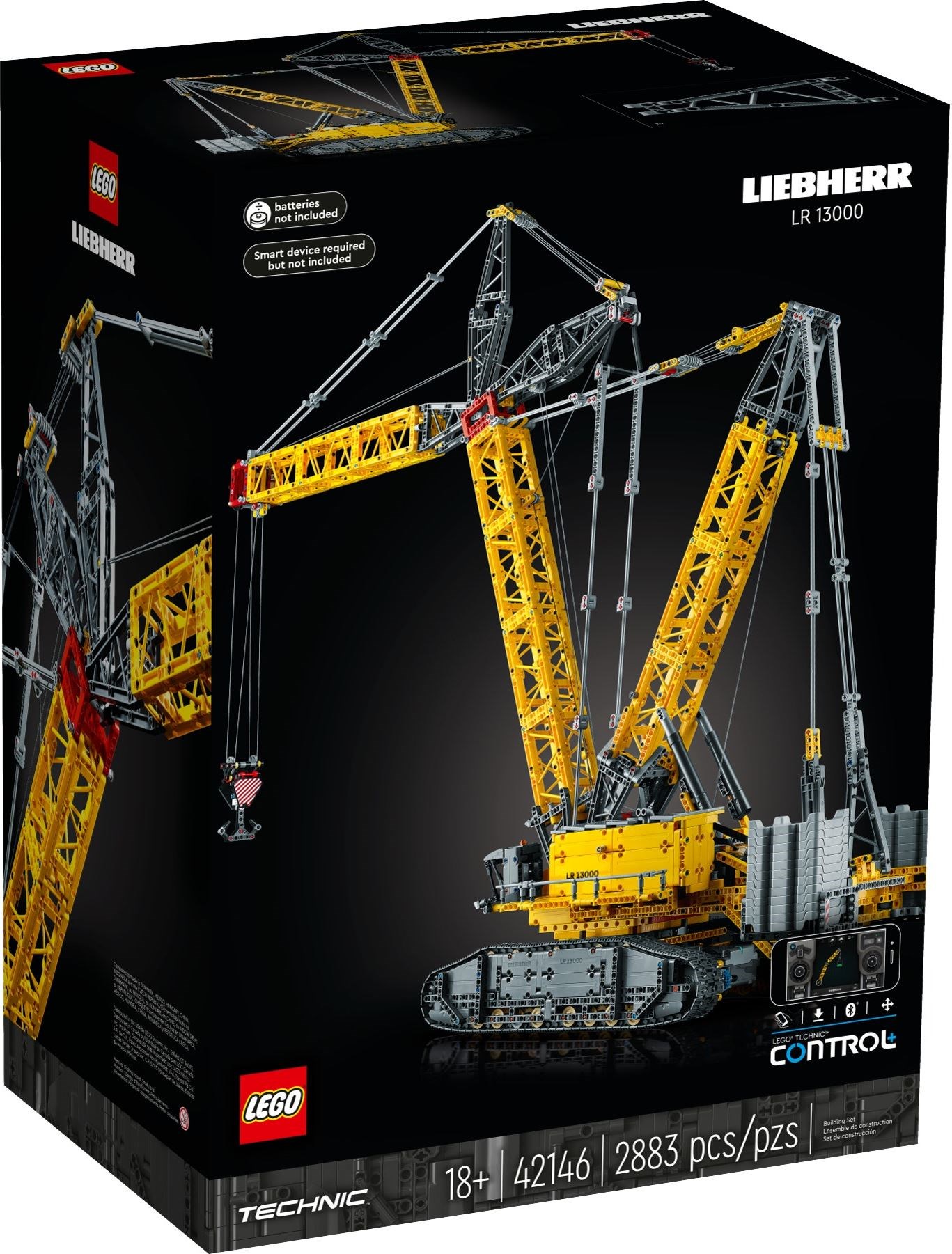
Liebherr Crawler Crane LR 13000 (42146): a metre tall, and every function on a motor
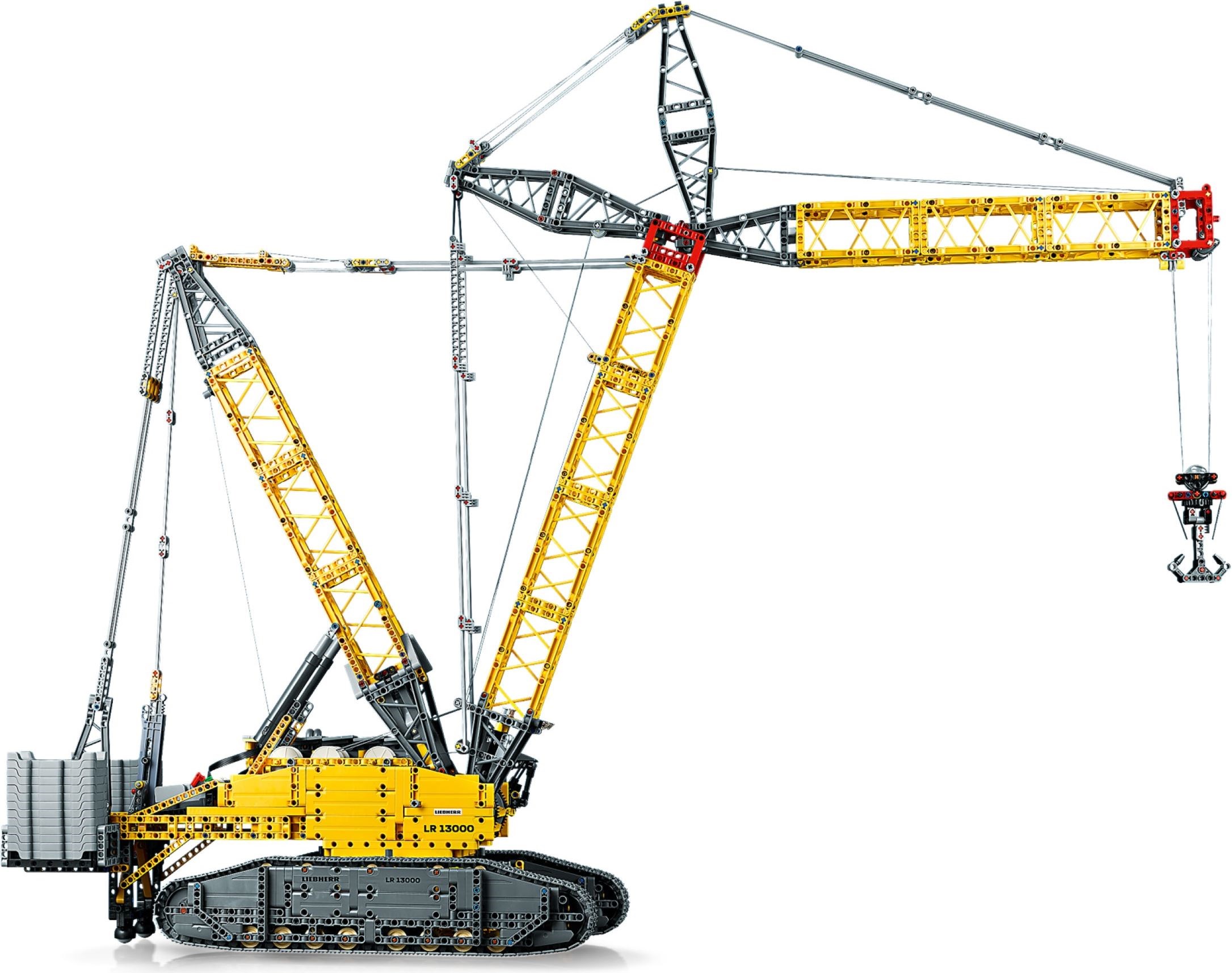
This is the biggest Technic set by size, and it gets there with fewer than 3,000 pieces. Boom up, it stands about 100 cm high and 111 cm across. The parts do it: forty new lattice frames make the towers, six large angular motors on two Control+ hubs move everything, and 24 ballast blocks weighing nearly a kilo hold it down. Apart from turning the hook on its turntable, nothing on it is worked by hand.
It is in the Brick Club library, and it is the kit to clear a table for before the box is open. Below is what the six motors drive, how the five bags split the build, and where the 6.5 metres of string will test you.

Why this one matters
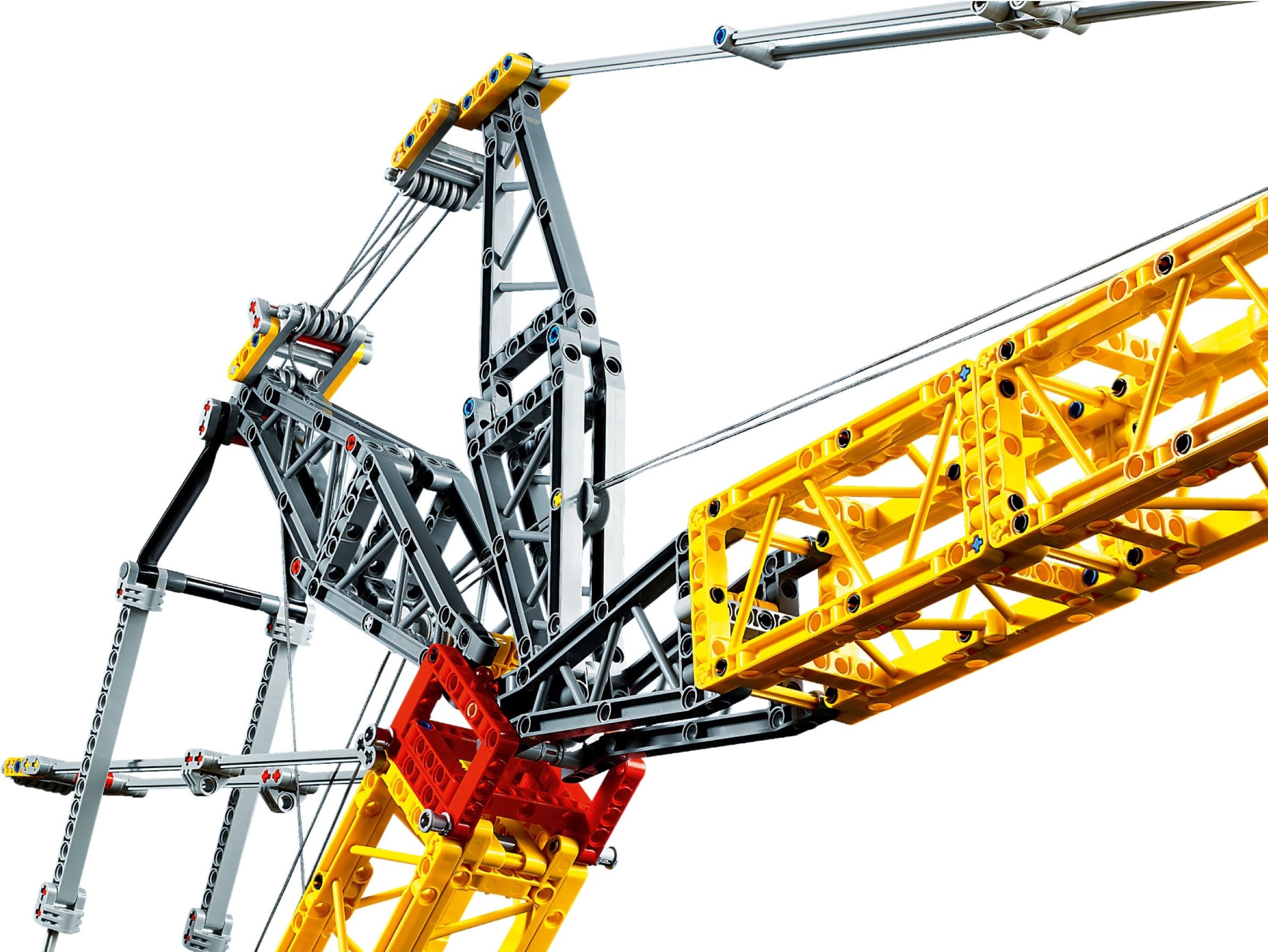
At launch in August 2023 it was the most expensive Technic set there had been, £579.99, yet only eighth by part count. The price is the electronics and the plastic: two hubs and six motors, then the new moulds, two lattice frames with moulded truss bars, twenty of each, sixteen dark grey triangular girders, 24 ballast blocks with no pin or stud on them at 41 grams apiece, and three strings, 6.5 m, 3.5 m and 2 m, the longest ever put in a retail set.
The name is the argument. Huw at Brickset says the model matches none of the LR 13000 layouts in Liebherr’s brochure: boom and jib lengths, track width and the ballast arrangement are all off. Brick Architect matched it to Liebherr’s SDW layout, heavy main boom, derrick and luffing fly jib. Both can be true; the layout is right and the proportions are not. The release slipped a year, reportedly over stability. The colours show the compromise: the new triangular frames are dark grey among yellow, which Huw, quoting Sariel, says gives it the look of a build waiting on a BrickLink order; the red frames at the boom ends he thought looked alright.
Be clear about the build. New Elementary planned a week and finished in three days; Brick Architect timed it at 7 hours 52 minutes. The frames do the work, and the functions are driven directly or through the shortest gear train. Tobymac said it did not feel like an 18+ set beyond its size and price. The interest is the rigging, the scale, and watching a kilo come off the table.
What it actually does
Every function is on a motor; only the hook’s turntable is turned by hand. Three motors sit in the crawler chassis with the first hub, for the tracks and the slew; three sit under the grey panels up top with the second, for the winches.
Two motors sit at the front of the tracks, each geared down through ordinary gears and then a planetary reduction inside a wheel hub, so the crane creeps rather than runs. One motor per side means it turns by running the tracks against each other. The 75-link tracks are a matte, softer plastic, and on a hard floor they are loud, because the parts alone weigh over five kilos. The tail rides on ball castors, so it wants a smooth floor.
The superstructure turns on a ring of curved quarter gears, eight to a ring though four make a circle, because the two layers sit 45 degrees apart and are pinned through. Between them an octagon of eight small train wheels runs in the gear groove as a bearing, as in the Rough Terrain Crane (42082). The third chassis motor drives it. Huw’s main operating complaint: the body rotates too quickly unless you go easy, and the load swings.
The derrick is the mast leaning back over the ballast. It does not move in use; two motorcycle shock absorbers hold its angle and let it move back a little, though Huw was not sure why. The main boom pivots in front of it on a pair of 60-tooth gears used purely as turntables. Between the two, the fixed runs are chains of 1×16 links, and the adjustable run is string through a six-strand block giving about 5:1, on a winch motor sitting directly on its reel.
Most LR 13000 layouts end the main boom with the hook. LEGO built the tall one, with a bent section at the boom head and a jib of three more 15-stud modules beyond it. The jib’s string runs through a second 5:1 block, so the second winch changes the angle between boom and jib. Tobymac, driving it from the generic Powered Up app before Control+ supported it, could over-extend some sections until the long link bars sagged, and expected the dedicated app to add limits.
The third winch feeds its string out along the boom and jib to a brick-built hook block with a pair of large pulleys in it, heavy enough to keep the strings taut, with a turntable to face the hook to a load. Huw lifted a 500 g can without drama, though the back end rose off the table. A one-litre bottle also came up, the body tipping and the app warning of the tipping zone. Tobymac stopped at a kilo too.
The 24 blocks simply stack in a basket at the tail; nothing clips them in, so a tip-over means restacking, not repairs. Under the tail is a pair of rollers the real crane does not have, there to spare the parts. The second hub sits above them on a tilting frame held by two rubber bands, its weight acting as counterweight through a sand blue gear rack housing that works as a spring against the jolt of a lift.
A curved slider top left slews the body, two small sliders drive the tracks, the left joystick works boom and jib, the right the hook. A diagram of the arm moves with the model; other screens show the centre of gravity and shortcuts to the highest, farthest, lowest and closest positions. No games, and no build without it: firmware, the stage tests and the final calibration all run through it.
How the build goes
Five numbered stages. Four small boxes inside the big one hold the frames, the ballast and the electronics; the bottom box has the numbered bags. Two books, 316 and 280 pages, and 22 stickers. Times are Brick Architect’s; the total was 7 hours 52 minutes.
Rotating base
Interlocking frames pinned in three directions, then the slewing ring: two layers of curved gears offset 45 degrees, an octagon of train wheels between them, a rigid frame on top. Brick Architect thought it would be very difficult to take apart later; worth knowing before you press.
Tracks and drive
Really eight bags plus parts from the boxes, and you need the table space. Small gears go round the top and bottom edges, a motor on each side, and the 75-link tracks wrap round in a few minutes each; joining the last two links is a snug trick. Checkpoint: the app updates the hub firmware and tests the tracks and slew before anything goes on top.
Tail, hub and winch platform
A rectangular block on the ring with a pair of 60-tooth gears for the boom, then the tail, which runs further back than you expect until the rollers go on under it. Two caddies for the ballast, then the second hub on its tilting mount. The three winch motors live in here.
Derrick, boom and jib
A small assembly near the tail, the derrick leaning back on its two shock absorbers, link cables down to the tail, the boom on its turntables, the six-strand block between them. Then the jib pivot, the second string and the jib. It stops fitting on a table here; tobymac moved the whole thing to the kitchen table.
Hook, cab and calibration
Stack the ballast, build the hook block, then rig it: more than a dozen steps from winch to hook and back, the slow part of the set. Then the cab, deck and vent roofs that hide the three winch motors. Last, calibration: each string winds until its motor stalls.
No member build has come back on this one yet, so these are the snags the reviewers hit.
- The string. Three strings, one of them 6.5 m, through many pulleys. Huw says it needs good eyesight, a steady hand and the patience of a saint; the app’s videos show how. Most pulleys are boxed in, so once a string is in it stays; miss a step and you start that run again.
- Rigging the hook. More than a dozen steps from winch to hook and back, and Brick Architect found the pictures not always clear. Time-consuming rather than hard.
- Frame orientation. The truss bars only line up if every frame in a tower faces the same way. Check before the two 7-stud axles that join each section go in.
- The app is part of the build. Firmware, a test at each stage, calibration at the end. Without it the crane cannot be finished, so have Control+ on a charged device before bag 1, and twelve AAs to hand.
- Ramps and speed. New Elementary’s went over driving sideways on a ramp; the fix was restacking the ballast. The body slews fast, so go easy with a load on, and keep it off carpet because the rear castors need a smooth surface.
On the shelf
There is no shelf. Boom raised it is about a metre tall and well over a metre wide; the superstructure alone is about 60 cm long and the track sprockets about 35 cm apart. Huw says it will not fit on a sideboard; tobymac had nowhere to display it. Plan on floor or a large table for the whole loan.
The look is honest industrial: yellow frames, dark grey girders, red frames at the boom joints, the grey ballast stack at the tail. The box is 7.9 kg and the parts alone 5.1 kg, and Brick Architect worked out that the ballast is close to a fifth of that (New Elementary made it 13%).
It is the one for you if you want the biggest thing in the library and have the floor for it, or if there are children in the house: it is slow, sturdy and simple to drive, and tobymac’s seven-year-old ran it unshown. Two or three long evenings, about eight hours; the building is not hard, the string is. Before it arrives, put Control+ on a charged phone or tablet, buy twelve AAs, and clear a metre of table and a smooth patch of floor. If you want more motors, the Liebherr R 9800 (42100) is the other two-hub Liebherr, with seven motors and 1,225 more pieces. Huw still called this one of his favourite sets of the year.
If you like this one, try
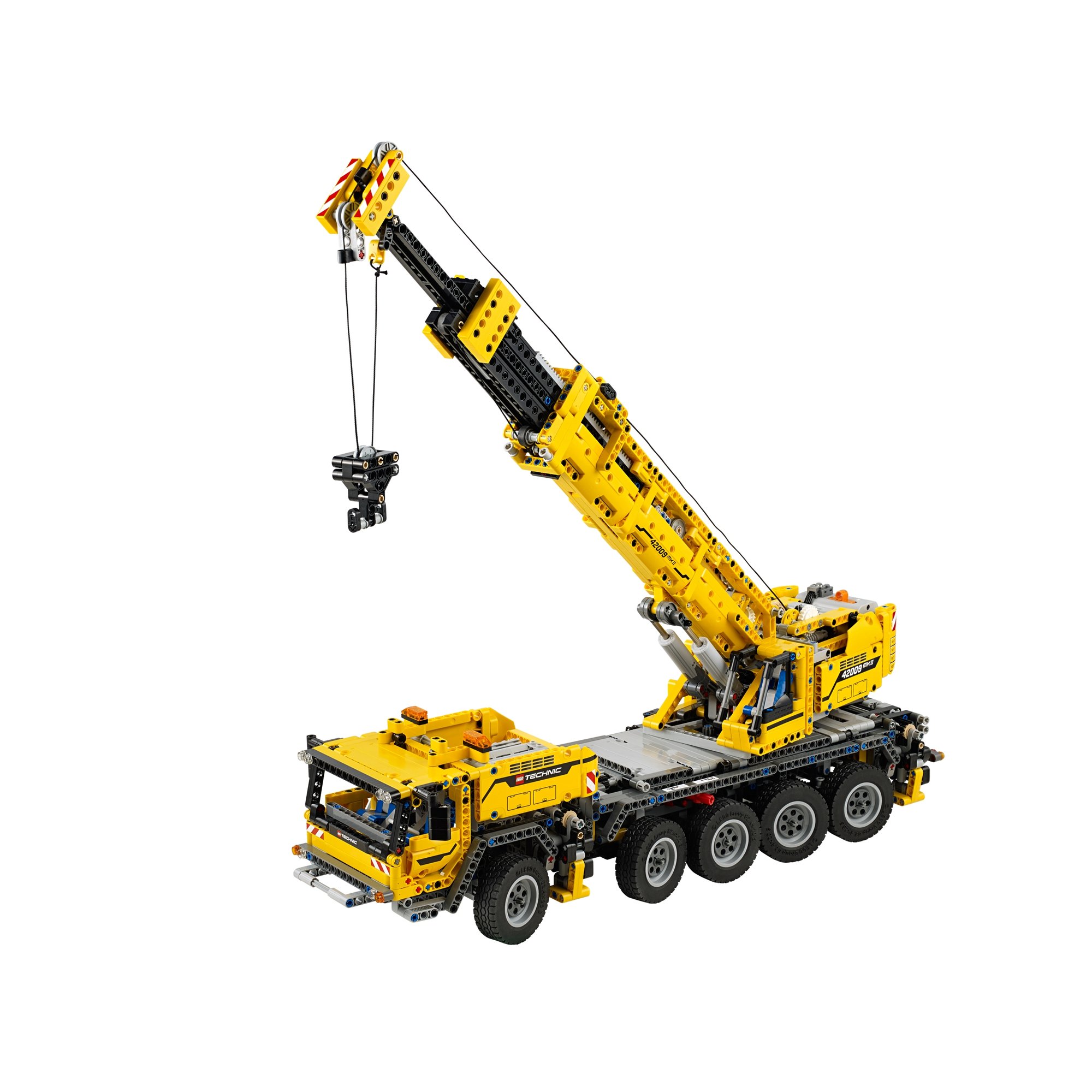
The other big construction machines in the library. The R 9800 is the other two-hub Liebherr, the Cat D11 another Control+ machine on tracks, and the two older cranes have outriggers and telescopic booms.


The Liebherr Crawler Crane is in the library
Technic Fan gets up to 6 kits a year, Master Builder up to 12. Delivery both ways is included and the prepaid return label is in the box.