

McLaren Formula 1 Race Car (42141): the F1 car that started the series
Before the Red Bull and the Ferrari there was this one. LEGO’s press text called it the first Technic Formula 1 car; Before the Red Bull and the Ferrari there was this one. LEGO’s press text called it the first Technic Formula 1 car; Huw at Brickset points out it is the first licensed one in over 15 years, after the Ferrari F1 Racer (8674) of 2006. Either way it is where the current run of big Technic F1 cars begins, and at 65 cm it is the longest model on our supercar shelf, with a bigger footprint than the Daytona SP3 at under 40 percent of the pieces. Either way it is where the current run of big Technic F1 cars begins, and at 65 cm it is the longest model on our supercar shelf, with a bigger footprint than the Daytona SP3 at a third of the pieces.
It is in the Brick Club library and one member has built it and sent photos. Below is what the car does in the hand, how the four bag groups split the build, and the two places where experienced reviewers went wrong and could not go back.

Why this one matters
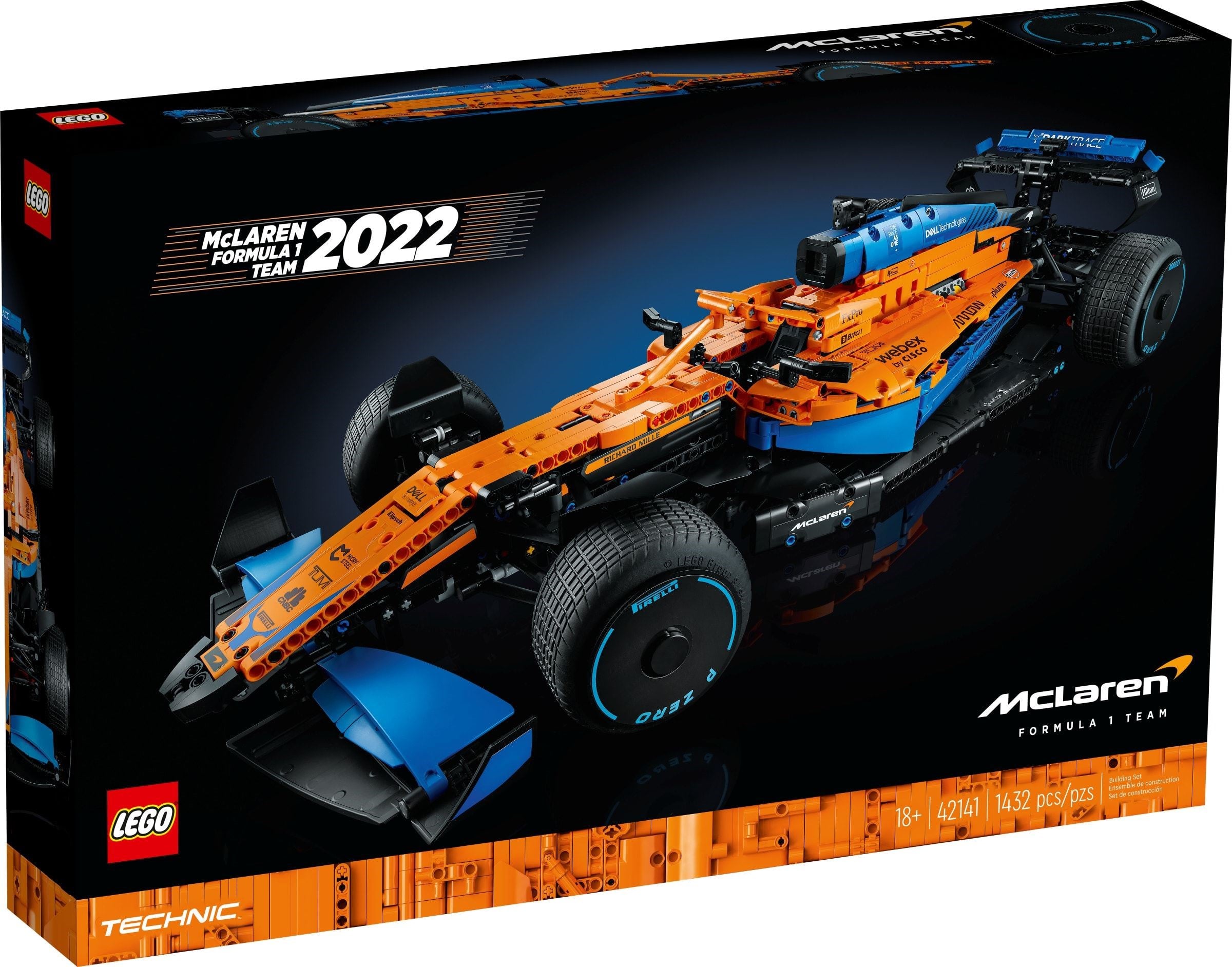
Two things to know before you open it. First, the livery is from the 2021 season, and how much of the shape is the 2022 car depends on who you ask. The box says 2022 in large letters; Huw at Brickset reads the body as the 2022 car, while Hothbricks and The Brothers Brick say it is mostly the late 2021 prototype with some 2022 aero in the wings. McLaren only showed the real car a couple of weeks before the set went on sale. It does not matter on a shelf. It will matter if you follow the team closely.
Second, what the box holds. Of 1,432 pieces, New Elementary counted nine gears, being generous; Hothbricks counted just over 530 pins. There is no gearbox. The functions are engine, suspension and steering. What you get instead is parts: a 3 x 19 frame that was the longest Technic beam LEGO had made, new angular panels above the front wheels, the smallest Technic panel ever at 2 x 1 x 1, ten moulds in orange for the first time, and the first set with four of the big treaded Tumbler tyres.
So it is a shape-and-parts build rather than a mechanism build. Huw’s verdict was that it does not offer a great deal functionally and is still the best Technic Formula 1 car yet, So it is a shape-and-parts build rather than a mechanism build. Huw’s verdict was that it does not offer a great deal functionally and is still the best Technic Formula 1 car yet. The two F1 cars that followed in 2025 are built at 1:8 and add a simple selectable gearbox, which this one does not have.
What it actually does
Everything is worked by hand. No motors, no gearbox, so each of these is a short path. One source below is LEGO’s launch press text rather than a build review; where it promises something the model does not have, I have said so.
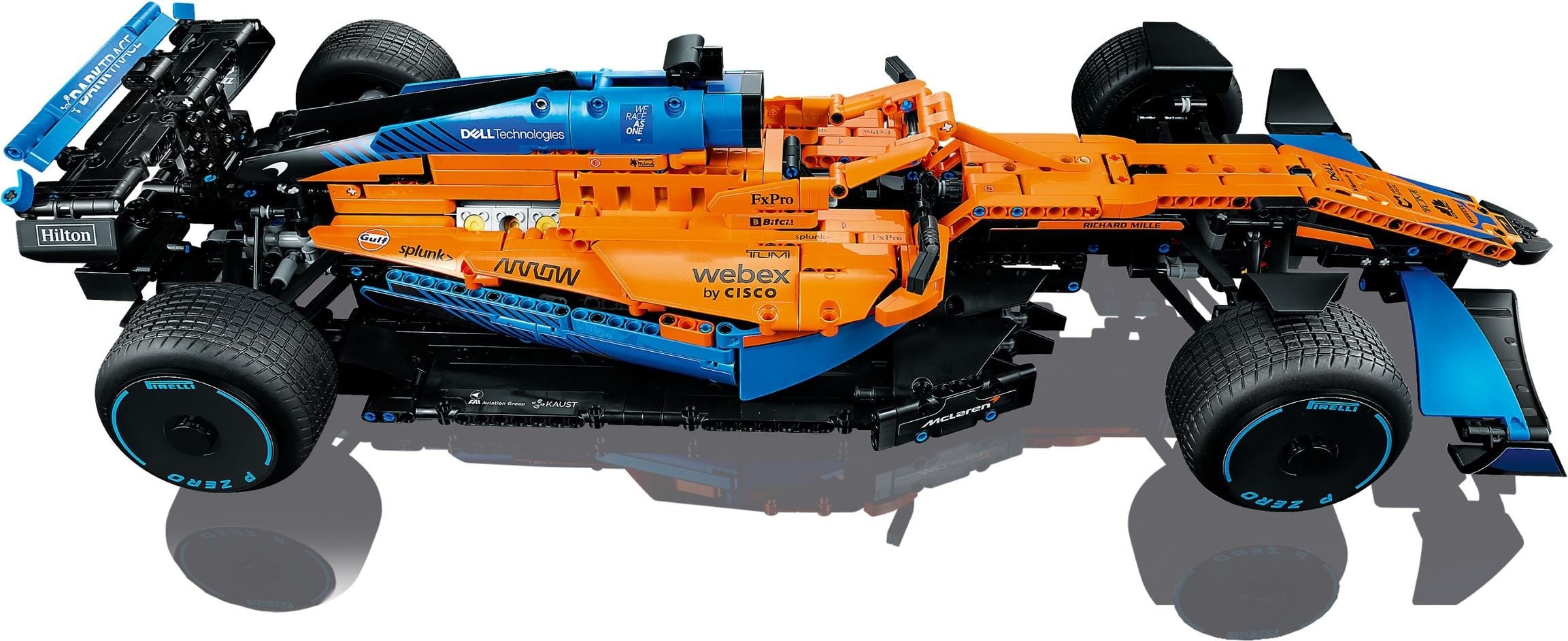
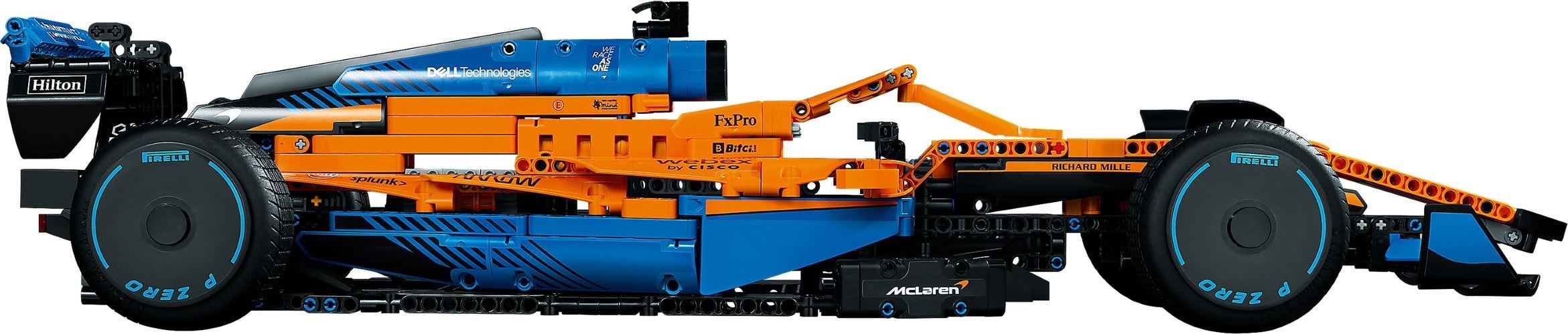
Roll the car and the six pistons pump. The path is as short as Technic allows: rear wheels to a differential, then one 20-tooth gear straight into the engine. New Elementary was surprised by how little there is. The cylinders sit behind the cockpit and show through an opening in the bodywork, which is either the best bit of the car or the thing that spoils the lines, depending on the reviewer.
Building starts with the rear differential, and it works: hold one rear wheel, turn the other, and the engine still runs. The press release listed a differential lock among the functions. It is not in the finished model; The Brothers Brick checked. What you have is a plain open differential, much like the 2013 Grand Prix Racer (42000).
There is no knob on top. Steering comes from the small wheel in the cockpit, under the halo. The rack sits in an orange 5 x 7 frame at the front and the drive runs the length of the nose to an 8-tooth gear behind the wheel. The wheel is hard to reach with adult fingers because of the halo, and when the front wheels point dead ahead the steering wheel sits a few degrees off. New Elementary traced it to how the 12-tooth gear meshes on the rack in bags 2, and there is a fix in the fiddly list.
Both ends are sprung and none of the springs stand upright. Two lie horizontally in the middle of the rear axle assembly; two more lie flat under the orange nose. Push-rods link them to the wishbones, as on the real car. Press the finished car down and it moves, but not much: The Brothers Brick found the travel drops once the springs are fitted, and Hothbricks calls it very rigid. That is the design. 65 cm of bodywork has to sit level.
The top flap of the rear wing tilts up and down to copy the drag reduction system. There is no linkage to the cockpit; you reach round the back and move it with a finger. Huw called it hand of God and said a cockpit control was never realistic at this scale. The Darktrace lettering runs across two stickers, and the gap between them is in the fiddly list.
How the build goes
Eleven bags: ten numbered 1 to 4, one unnumbered bag of large parts and the rims, the tyres loose, three sticker sheets and a 320-page book. That Brick Site put it at 10 to 12 hours, Hothbricks said the assembly is quickly dispatched, GamesRadar spread it over several weekends, and our member build post says 4 to 5 hours. Call it one long weekend if you sticker as you go.
Rear differential, suspension and engine
Everything mechanical is in this group. Rear differential first, then the wishbones and the two horizontal springs, then the long frame from the unnumbered bag as the backbone, then the V6 on top. Before you leave bags 1, roll the rear axle on the table and watch the pistons. Nothing later will test it again.
Front suspension, steering and the join
The steering rack in the orange 5 x 7 frame, then the front wishbones and push-rods, and the two front springs slide into a groove and lock in slightly compressed. This is where New Elementary meshed the 12-tooth gear wrong, so read the fiddly list first. The first stickers arrive here and they are the smallest in the set. The two 3 x 19 frames form the cockpit sides, the seat and wheel go in, and the front is joined to the rear.
Rear body, sidepods, nose and the fin
This is where it starts to look like a car and the build speeds up. The tail is detailed in System and Technic parts, the blue underbody panels go down each side, and the air inlets are built as fins on pneumatic elements. The nose takes the tapered curved panels from the Sián (42115), here in black and blue. Bags 3 finish with a black 3 x 19 rotor blade along the top as the engine cover fin.
Orange panels, intake, mirrors, wing and wheels
The orange sidepod panels arrive loaded with sponsor stickers, then the 11 x 3 curved panels close the body up. The airbox above the cockpit is a dense sub-assembly of bars and 1 x 2 round plates to get studs facing both ways. The mirrors go on as bare axles with no bush to locate them, and the rear wing drawing is turned 90 degrees. Last, the wheels. The rears push on easily; That Brick Site found the fronts awkward.
One member has built this one for us and the reviewers were unusually specific about their own mistakes. Slow down here.
- Mesh the 12-tooth steering gear one tooth over. New Elementary lined it up square on the rack and got a steering wheel that sits off-centre with the wheels straight, because the steering runs through another pair of gears. Turn the 12T gear one tooth when you fit it in bags 2. Once the nose is panelled it is buried for good.
- The front springs live slightly compressed. They slide into a groove and lock in, and even at full droop they are squeezed. New Elementary called it a critical flaw; a commenter pushed back that steady compression does a spring little harm. It is how the set is built. Do not fight it.
- Wheel cover stickers must be dead central. The Pirelli covers are 8 x 8 round plates with a round sticker each. A millimetre off centre and the cover looks like it wobbles as the car rolls. Apply them with the plate flat on the table.
- Mirror stalks have no spacer. The arms are axles in a hole with no bush to set the depth, so a knock pushes them through. The Brothers Brick checked twice for a missed part; there is none. Set them by eye and lift the car by the floor.
- The rear wing drawing is rotated, and the Darktrace stickers have a gap. The step that mounts the wing shows it turned 90 degrees; the next step makes the right way obvious. The box and instructions show a gap between the two halves of the Darktrace name. The Brothers Brick tried to close it and only half succeeded.
On the shelf
Brickset measures it at 65 cm long, 27 wide and 13 high, and Huw worked that out as roughly 1:13 against the real car rather than the 1:8 the later F1 cars are sold at. It needs a shelf to itself; GamesRadar notes it has a bigger footprint than the Daytona SP3. The orange, blue and black are regular LEGO colours, which is why New Elementary rated the box as a parts pack.
Two things reviewers would change. The tyres are the treaded kind from the Batman Tumbler, all four the same width, where the real car has wider rears and, in the dry, slicks. And the layered orange sidepod panels leave gaps that show close up; Huw’s line was that it looks great from a distance. GamesRadar found the rear rain light and the tip of the airbox come off when it is picked up, so lift it by the floor.
A member who has built it
One McLaren has come back through the door with photos, written up in the member build post linked under each picture.

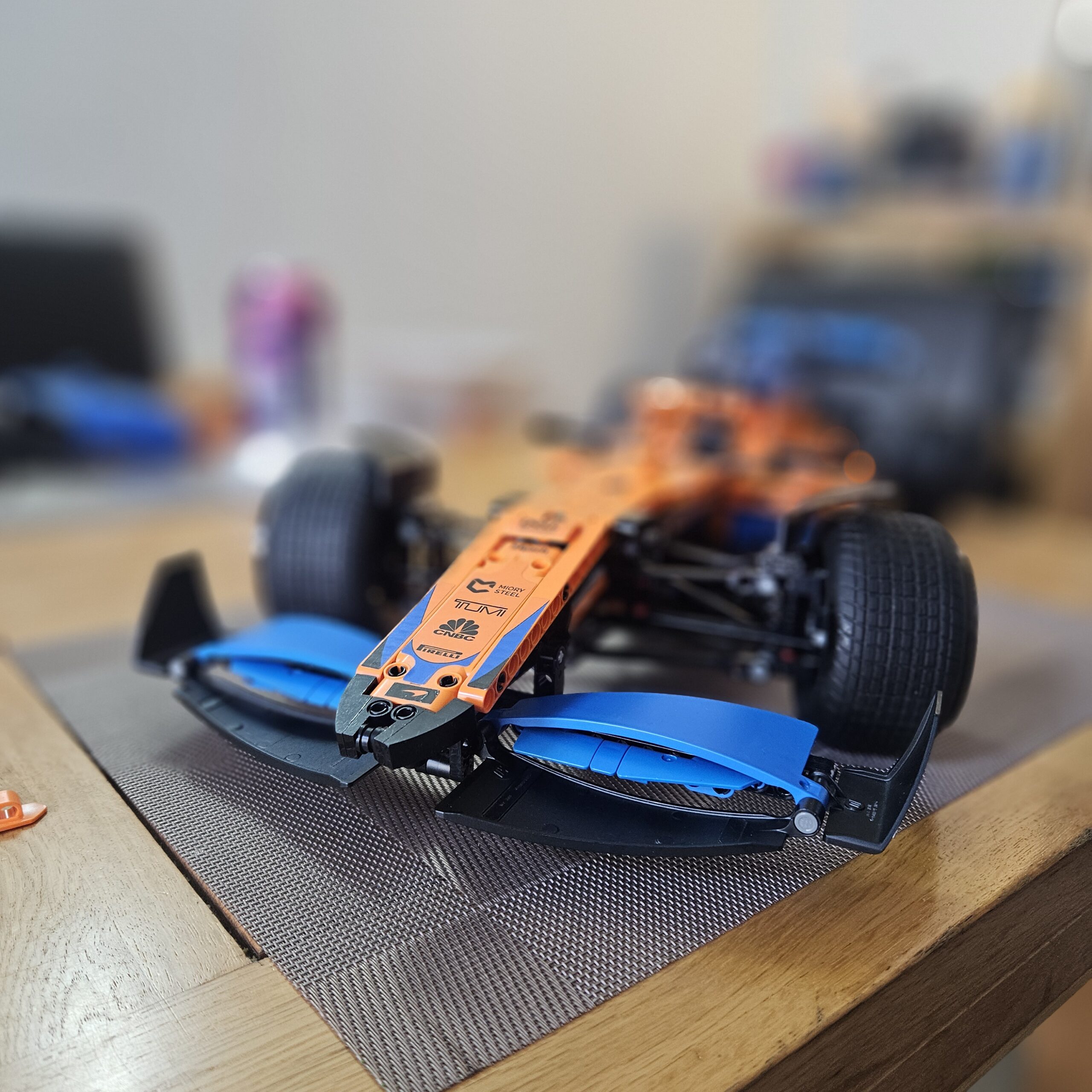
It is the one for you if you want a big, bright F1 car on the shelf and a build that does not eat a week. It suits a member who has not done a 1:8 supercar and does not want to start at 3,000 pieces; it is the wrong one for anyone chasing a gearbox, because the drivetrain is a differential and one gear. Allow a long weekend, mesh the steering gear one tooth over in bags 2, and get the wheel cover stickers central. For the same layout with newer parts and a two-speed switch, the Red Bull (42206) is the follow-on.
If you like this one, try
The other Technic race cars in the library. The Red Bull and the Ferrari are the 2025 F1 cars that followed this one, the P1 is the McLaren with a real gearbox, The other Technic race cars in the library. The Red Bull and the Ferrari are the 2025 F1 cars that followed this one, and the Ferrari is the closest in piece count; the P1 is the McLaren with a real gearbox, and the 488 GTE is the endurance racer of similar size.



The McLaren Formula 1 Race Car is in the library
Technic Fan gets up to 6 kits a year, Master Builder up to 12. Delivery both ways is included and the prepaid return label is in the box.