

Mobile Crane MK II (42009): ten wheels, one motor, four functions
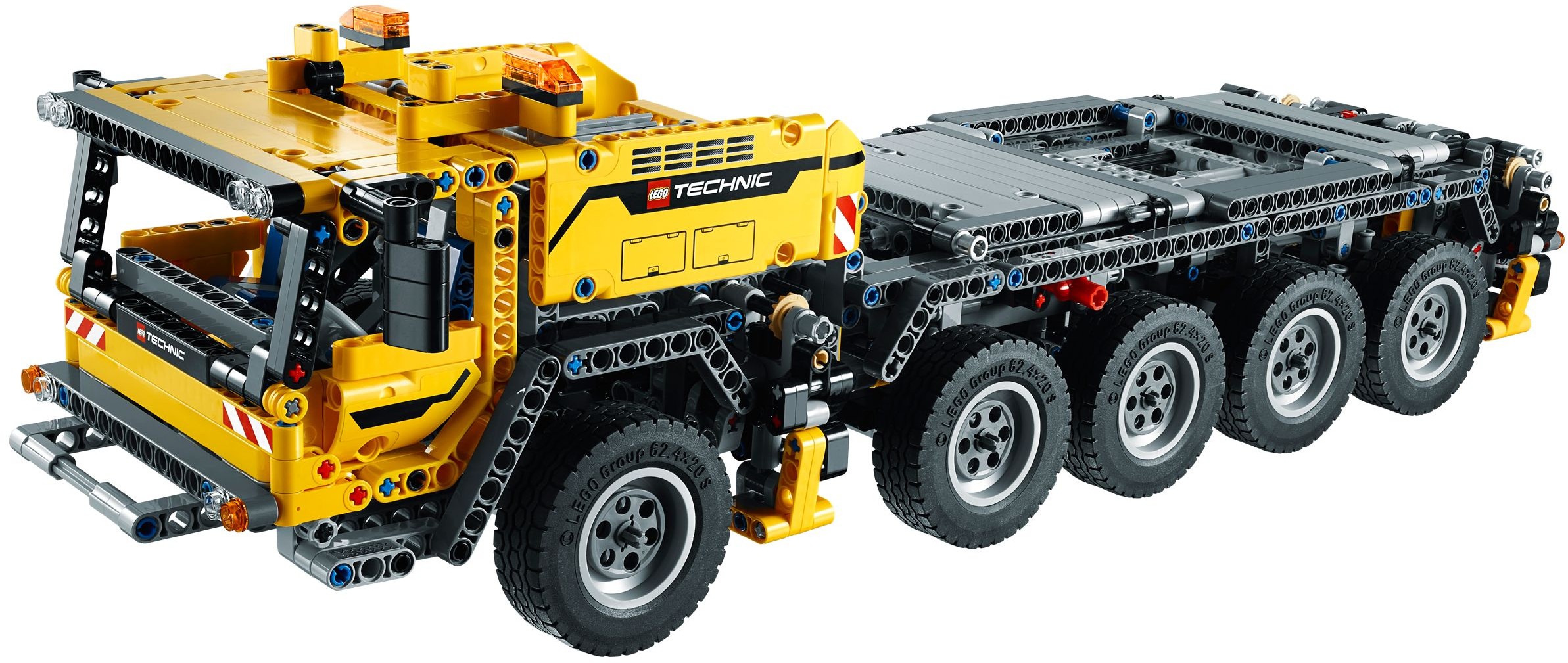
The first thing you notice is the steering. Ten wheels on five axles, eight of them steered, and one 32-stud axle running the length of the carrier turns the lot, each steered axle through the angle its position needs (21 degrees at the front, 17 at the rear, 13 on the inner pair) so the wheels follow each other round a bend. It was the biggest Technic set LEGO had made when it arrived in August 2013, 2,606 pieces, from the same designer as the old 8421 Mobile Crane, and reviewers at the time treated it as the successor that set had been waiting for.
It is in the Brick Club library. No member has written up a build yet, so what follows comes from the reviews and from LEGO’s own material: what the one motor drives, how the six books split the work, and where the reviewers had to go back.

Why this one matters
One Power Functions L-motor sits in the superstructure and runs everything except the steering and the pistons. A four-way gearbox sends it to the boom lift, the boom extension, the winch, or down through the turntable to the outriggers. Miguel at The Technic Gear took the gearbox for a special part when he first saw LEGO’s pictures; it is a few beams and two clutch gears. Every function is protected by a white clutch gear, so nothing strips if the motor is left running against a stop.
The other reason to want it is the carrier. Cwetqo on Eurobricks explains the steering: rather than gearing each axle differently, as 8421 did, every rack runs at the same ratio and the angle comes from where the rack sits. The inner pair get a four-stud offset for 13 degrees, the rear axle three studs for 17 degrees, the front axle two studs for 21 degrees. The middle axle does not steer at all; it carries the differential that turns the V8. Miguel found it precise and smooth, and easier to steer than the Unimog, and said he had built the whole system before he realised what it was.
There is very little new in the box. Four 8-tooth gears that slide freely on their axles, used in the outriggers, and six curved panels with more mounting holes than the old ones, which is what lets the boom hold its own shape. The rest is volume: nearly a thousand pins by Cwetqo’s count (a builder in the Eurobricks thread put it at 495 black friction pins and 214 blue ones), and enough beams that whole surfaces are made by stacking them, a trick that until then belonged to fan builders.
What it actually does
The steering and the V8 are worked by hand. Everything else runs off the L-motor, and which function moves depends on where the gearbox lever sits. The one thing it will not do is drive itself: there is no remote control and the motor never reaches the wheels.
The motor and the battery box live in the superstructure, the battery box at the back as a counterweight. A lever picks one of four outputs: lift the boom, extend it, wind the winch, or send drive down through the turntable to the carrier. Cwetqo counted more than 40 gears in this section and it is where he had to backtrack twice. Once built it is buried under the yellow panels, so run the motor through all four positions before the panels go on.
With the main gearbox set to the carrier, drive comes down through the turntable to a second gearbox in the chassis with its own lever, a red one in Cwetqo’s photographs. One way, a rack and pinion at each corner pushes the four beams out of the sides of the truck together, driven, in Miguel’s account, by a 32-stud axle that runs from the back of the carrier to the front (Cwetqo puts the 32-stud axle in the steering instead). The other way turns four mini linear actuators that slide 16-stud axles down until the feet touch the floor. Both reviewers who built it say the same thing about the second stage: it is very slow. Cwetqo puts it down to friction over the long path from motor to actuators, and Miguel notes that on his model the feet reach the floor and stop rather than taking the weight. The front and rear modules are built separately and are almost identical.
Two synchronised large linear actuators lift the boom, the same arrangement as the 8043 Excavator and, Cwetqo says, with the same awkwardly placed bevel gear, which is harder to fix here. The battery box counterweight is enough for the empty boom. Put more than about 200 g on the hook and Miguel found the whole superstructure tipping forward. Treat it as a crane that lifts small things.
The boom is three sections. Gear racks drive the first stage and strings with studs on the ends pull the next stage out at the same time, so both extend together. Fully out it is well over 60 cm long and, with the boom raised, the tip is 77 cm above the table. It is not quick: Miguel timed the full extension at 40 to 50 seconds, and extended and loaded, it flexes.
The fourth gearbox position winds the main string. Unlike 8421, paying out the hook is not tied to extending the boom, so you do it in two moves, and the hook is plastic rather than metal. With nothing on it the hook is too light to keep the string taut, so it goes slack on the drum and tangles. Miguel wanted a heavier hook, and so will you. Let the hook down with something small on it.
The steering is turned from the rear of the carrier, where a 24-tooth gear on the steering axle shows through, and the racks turn four of the five axles by their different amounts. The middle axle is fixed and carries the differential that spins the eight-cylinder engine behind the cab. The engine is left uncovered, so the pistons are on show, and the instructions have you build it upside down. The turning circle is wider than 8421’s; the steering itself is smooth.

How the build goes
Six instruction books and 24 numbered bags, split three ways: fifteen bags marked 1 and books 1 to 3 for the carrier, five bags marked 2 and books 4 and 5 for the superstructure, four bags marked 3 and book 6 for the boom. Each book runs to 70 or 80 pages. Miguel’s build took about eight hours plus a few more fixing a gearbox; the Rebrickable review discussed on Eurobricks came in at 13.5 to 14 hours.
Carrier: axles, steering and engine
The five axles go together first, with the steering racks at their different offsets and the 32-stud steering axle threaded through the lot, then the middle axle’s differential and the V8 behind the cab. Turn the steering before the bodywork goes on and watch the front wheels turn further than the inner pairs. If they all turn the same amount, a rack is in the wrong hole.
Outrigger modules
The front and rear outrigger units are built as separate modules, nearly identical, each with a rack for the sideways beams and mini actuators on sliding 16-stud axles for the feet. They go onto the carrier with the second gearbox and its lever. Push the 16-stud axles in straight: technicmad on Eurobricks bent one seating it in the gears and the foot wobbled from then on. The carrier is finished with the cab, the stacked-beam decks and the turntable.
Superstructure and gearbox
The four-way gearbox, more than 40 gears, then the two big linear actuators for the boom lift, the L-motor and the battery box. Cwetqo went back into this section twice. Miguel lost a few hours to a mistake in one of the inner gearboxes, without saying which, and, testing it half built, could not tell whether it was behaving or not. Run the motor through all four positions before the yellow panels close it in. It is also, Cwetqo says, the best part of the build.
Boom and hook
The three-section boom, built largely with studded parts to keep it slim, then the six new curved panels, the winch string and the hook. Thread the studded strings that pull the outer section before the panels go on. Once the boom is pinned to the actuators the crane is finished and, as Cwetqo found, it does not fit in a normal photo corner.
No member has sent a diary for this one yet, so these come from the reviews.
- The superstructure gearbox. Over 40 gears in a small space, and Cwetqo had to correct it twice. Check that each of the four lever positions turns a different output, with the motor, before the panels go on.
- Black against dark grey. Several builders in the Eurobricks thread struggled to tell the black beams from the dark bluish grey ones in the instructions. Sort the two colours into separate piles before each book.
- The 16-stud outrigger axles. They slide through gears as the feet go down. technicmad bent one pushing it into place, the bend was too slight to straighten, and that foot wobbled afterwards. Push them in square and do not force them.
- The 32-stud axles. Two come in the box, one a spare, and they are loose rather than packed. Miguel puts the one you use in the outriggers and Cwetqo in the steering; either way it runs the length of the carrier and, Miguel says, is hard to keep straight. Feed it through with the carrier flat on the table.
- Hook slack. The plastic hook is not heavy enough to keep the string taut. Wind it in and out with something small on the hook, or the string bunches on the drum.
On the shelf
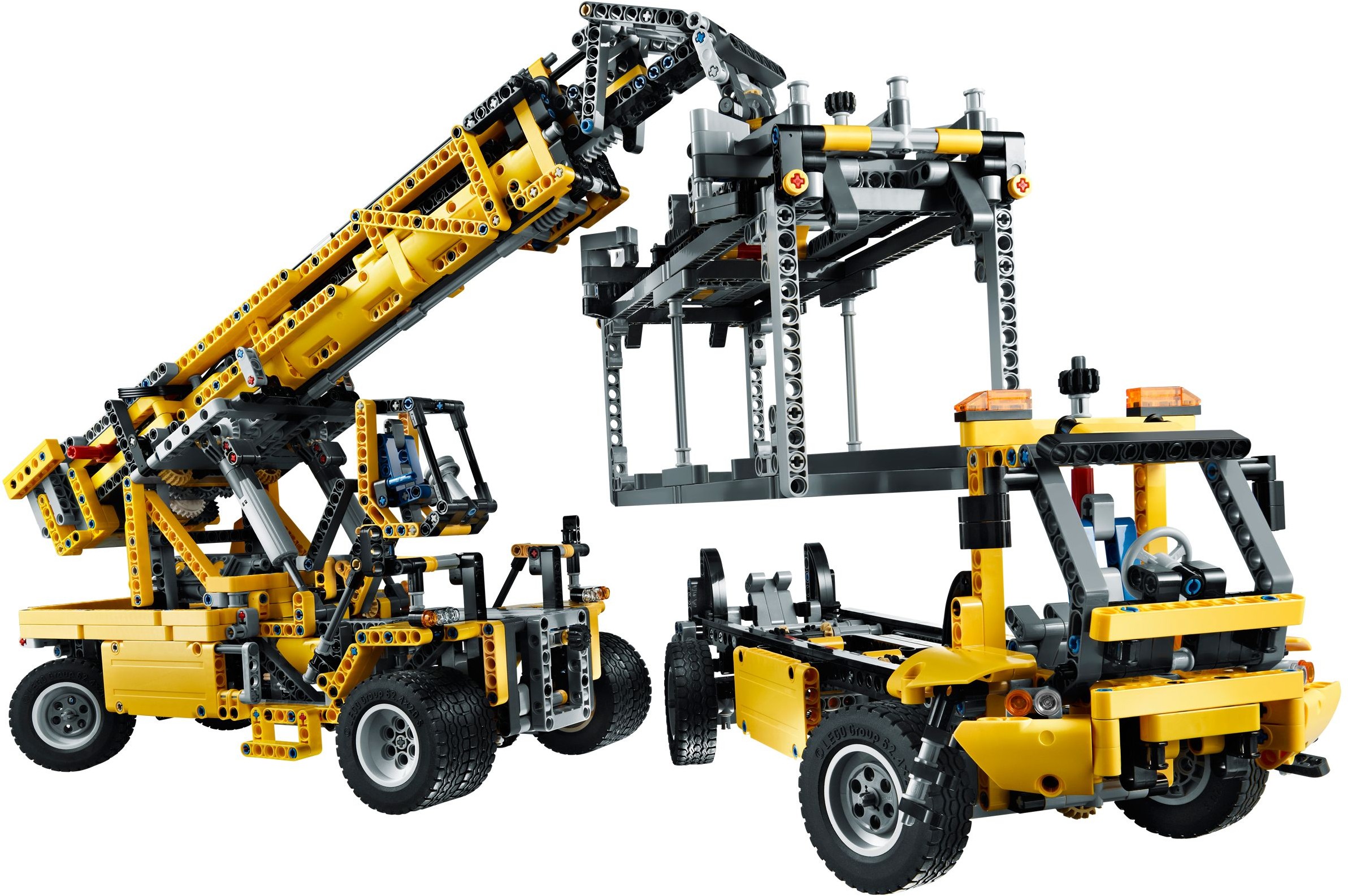
It is yellow and grey, and Cwetqo thought the carrier could have used more yellow. The box says 57 cm long, and the raised boom reaches 77 cm up, so it wants a deep shelf or the floor, and it looks best with the boom up. It is a 2-in-1: the alternative is a container stacker and a separate truck, and those instructions were download only rather than in the box.
Two things spoil the back view. The battery box sits exposed at the rear of the superstructure, which Cwetqo held against it next to 8421, and the winch string needs a weight on the hook to stay tidy. The cab doors and the crane cab door open, and the engine is uncovered so the pistons are visible from the side.
It is the one for you if you want the steering and the gearbox rather than a display piece. It is a long build, eight to fourteen hours depending on who you believe, and the superstructure gearbox is the one place to slow down. It does not lift much and it does not drive itself. Members who want more crane for the same idea, one motor and a bank of levers, should look at the Rough Terrain Crane (42082), which came five years later with 4,057 pieces and a boom that reaches a metre. If you want to see how eight-wheel steering and a four-way gearbox are done with ordinary parts, this is the one.
If you like this one, try
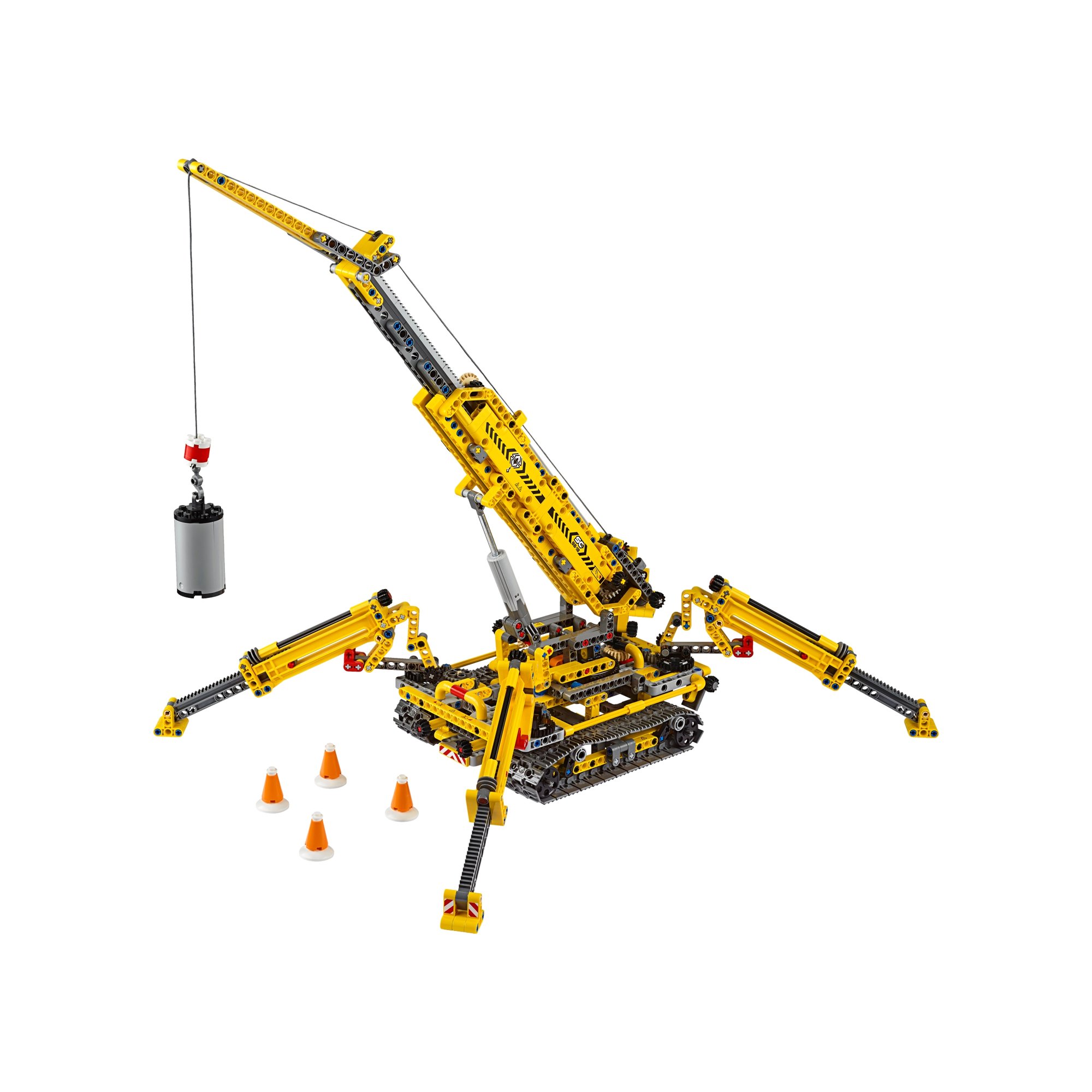
The other cranes and big diggers in the library. The Rough Terrain Crane (42082) is this set’s successor in all but name, and the Compact Crawler Crane (42097) is the short-evening version of the same functions.


The Mobile Crane MK II is in the library
Technic Fan gets up to 6 kits a year, Master Builder up to 12. Delivery both ways is included and the prepaid return label is in the box.