

Rough Terrain Crane (42082): the turntable that carries the whole thing
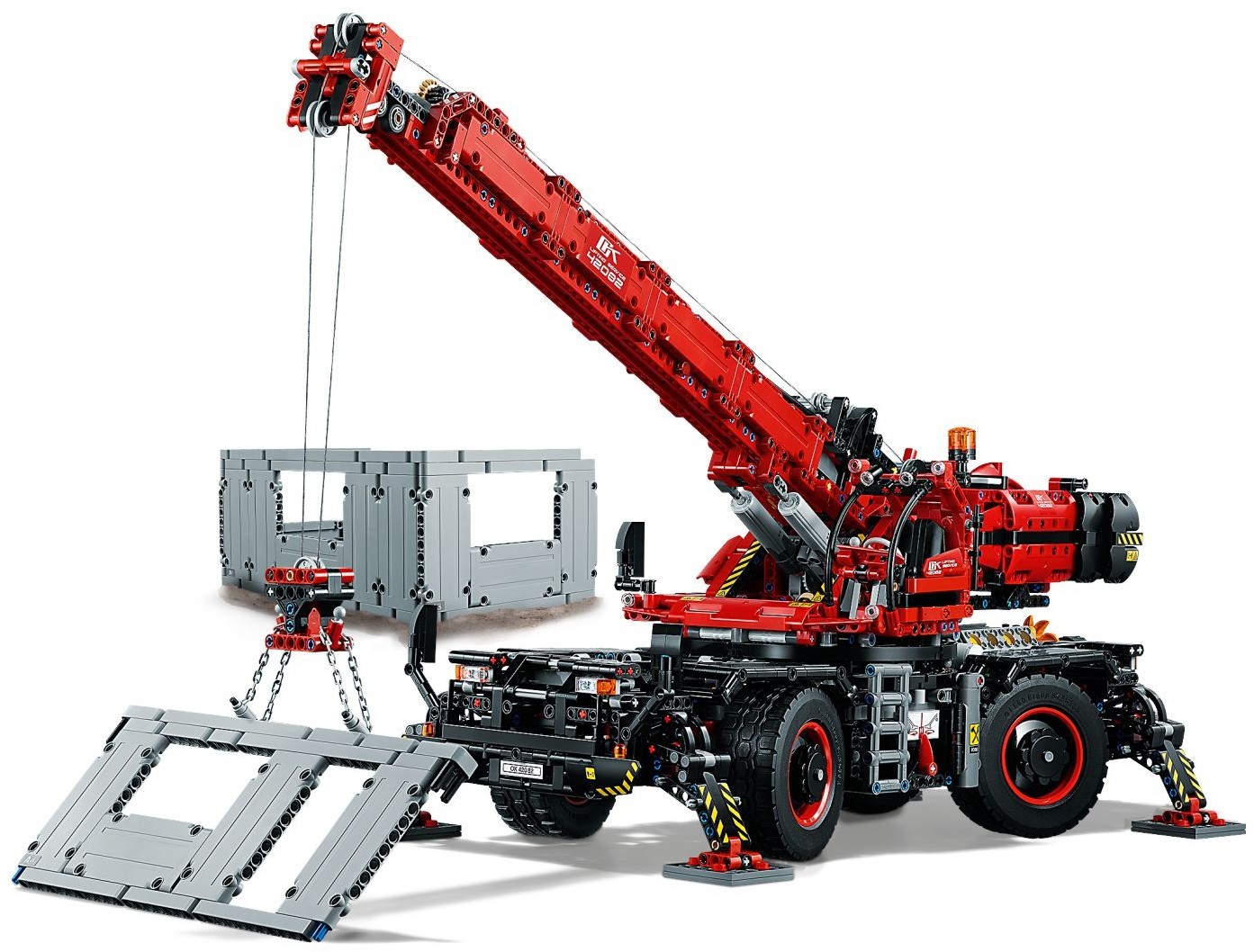
When it arrived in August 2018 this was the biggest Technic set LEGO had made, 4,057 pieces, but the count is not the reason to want it. The turntable is. The upper half carries the boom, the motor and the battery box, and a normal Technic turntable would rock under that weight, so the designers built a ring from four curved gear racks, sat a second ring of four on top, and put eight tiny train wheels between them as a roller bearing. One L-motor then drives five functions through three gearboxes.
It is in the Brick Club library and two members have built it. Below is what each lever does, how the 13 stages split the build, and where one reviewer lost an hour to one missed gear.

Why this one matters
Reviewers who expected a monster that only just worked came away saying the opposite. Alexander Holroyd at Brick Architect set it against the Bucket Wheel Excavator (42055), which always felt on the limit of what the parts could take, and said there is none of that here: the functions feel powerful, robust and confident. The Brothers Brick got theirs to lift 1.1 kg of drinks cans before the winch gave up, about twice what the Mobile Crane Mk II (42009) managed.
There are no new parts in the box. The headline new colour is the 11 x 11 curved gear rack in black, eight of them, which is what the turntable is made of; The Brothers Brick also counts four 7 x 3 curved panels in red as a first. The rest is ordinary Technic used well: 430 axles, 151 gears and 593 connectors by The Brothers Brick’s count.
Inside are 26 numbered bags across 13 stages, two thick books that run past a thousand steps, a battery box and a Power Functions L-motor. It is the old Power Functions system, not Powered Up, so six AA batteries and no app.
What it actually does
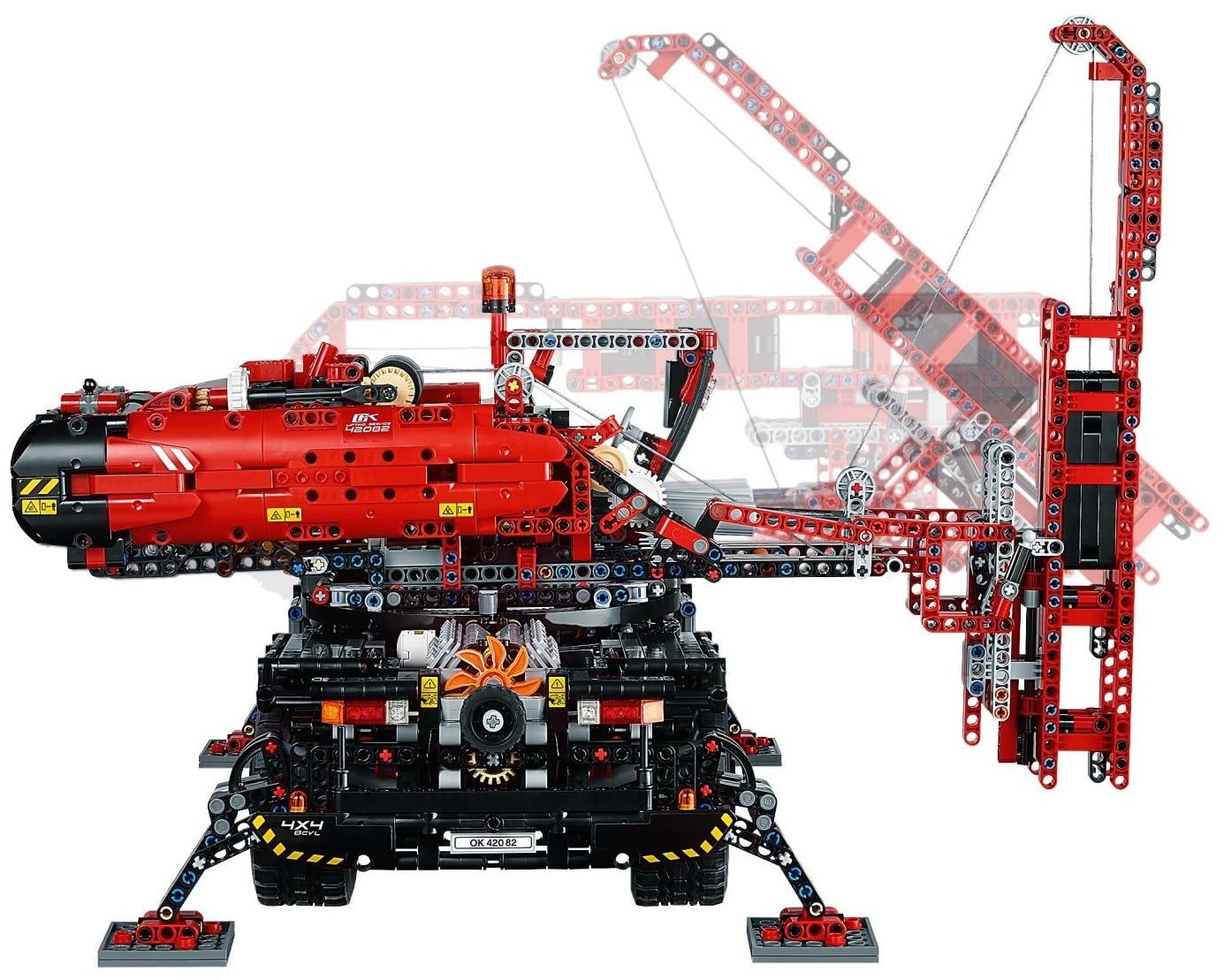
Two functions are manual, the steering and the V8. The other five run off the one L-motor, and which one moves depends on where three switches and a gate-style shifter sit. The motor only ever turns one way; the levers choose the function and its direction.
The main selector sits on the superstructure beside the big gearbox behind the boom. One way, the motor drives the chassis functions, outriggers and slew; the other way, the three boom functions. So you cannot run an outrigger and the winch at once, which Brick Architect reads as protection for the motor. Two levers on the sides of the chassis pick outriggers or rotation, and a gate-style shifter on the superstructure picks boom up, boom out or hook, one at a time. It is the gearbox first used on the Crawler Crane (42042): the motor never reverses, the lever does. Adam White at BricksFanz found it looked complex and was not complex to build.
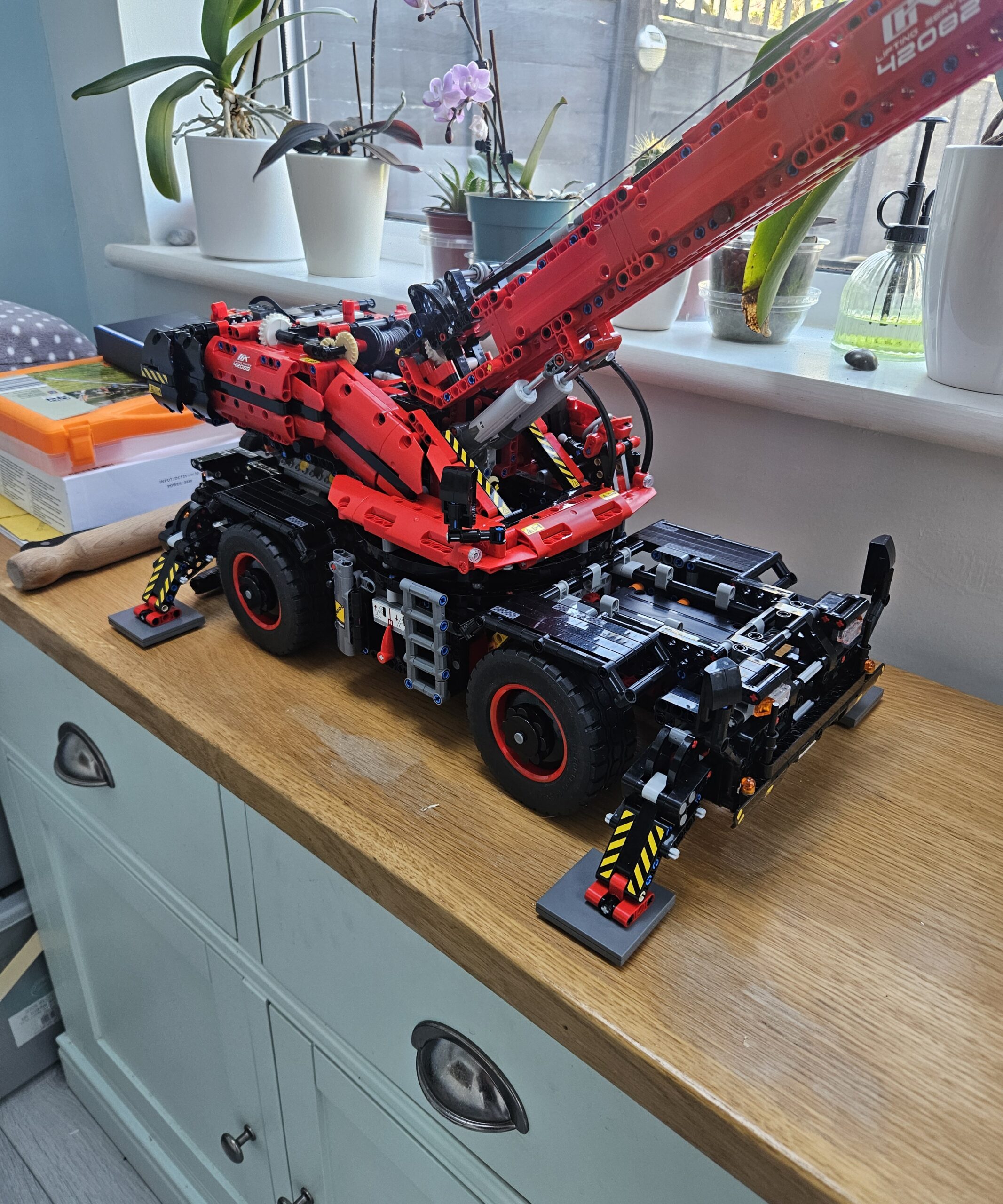
With the main selector in the lower position, one chassis lever winds all four legs out together on small linear actuators. Adam liked the slow, even motion down and back up. They are heavily geared down and do not lift the crane clear of the ground; they take weight off the wheels and stop it rocking. Four tiled pads live in a compartment at the front and go under the feet, and they make a real difference. One gripe from Brick Architect: nothing locks the legs down, so the actuators carry the load.
The other chassis lever turns the whole upper half through a full circle. Power comes down through a single axle in the centre of the turntable into the reduction gearbox from stage 1, then back up to the ring. It would have been simpler to drive the rotation from inside the tower, Brick Architect notes, but then the lever would turn with it. The turntable is two rings of curved racks with a free-floating ring of eight small train wheels between them, and the rotation is, in his words, silky smooth. A stud of clearance between tower and chassis, and nothing rubs.
With the main selector in the upper position, one slot on the gate shifter lifts the boom on a pair of linear actuators built at the start of stage 9. It travels from almost flat to almost upright at a decent pace, slow enough for precise control of the height. The two actuators face opposite ways on one axle, so they extend by very slightly different amounts as the boom rises. Brick Architect noticed, could not find an easy fix, and found it made no difference in use.
The other two slots run the boom out to nearly twice its length and wind the hook. The boom is two sections, not three like the Mobile Crane Mk II, and the string is the medium thick type from the 6×6 All Terrain Tow Truck (42070), around two metres of it. Two sliding pulleys spool it neatly onto the drum. Extending the boom does not pay out string, so let the hook down first or it climbs to the tip. Two white rubber bands in front of the battery box add friction to the extension and winch axles so gravity cannot wind them back in neutral.
Steering is a single tyre-shaped knob at the very back of the chassis. It turns both axles in opposite directions, so the turning circle is respectably tight for something 76 cm long. Both axles are driven through two differentials, and rolling the crane spins the eight pistons at a satisfying speed; there is an oil filter next to the engine. The portal hubs put the pivot a long way from the wheel, so you cannot really steer it standing still. Roll and steer together.
How the build goes
Thirteen numbered stages across 26 bags. The Brothers Brick’s build took about 24 hours over three days. The Brothers Brick’s one real complaint was that this set gives you no checkpoints, so make your own.
Chassis gearbox
A clock-like tangle of gears in the centre of the chassis: the reduction gearbox for the slew and the two selectors for outriggers and rotation. Alexander at The Brothers Brick left out one small 8-tooth gear in the first pages and found out at bag 11, when the tower would not turn with 3,000 pieces on top of it. Brick Architect found the train stiff even built right. Turn the input by hand before you move on, and note step 119: the four 3L stop-axles go in part way and stay there until step 545, whatever the later pictures show.
Axles and outriggers
Two axle units with portal hubs, two differentials and the steering, then the two outrigger assemblies. The chassis is almost symmetrical here and the green and orange parts are there to tell the ends apart, which the instructions do not point out. It looks small at the end of stage 2. Once the outriggers are on it does not.
Engine, steering and the turntable
The steering knob and V8 in stage 4, bracing in stage 5, then the whole of stage 6 is the turntable: the bottom ring of curved racks, the floating ring of eight train wheels on towball bars, and the top ring pinned through the centre. The Brothers Brick called it the best thing in the model for engineering and part use. Watch the bag numbers here: old-style bags print a dot after the 9 and new-style bags do not. Alexander was hours in before he noticed he seemed to have one bag 6 and two bag 9s.
Levers, wheel arches and wheels
The control levers for the chassis selectors go on in stage 7; stage 8 is the wheels, arches, ladders and lights. Reviewers who like to leave wheels off until the end could not here: the chassis is now too heavy for the outriggers alone to hold it up.
Superstructure and the marriage
Stage 9 opens with the boom-lift actuators and the upper or lower selector. Stage 10 is the second gearbox with its rubber bands, then the battery box and L-motor, the battery box at the back as a counterweight. The finished tower drops onto the centre of the turntable with a single axle carrying the drive down. The battery box comes out easily later; the motor does not.
Boom, panels and accessories
The two-section boom in stage 11, strong and rigid, then the red panels, the cab with its sliding door, two toolboxes, the fire extinguisher, the outrigger pads, and finally four wall sections for it to lift, each with two chains.
Two members have built this one so far: Alan’s build (October 2025) and another member’s, whose photos are further down. Between Alan’s write-up and the reviews, these are the points to slow down for.
- The missed 8-tooth gear in stage 1. The most expensive mistake in any of the reviews: one small gear left out on the first pages, found at bag 11 when the tower would not rotate, an hour opening one side of the crane to get it in with tweezers. Before you leave stage 1, turn the input and check the output turns.
- Bags 6 and 9. The box mixes two bag designs. The older ones print a dot after the 9; the newer ones do not. If a bag leaves you with pieces you do not need, you have opened the wrong one.
- The four stop-axles at step 119. They go in part way in stage 1 and the pictures from stage 2 onwards draw them fully home. They are not pushed in until step 545 in stage 7.
- The end gear on the boom drive. Adam at BricksFanz put it on the wrong side and the stickered switches worked backwards. Easy to fix, if you test the levers before the panels go on.
- Let the hook down before you extend. Extending the boom does not pay out string. Wind the hook out first, or it is pulled up to the tip and the boom will not extend.
On the shelf
In driving position it is 76 cm long, 20 cm wide and 27 cm high, and with the boom up and out it reaches past a metre, so this is a floor model or a deep sideboard rather than a shelf. The sealed box weighs around 5 kg on The Brothers Brick’s scales, 6.1 kg by Brickset’s listing. Built, you can pick it up by the chassis, the tower or the boom and nothing gives.
There are 72 stickers in 46 numbered sets, none bigger than a medium panel. The ones that matter are the function labels by the levers and the pinch-point warnings by the exposed gears on the tower. Brick Architect applied only the labels and preferred it that way. The back of the tower is held on by three pins and comes off for battery changes: six AAs.

Members who have built it
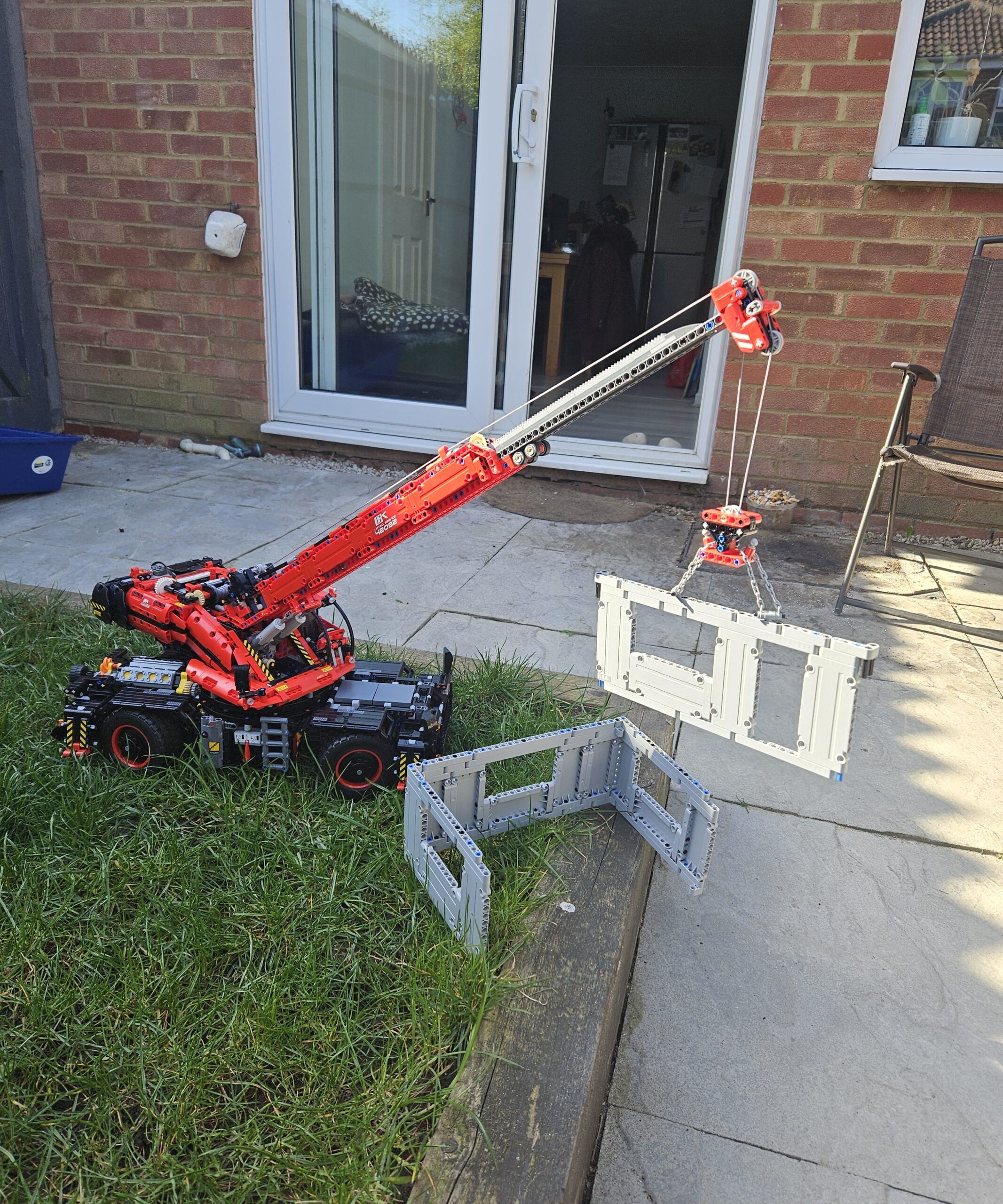
One member sent in photos of their finished crane doing what it was built for: outriggers down on their pads and a wall section from the box on the hook, indoors on a sideboard and out on the lawn and patio. The diary is linked under each picture.
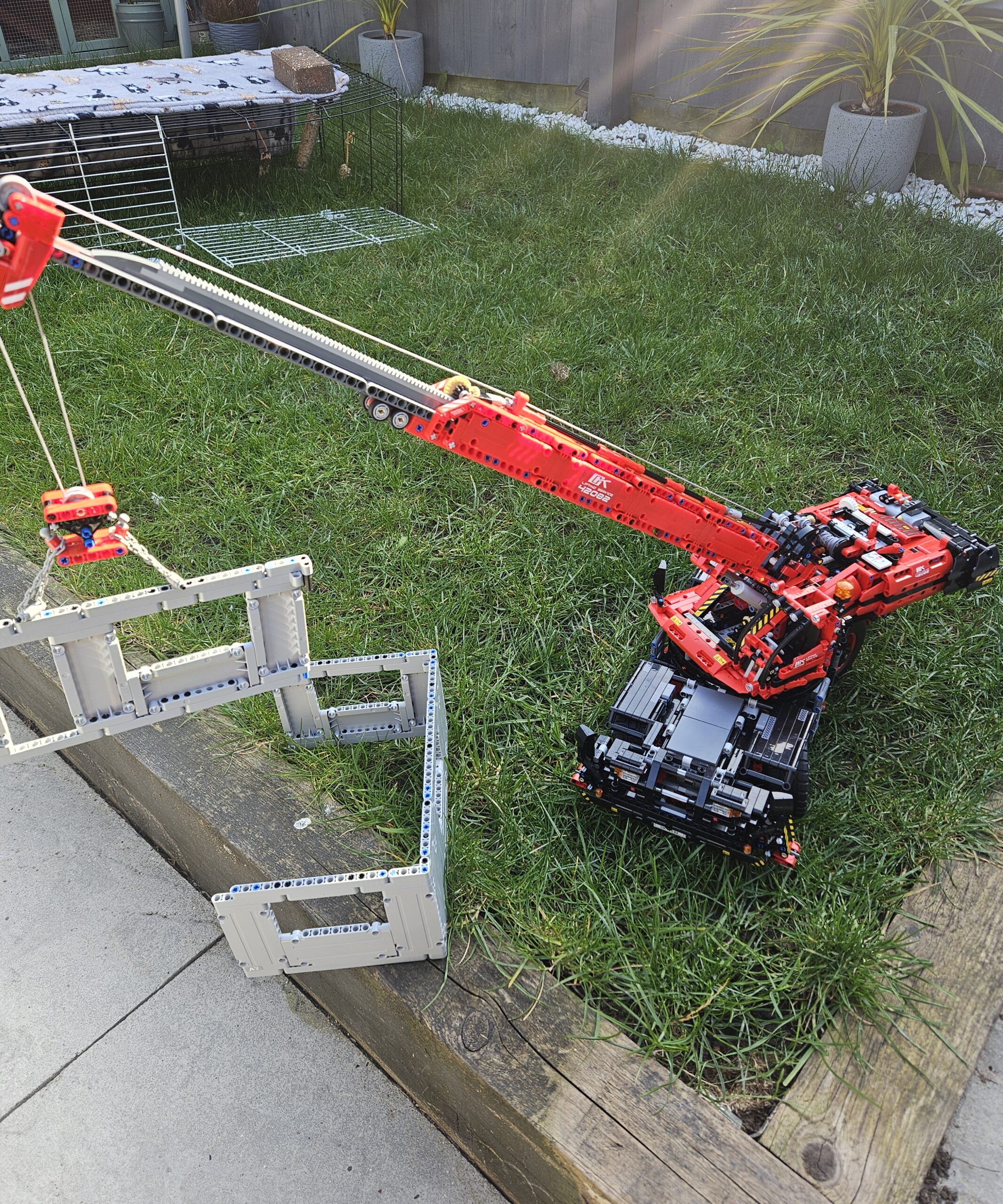
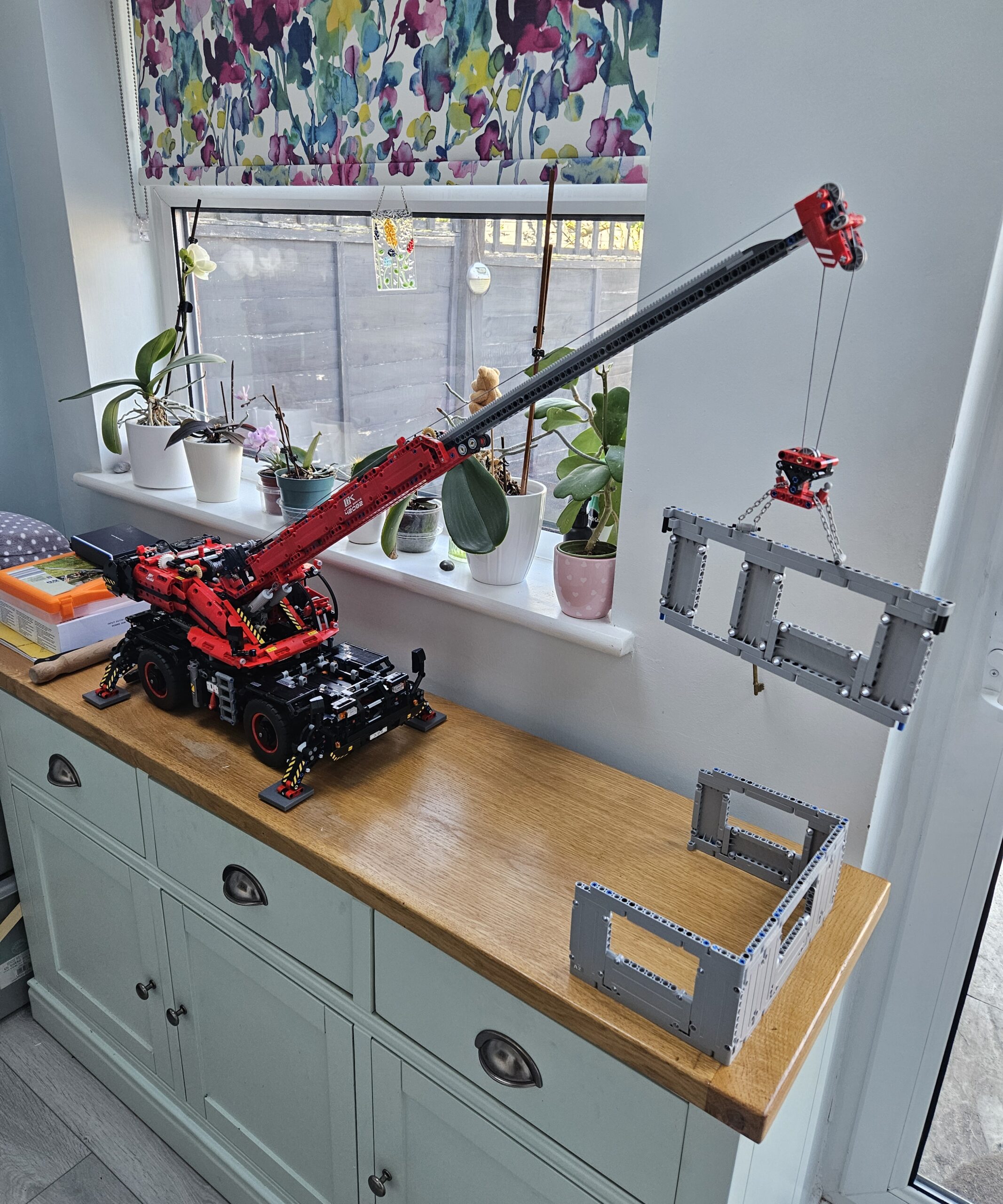
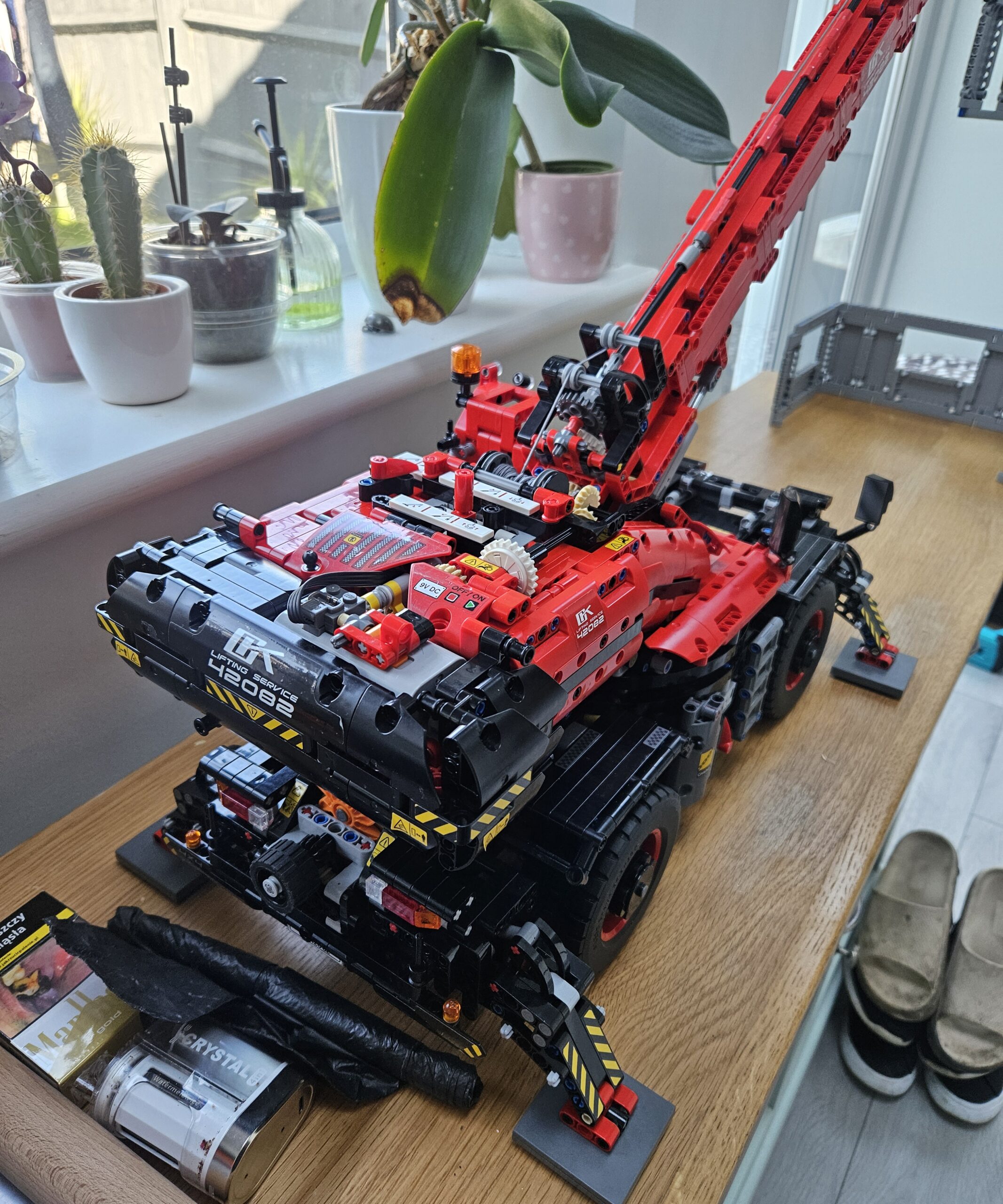
This is the one for you if you want the biggest mechanical build in the library that still works properly when it is finished. It is not a two-evening set; the one timed build in the reviews came in around 24 hours across three days, and Alan’s diary calls it a proper weekend. Test the stage 1 gearbox before it disappears, read every bag number twice, and put the wheels on when the book says. If you want a gearbox you shift yourself, this is not it; the levers do the thinking.
If you like this one, try
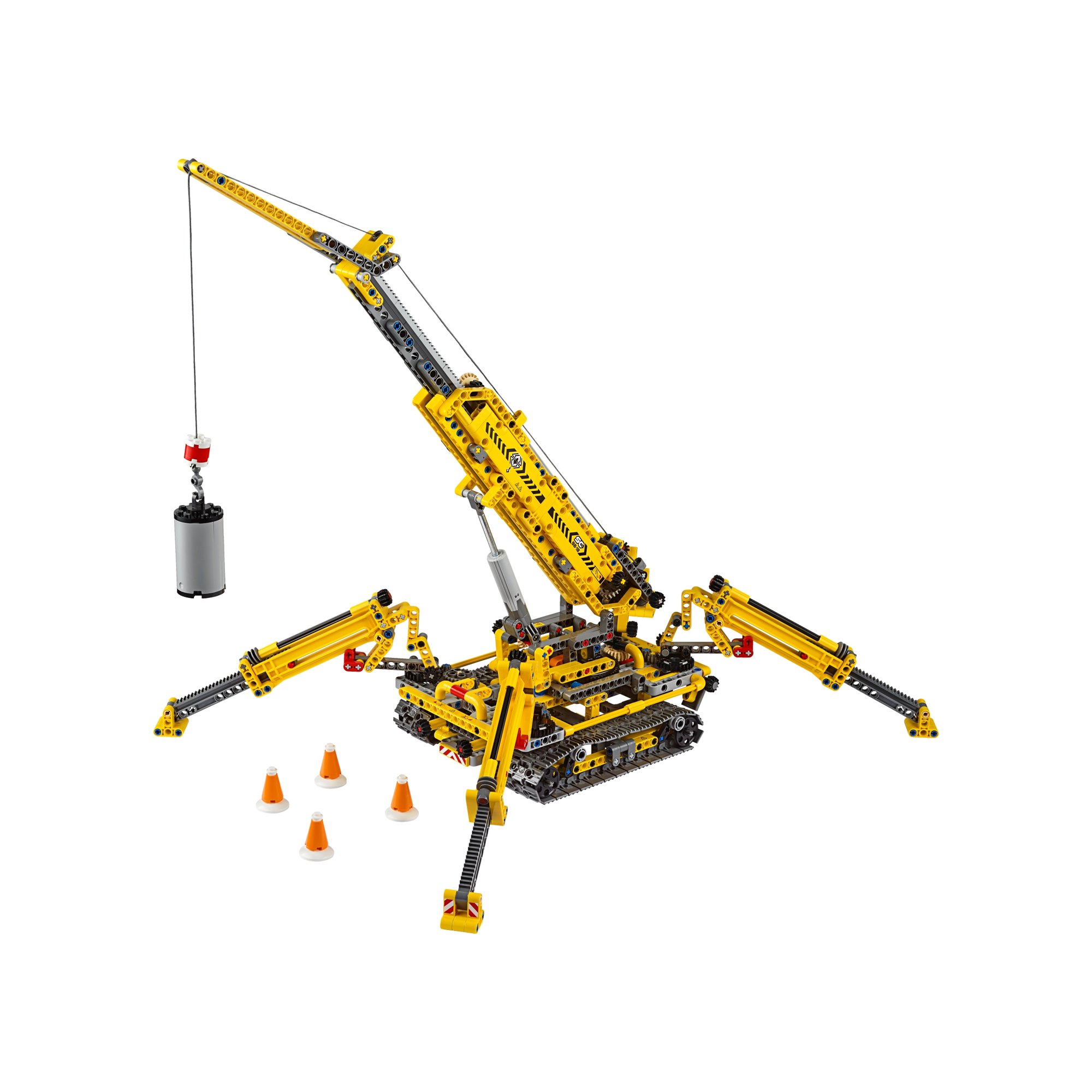
The other cranes and big diggers in the library. The Mobile Crane Mk II (42009) was the biggest Technic crane before this one, and the Liebherr R 9800 (42100) is the one construction set in the library with more pieces.

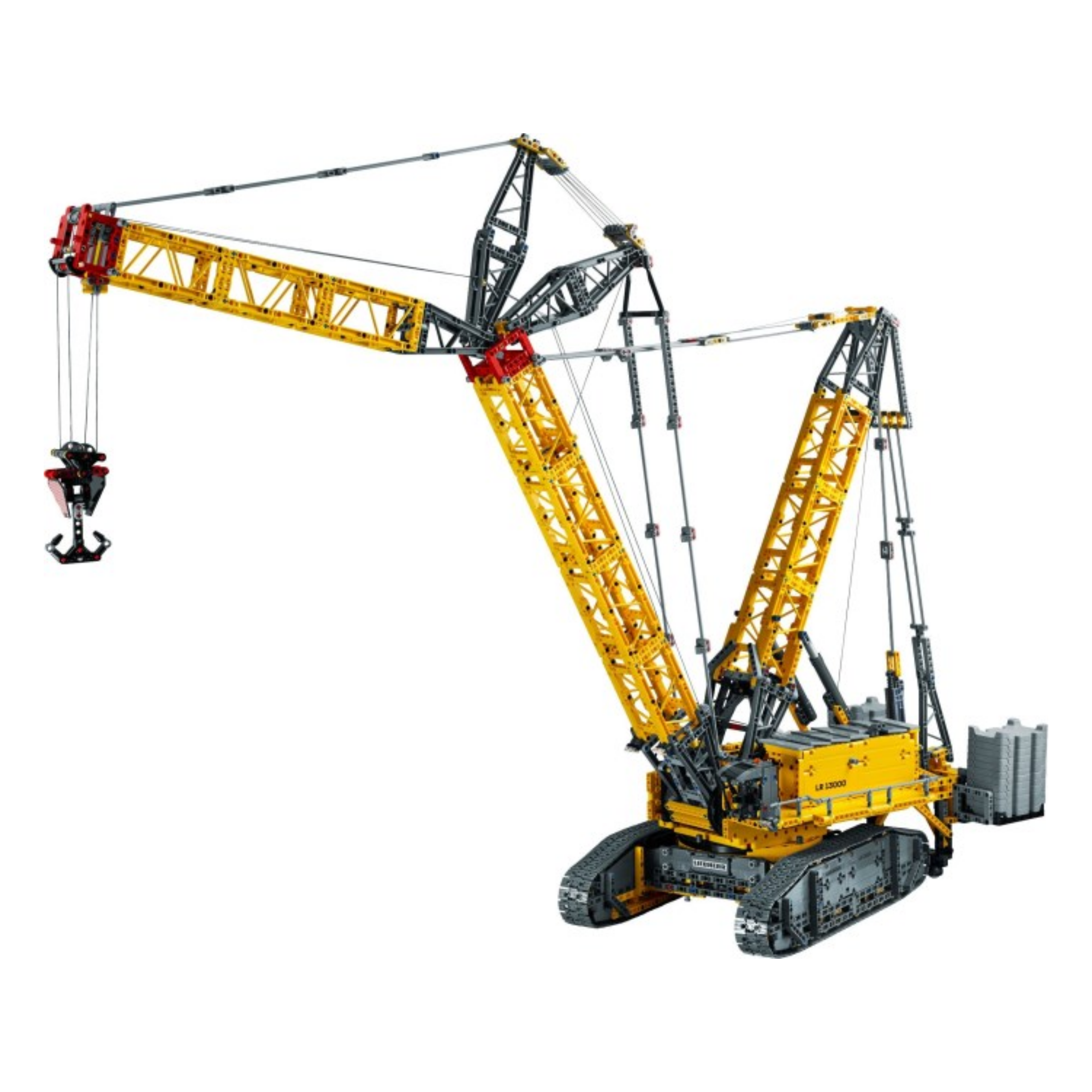

The Rough Terrain Crane is in the library
Technic Fan gets up to 6 kits a year, Master Builder up to 12. Delivery both ways is included and the prepaid return label is in the box.