

THE BATMAN Batmobile (42127): two light bricks and a jet exhaust on a two-hour build
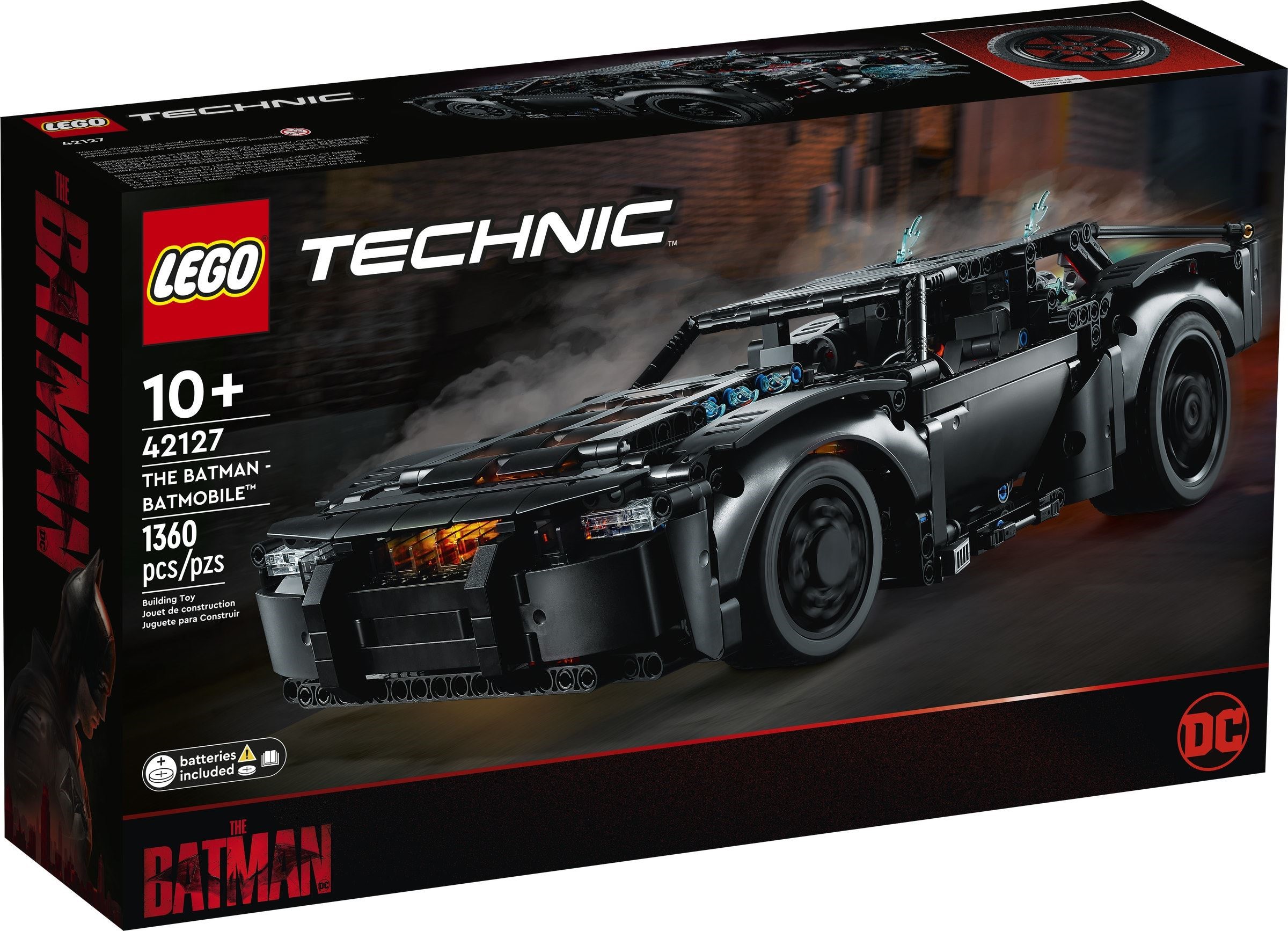
Two light bricks, a V8 you can see through, and a jet exhaust that spins when you push the car along. That is what makes this one different, and LEGO put it on the front of the box: batteries included, on a Technic set. Underneath is a plain chassis with a rear differential and steering from a knob on the roof. No gearbox, no suspension. It is 1,360 pieces and it builds in an evening.
It is in the Brick Club library. Below is what actually moves, how the seven bags go together, and where the reviewers got caught out. There are no member diaries for this one yet, so the build notes come from four reviews rather than from our own copy.

Why it is in the library
It is the quickest big-box car we have. Huw at Brickset put it at 15 minutes a bag at most and 1.5 to 2 hours in total, and the box says 10+. That makes it the kit to have sent when you want a Technic evening rather than a Technic fortnight, or when there is a Batman fan in the house who has not built Technic before. Two of the four reviewers called it a starter set for exactly that person.
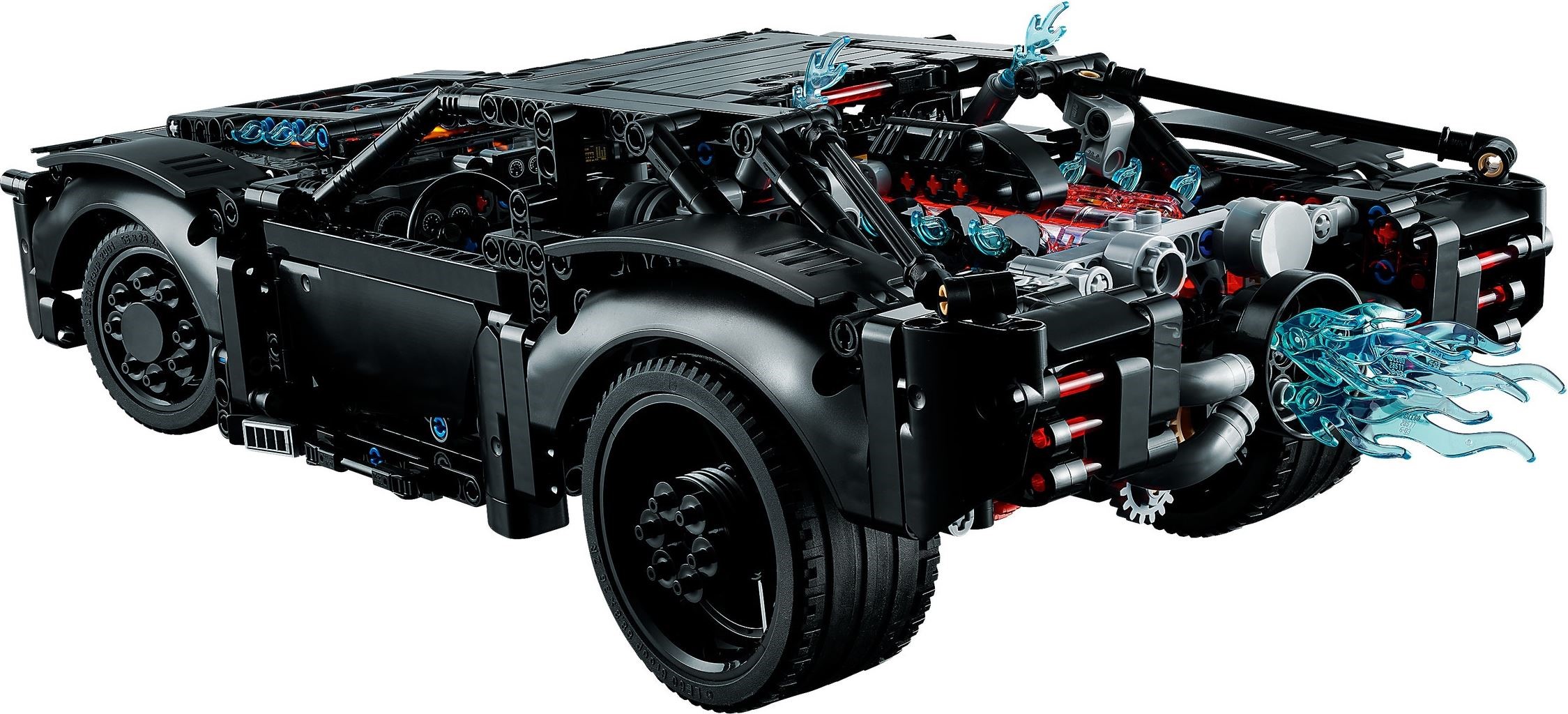
The lights are the point. Technic sets almost never carry light bricks; this one has two of the standard 2×3 System ones, an orange one at the front that glows through the bonnet and grille and a red one under the engine that shines up through transparent cylinder blocks. Transparent cylinder blocks had last appeared in 2006, on the 8282 Quad Bike, and Jim at Eurobricks points out that these are the newer mould. The engine under them is, in Huw’s words, probably the best and most detailed to have appeared in a Technic car, with exhaust manifolds and small light blue flame pieces coming out of the cylinders.
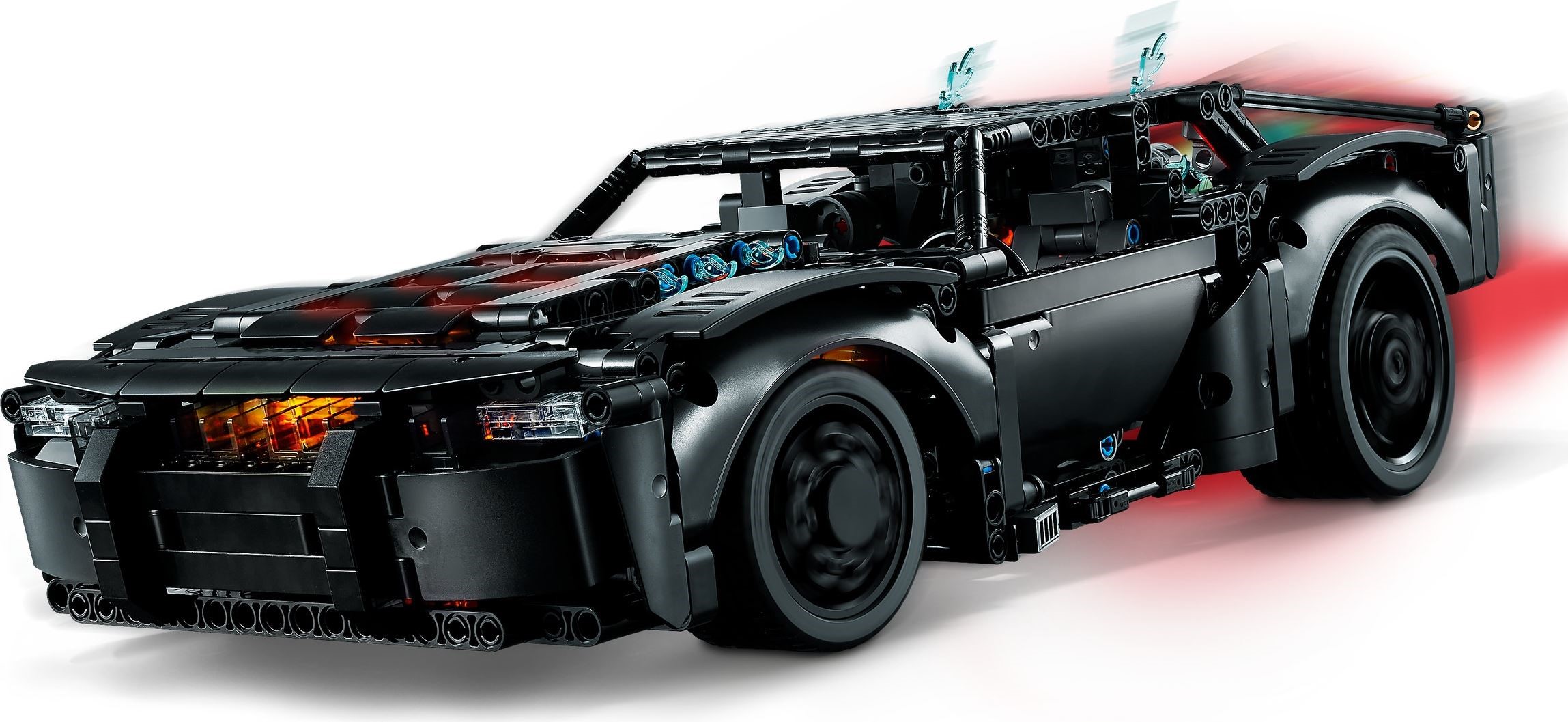
It is also a parts box in black: eleven of the 2×3 curved panels, where the McLaren Senna GTR (42123) had two, and the big arched mudguards, which the Brothers Brick called new in black. The manual is one 260-page book with three dashboard stickers and nothing else. Dom’s Dodge Charger (42111) was the first Technic car built from a film, and this one followed it; three of the four reviews compare it with the Charger, and the Brothers Brick also stood it next to the bigger Batmobiles.
What it actually does
Everything is worked by hand or by rolling the car. There are no motors and no gearbox. LEGO’s own list is steering on the front wheels, a differential on the rear wheels, a spinning flame, opening doors and bonnet, and the two lights.
The clever one. The steering knob on the roof sits on an assembly that is not fixed rigidly to the chassis, and it is meant to move: press it down and it hits the switch on the red light brick just in front of the engine. The light comes up through the transparent cylinders and out of the open engine bay, so you can steer and light the engine with one hand as you push the car. It does not lock on. In low light it is a good effect; in normal room light, the Brothers Brick found, you can barely tell it is there.
The second light brick sits under the bonnet, just in front of the cabin. It is switched by pushing a silver pin joiner forwards between the seats, which Jim at Eurobricks took for a throttle. The glow comes out through the gaps between the small bonnet panels and through the grille. The catch is the switch: there is no steady-on position, so you hold the lever with a finger poked through the windscreen opening, which the Brothers Brick found awkward with adult-sized hands. It is the weaker of the two lights.
Roll the car and the rear wheels turn the differential, and the differential turns the engine. The cylinders are capped with 2×2 round tiles, so with ordinary blocks you would see nothing; because the blocks are clear, you can watch the pistons go up and down. One thing works against you seeing it: the light blue flame pieces sit over the top and hide a fair bit of the piston travel. The manifolds and the red glow make up for it.
At the back, between the tail lights, a hub carrying the transparent flame pieces is connected to the drive shaft. Push the car forward and the flames spin. Jim at Eurobricks said it adds to the coolness of the car, and the Brothers Brick called it one action feature the designers got exactly right. It also sticks, along with the rear wheels, if the engine is not seated properly, which is covered below.
The front wheels steer from the knob on the roof; the steering wheel in the cabin is a dummy. The knob is designed to pull off for display, leaving a short axle showing through the roof, the same trick LEGO used on the Ford Raptor. The box does not list steering, but the front wheels in the box art are turned. There is no suspension at either end, and the rear wheels are a larger diameter than the fronts.
The two doors open on simple hinges and there is not much to them. The bonnet lifts and there is nothing under it except the orange light brick. Inside are two seats that the Brothers Brick liked as a design in their own right, the three dashboard stickers and an accelerator pedal. The Brothers Brick would have swapped the blue pin through the middle of the steering wheel for a black one.
How the build goes
Seven numbered bags, plus two loose bags for the tyres, rims and wheel arches, and one manual. The Brothers Brick counted nine numbered bags in its early copy, but Brickset, Eurobricks and BricksFanz all count seven and the instructions run in seven stages, so I have gone with seven. Huw at Brickset had it built in 1.5 to 2 hours.
Chassis
A front section and a rear section, joined by a single pin on each side. It is not very sturdy yet, and Jim at Eurobricks guessed the seats would fix it. They do, in the last bag. Leave it as it is.
Engine, both lights and the steering assembly
The V8 with its clear cylinders and blue flames, the red light brick in front of it, and the steering assembly that presses the switch; that assembly has some play in it by design. The orange light brick goes in just in front of the cabin, with its lever in the cockpit where the seats will go. Test this bag properly: turn the drive by hand and check the pistons move freely, because once the bodywork is on you cannot get back in without a lot of undoing.
Right side, front bumper and bonnet
The right front wing and door, then the front bumper and the bonnet, made up of small panels with gaps between them for the light. This is where the Brothers Brick rebuilt sections a few times after getting them out of alignment, and BricksFanz found the instructions did not always make clear where a section attaches. Check each section against the picture before pressing it home.
Left side and rear
Bag 5 is bag 3 mirrored, plus the curved macaroni parts across the back. Bag 6 is the rear end: the open engine bay and the tail lights built from red lightsaber blades. The repetition is short and this is the last of it.
Seats, wheels, flames
The seats go in and the chassis firms up. Then the wheels, the smaller pair at the front, the hubcaps, and the light blue flame pieces on the bonnet and exhaust. Push it along the table and check the exhaust spins and the pistons move before you call it done.
No member notes yet on this one. These are the points the four reviewers flagged.
- Seat the pistons before you close the engine. BricksFanz built the engine twice. If the moving parts are not sitting properly in the case the gears will not turn, and on the finished car that shows up as rear wheels that lock and an exhaust that sticks.
- The chassis is meant to wobble in bag 1. Two halves, one pin a side. It is not a mistake, and the seats sort it out in bag 7. The roof knob assembly has some play too, because it has to move down to press the light switch.
- Bodywork alignment. The wings and doors are built as sections and attached to the core. The Brothers Brick rebuilt a few times after getting sections out of line, and BricksFanz found the instructions can make it hard to see where a section connects.
- The sticker sheet may be inside the manual. In the Brothers Brick’s copy it was tucked into the book, so check there before assuming it is missing. Three stickers, all dashboard, and Brickset’s view is that you can leave them off without it showing.
- You cannot test the functions until late. BricksFanz’s other complaint. So test what you can when you can: pistons at bag 2, steering as soon as the front wheels are on, the exhaust the moment it is fitted.
On the shelf
Brickset’s data puts the finished car at 45 x 17 x 11 cm, though Huw measured his at about 40 cm long. It is black, very dark grey and not much else, so it disappears against a dark shelf. Two things about the shape are the set, not your build: the gap above each wheel where the arched mudguard meets the curved panel over it, which Huw and Jim both called out, and the larger rear wheels, which Huw doubted were accurate. There is no glass in the windows.
Pull the roof knob off for display and only a short axle end shows on the roof. Two of the four reviewers said it looks better in the room than in photographs, and the rear three-quarter view, engine bay open and flames out, is the angle to face the door. The lights are a low-light trick; in normal light the Brothers Brick could barely see that the red one was on.
Have it sent when you want one evening, not a week. It is the right first Technic kit for a member’s child, or for a Batman fan who wants the lights and the spinning exhaust and does not need a gearbox. If you are after a mechanical session it is not that, and the reviews say so: Huw called the technical features minimal, and Jim at Eurobricks only warmed to it at the end. Two hours at a steady pace. Before it goes back, check the roof knob is in the box, since it is designed to pull off, and count the small transparent flame pieces.
If you like this one, try
The other film sets in the library. The two Tumblers and the 1989 car are bigger System builds of other Batmobiles; the ECTO-1 is the one to try if you liked the idea of working features hidden in a car.


THE BATMAN Batmobile is in the library
Technic Fan gets up to 6 kits a year, Master Builder up to 12. Delivery both ways is included and the prepaid return label is in the box.