

Volvo EC500 Hybrid Excavator (42215): one motor, four jobs, and a tool change you can drive
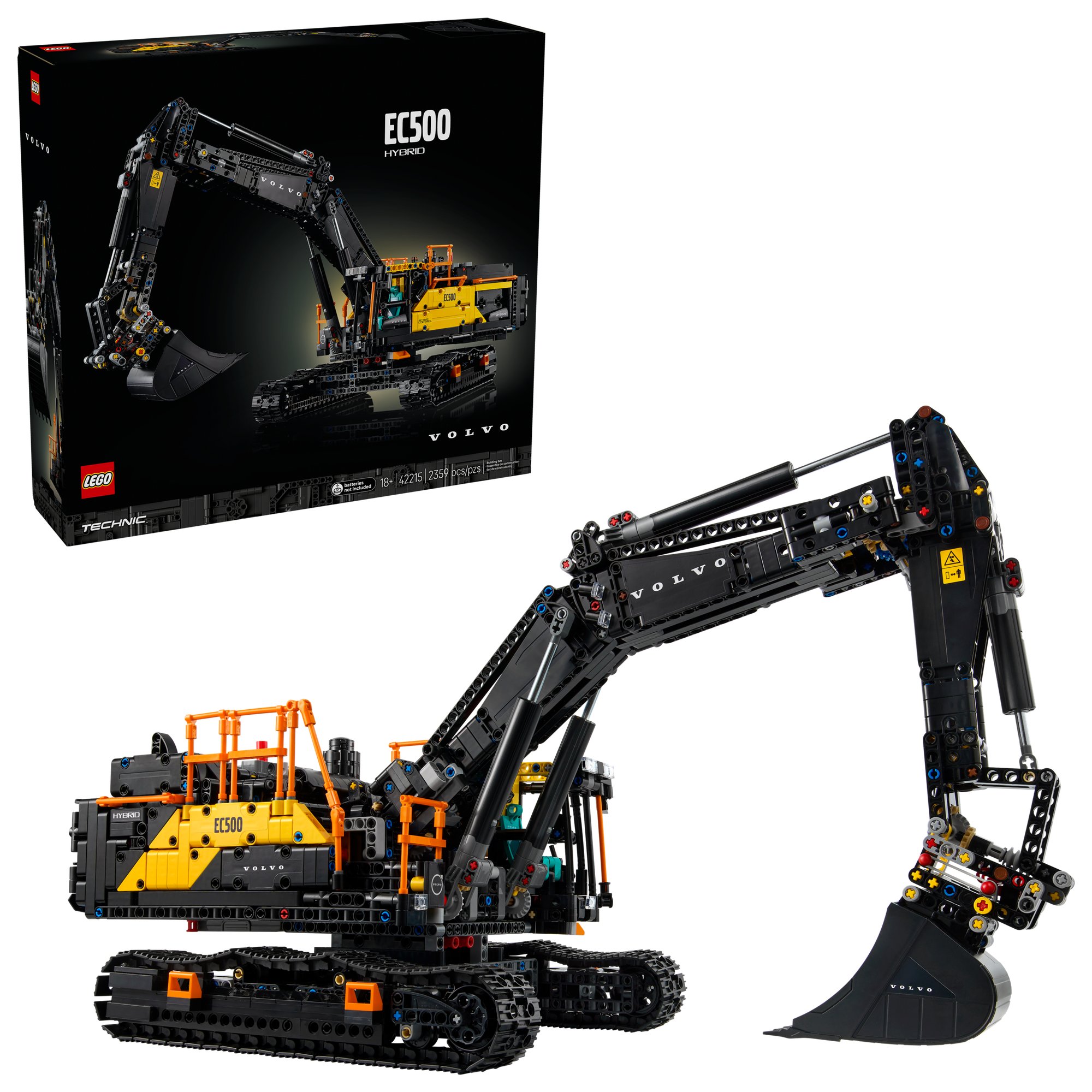
One motor, one gearbox, four outputs. A red lever on top of the body picks which function the motor is talking to, and the drive runs through a wall of gears, up the boom on three shafts, and out to four linear actuators standing in for hydraulic rams. One output does something no other Technic plant model has done: it locks and releases the tool on the end of the arm under power, so the lock holding the bucket or jackhammer is worked from the gearbox, not by hand.
It is also the set every reviewer called overpriced. At £349.99 for 2,359 pieces and one motor, Huw at Brickset called the price ridiculous. That argument goes away when the kit arrives in a box and leaves in the same box. Nobody has sent a diary back on it yet, so what follows comes from the Brickset, Brothers Brick and New Elementary reviews and the Brickset data.

Why this one is worth an evening or three
The real EC500 works in quarries and mines, and the hybrid version carries no batteries or electric motors: it uses the energy of the boom dropping to supercharge the engine. LEGO’s model is the eighth Volvo in Technic, launched on 1 August 2025, two months after the smaller L120 wheel loader (42209). It is the 18th biggest Technic set by part count and, at launch, the seventh most expensive.
What you are borrowing is the gearbox. Huw describes it as built between two stacks of beams, complex and compact, taking the motor to one of four output axles in either direction. New Elementary’s tobymac put it plainly: so many gears crammed into a tight space, going in all directions, and that is why he loves Technic. All three reviewers liked the build. The complaints are about what happens after it is finished.
Those complaints are real. The tracks are not driven, the body turns by hand, the motor is noisy, and the actuators are slow: The Brothers Brick clocked roughly four minutes to raise and lower the boom and arm. For a member that changes the question. You are not buying a toy for years. You are building a gearbox for three evenings and posing a 54 cm excavator until the return label calls.
What it actually does
One Powered Up motor and one battery hub, nothing else electrical. Huw calls the motor a medium motor and New Elementary an L motor, so take the label loosely. Everything below the selector is a mechanical path you built yourself, and the tracks and turntable are worked by hand.
The red lever moves left or right into one of four positions, then up or down for direction. Reading the labels left to right: tilt the arm, curl the bucket, lock or release the tool, raise or lower the main boom. Only one function is live at a time because the selector sits on a single long axle, and that axle is why it can be stubborn: New Elementary found it tends to jam and needs a fine touch to seat.
Behind the lever is the reason to build the set. The gearbox sits at the back between two stacks of beams: a bank of clutch gears on top, a second row below to slip if something jams, then a group of ratio gears so each function runs at a sensible speed.
Two long linear actuators raise the boom, sitting exactly where the hydraulic cylinders are on the real machine. A run of gears drives both at the same rate. New Elementary spotted a wrinkle: the drive passes through two 28-tooth bevel gears placed as mirror images, so as the boom rises one actuator wants to extend a fraction and the other to retract, twisting the boom slightly. The effect is small but it adds stress. Like every function it is slow, because the actuators take many turns to travel; Huw timed 40 seconds for the actuator that bends the boom to go from one end to the other.
Three drivetrains run up through the boom. Two sit higher than the pivot, so as the boom rises those shafts have to get shorter. The set uses the 3L CV ball joints for that, a friction-free shaft that lets an axle slide in and out, and New Elementary thinks this is the first set to use the trick. Universal joints and long axles carry the drive to the third large actuator, which folds the arm, and a fourth, small actuator curls the bucket. At full stretch the bucket could go below ground level if the model were not on a flat table.
At the tip of the arm a rubber band holds a pinching assembly that grips either the bucket or the jackhammer, and the third gearbox position drives a lock that holds it there. Huw calls interchangeable tools unique among Technic plant models and the motorised lock impressive, though he suspects lining the bucket up without a hand of God would be extremely difficult. The Brothers Brick was less taken: the lock is the easiest mechanism to push past its limit into grinding.
The hammer itself is not on the motor. Twist a gear on its side and an elastic band and ratchet inside thump it down. The stroke is tiny and quick, and The Brothers Brick and New Elementary would both rather it ran off the gearbox, but it does something.
A door on the side swings open to a lever on the hub’s switch; flip it left and the motor starts. The hub comes out for new batteries by taking off the removable panel on the back. Clutches sit inline to save the motor at the stops, but every reviewer says it strains audibly before they slip. The tracks freewheel, the top spins a full circle on a big turntable gear by hand, and the cab door opens. That is the list.
How the build goes
Sixteen numbered paper bags, one unnumbered polybag of long beams, frames and actuators, and two instruction books in a card sleeve. The covers suggest one book per configuration; in fact the build is simply split in half. None of the reviews maps bags to stages or gives a time, so the order below follows The Brothers Brick’s account and the eight to ten hours is our estimate.
Undercarriage and tracks
The base, then two track frames each wrapped in 45 tread links, a slightly softer, less shiny material than older Technic treads. A giant turntable gear sits in the middle so the body can swing a full circle. The tracks connect to nothing, so this stage is quick.
The gear wall and the gearbox
The heart of the set. A wall of beams goes up in the middle of the body, deliberately multicoloured so you can see where each gear goes, and gears hang on both faces. At the back you build the gearbox itself: the clutch bank, the slip clutches under it, then the ratio gears behind. Two of the long actuators go on now as the foot of the boom. Take this in one sitting if you can.
Selector, motor check, and the lower boom
A topper goes on with the red selector and its labels, and the motor and hub are connected. Here the instructions tell you to run a motor check to confirm every gear is in the right place. Do it; everything after this buries the gearbox. Then the lower boom with its universal joints, long axles and the third actuator, on a small assembly of turntables and CV joints that carries the weight and passes the drive up.
Bodywork, cab and railings
The new 3 by 3 triangular panels, six yellow and six black, give the livery its shape. The cab goes in with a turquoise seat and a door, and a second door covers the switch. Orange bars, rigid hose and connectors become the roof railings, and the rear panel closes over the wiring. This is the fast, satisfying part.
Arm, coupler and tools
The final actuator goes into the arm with the linkage that carries drive end to end, then the coupler with its rubber band and lock. Last come the bucket, a new mould big enough to cradle the old 4 by 7 bucket, and the jackhammer. Test the lock gently the first time.
No member diary exists for this one yet, so these come from the three reviews. Most of them are about the selector and the stops.
- The selector jams. It sits on a long axle and New Elementary found it tends to jam easily and needs some fiddling to seat. Do not force the lever; back off and try again. The middle two labels also sit slightly off centre under it, so read the icons rather than the alignment.
- Run the motor check when the book says so. After the gearbox section the instructions have you power up and confirm every gear is in place. Skip it and a wrong mesh is buried before you find out.
- Stop before the stops. The Brothers Brick says the actuators sound horrible when pushed too far, and Huw at Brickset found the motor strains before the clutches slip. Watch the function, not the lever, and flick it back as it reaches the end. The tool lock is the easiest to overrun.
- Stickers that will not lift. Both The Brothers Brick and New Elementary had sheets that were not fully die-cut. Ease each one up from a corner with a fingernail.
- The triangle panels do not join. Two of the new panels cannot be connected along their long sides, so the instructions leave them loose. That is by design, not a missed pin.
On the shelf
Brickset lists it at 29 x 54 x 24 cm, and New Elementary measured 57 cm long, 25 cm wide and 27 cm high with the boom folded. New Elementary measured 50 cm high at maximum reach and 71 cm long stretched out, and Huw had it at 60 cm long and 40 cm high in a middle pose. Allow a full shelf and some ceiling. The Brothers Brick called it an imposing heftiness that just feels right, and Huw found the orange rails make it pop. Once it is posed, switch it off: the motor is coupled to gears even at idle and makes what Huw called a terrible racket.
This is the one for you if the part you enjoy is the gearbox rather than the driving. Renting it sidesteps the one thing every reviewer could not get past, the price. Allow three evenings, put fresh batteries in before the motor check, and treat the selector and the stops with a light hand. If you want a machine that drives, slews and digs under power, look at the Liebherr R 9800 (42100) instead.
If you like this one, try
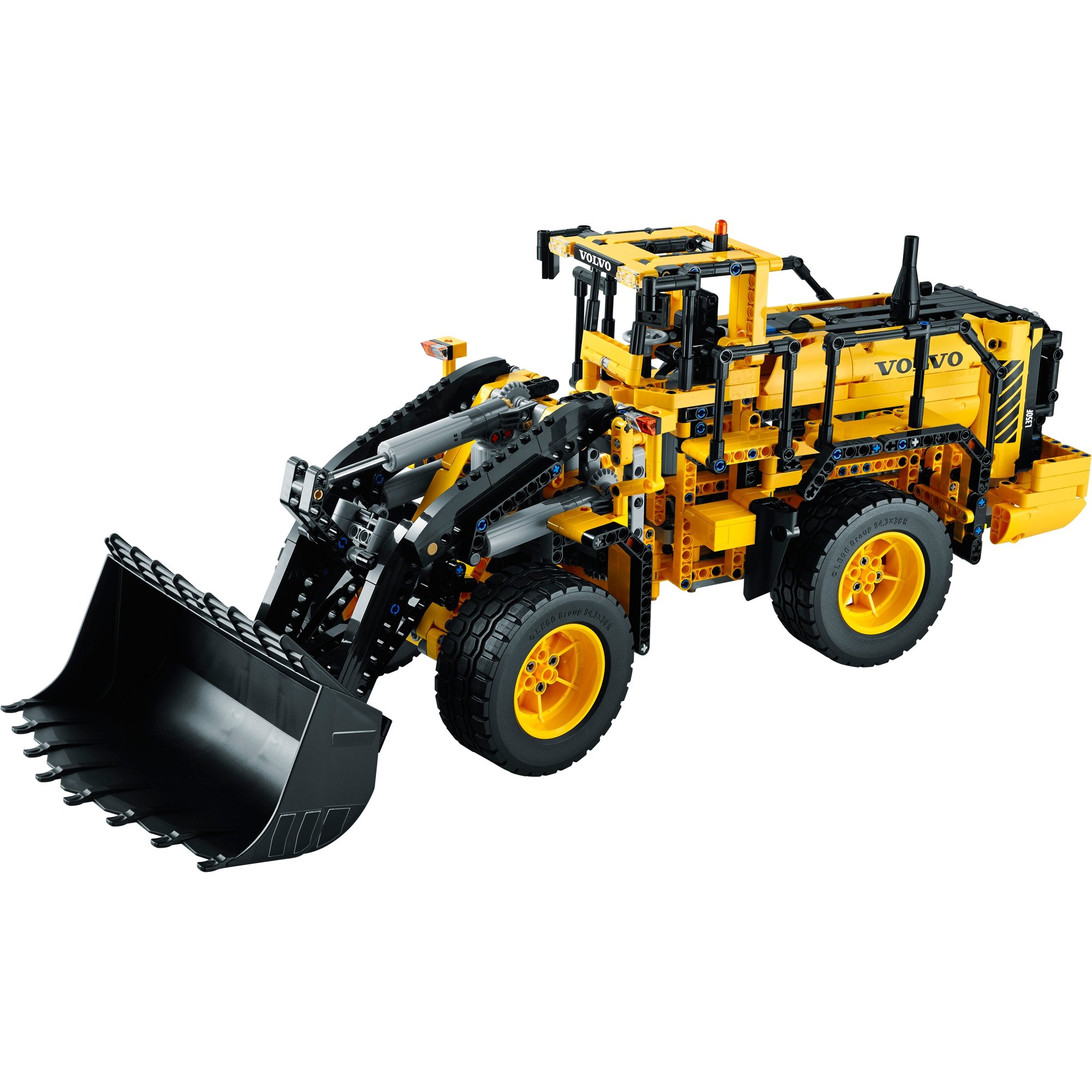
Three of these are New Elementary’s own comparisons, all on the plant shelf. The Rough Terrain Crane (42082) is the other single motor, many functions build; the Liebherr R 9800 (42100) is the opposite answer with seven motors; the L350F (42030) was the first Volvo in Technic.



The Volvo EC500 Hybrid Excavator is in the library
Technic Fan gets up to 6 kits a year, Master Builder up to 12. Delivery both ways is included and the prepaid return label is in the box.