
You cannot order a kit here, so this is not a list to shop from. It is a way of working out whether the box that just arrived is one you can share with a child, and how to split it up if it is.
The short version: the best Technic set to build with a child is rarely the smallest one. It is the one with visible progress, mechanisms you can test as you go, and instructions that break into sessions of about an hour.
How to tell in the first ten minutes
Open the instructions and look at three things before either of you touches a brick.
Does the model do something recognisable when it is finished. A crane that lifts, a bucket that digs, wheels that steer. Abstract chassis work loses a nine-year-old fast, and a gearbox that only reveals itself at the very end is a hard sell.
Are there testable moments along the way. If the steering connects at step 40 and you can waggle it, that is forty steps with a reward at the end. If nothing moves until step 300, that is a long time to ask somebody to keep faith.
Does it divide into numbered bags of sensible size. This is the one people overlook. A set that splits into six clear sections gives you six natural stopping points and six small victories.
The age on the box is a starting point, not a promise. Familiarity with Technic pins matters more than the number, and so does patience on the day.


The Heavy-Duty Excavator is the one I would hand to a younger builder first. 569 pieces, so it finishes inside a weekend, and the arm, bucket and 360 degree rotation all work. Small enough that a child can hold the whole finished machine.
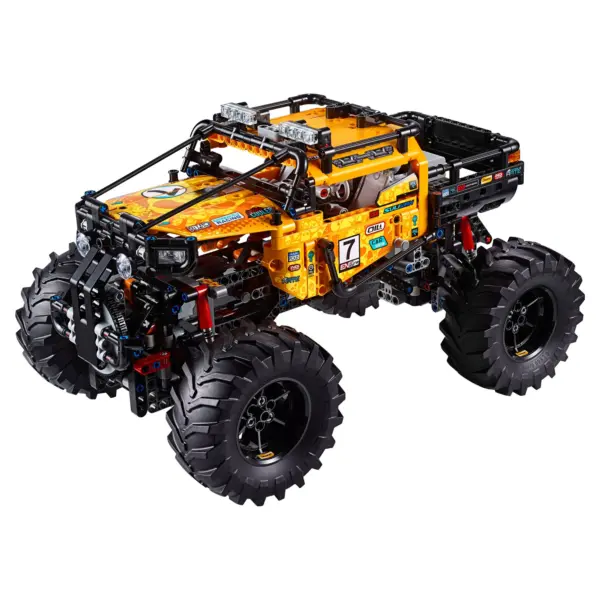
The 4×4 X-treme Off-Roader is the one that buys you the most goodwill, because when you finish it you drive it around the house from a phone. Real four-wheel drive, proper suspension and a working gearbox underneath, so it is a serious build with a toy at the end of it. 958 pieces.
The Dodge Charger is the longer one, 1,077 pieces and marked 10+. The V8 pistons move, the suspension works, and the subject carries a lot of motivation with a certain sort of child. Save it for somebody who has already finished a Technic set and wants a bigger one.
How to help without taking over
Sort only the parts for the current numbered bag, not the whole box. A table covered in six hundred pieces is intimidating and it makes a lost pin impossible to find.
If a step needs several black pins, count them out together before building. It sounds fussy and it saves an enormous amount of unpicking.
When something will not line up, do not reach in and fix it. Ask them to compare the model with the picture from two angles first. Nine times out of ten they find it, and the tenth time you have still taught them how to look.
Give the younger builder ownership of a function, not just a bag. Steering is the best one, because every axle and connector has a visible result they can test themselves.
The adult’s job is sorting, reading one step ahead, and asking for a function check before the next section starts. The child’s job is as much of the actual building as possible.
If something binds, go back to the last point where it moved freely and compare the two sides together. That turns a missed pin into part of the build rather than the moment the adult took over.
Stop after a complete module. Put the loose parts back in their trays and start next time with a quick function check. A child remembers finishing a working machine, not the number printed on the box.
What to do if the box that arrived is too big
Sometimes a 3,500-piece flagship lands and there is a nine-year-old in the house who wants in. That is fine, it just needs a different job.
Give them the sub-assemblies. Flagship instructions are full of small self-contained modules, a suspension corner, a wheel hub, a section of engine, that take fifteen minutes and produce something that visibly works. Hand those over and keep the long structural runs for yourself.
What does not work is asking a child to sit through two hours of chassis. That is how a shared build quietly becomes the adult’s project with somebody watching.
If you have built one of these with a child, I would like to see it. The Facebook group or garreth@brickclub.uk, either is fine.
Six or twelve kits a year, and you never know which
Every box is a Technic set worth over 100 pounds, chosen at random, and you never get the same kit twice. Postage both ways, a pre-paid return label, a brick separator and the official instructions come with all of them.
Browse subscriptions See what is in the library