
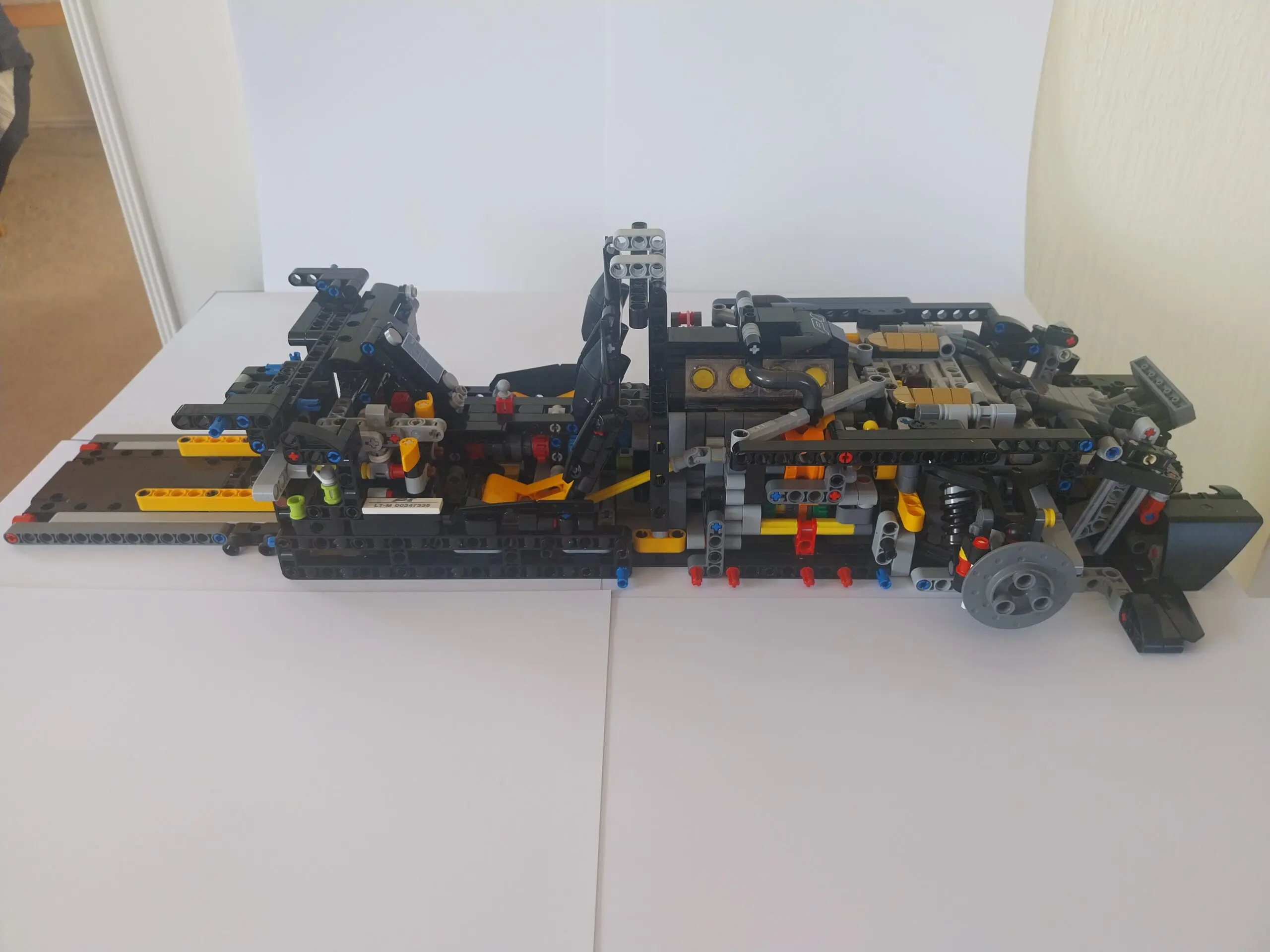
Every so often a box turns up that is a genuine commitment. Not a Sunday afternoon, not a couple of evenings, but a fortnight of a table being out of action and a lot of small grey pieces you will not recognise.
You do not get to choose when one of these arrives, so knowing which ones they are and what each wants from you is half the battle. These are the six biggest in the library by piece count, and there is a seventh at the bottom that beats all of them on sheer size.



The machines ask for time. The cars ask for care.
Split the six in half and the difference is obvious. Three of them are working machines and three are 1:8 road cars, and they are not the same kind of fortnight at all.
The Liebherr R 9800 is the biggest thing in the library at 4,108 pieces and eight Power Functions motors. Expect twenty hours plus. The boom, the dipper, the bucket and the walking pontoons all work, and the finished machine is heavy enough that you will want to think about where it lives before you start rather than after.
The Rough Terrain Crane is 4,056 pieces and about twelve hours, and it is the one I would call the most demanding build of the six. An eight-speed gearbox, four outriggers that extend, a slewing superstructure and a telescopic boom, all crammed into a chassis where everything competes for the same space. Get one gear selector seated wrong and you will feel it in three different functions.
The Cat D11 is the app-controlled one, 3,854 pieces, with motors running the tracks, the blade and the ripper. Less fiddly than the crane and more satisfying at the end, because you drive it around the floor rather than admiring it on a shelf.
Clear more table than you think you need, then clear some more. On all six of these the sub-assemblies get large before they get joined, and you will have three separate half-finished sections sitting about at the same time.
Do not start a big one the night before something else needs the space. Half a Liebherr in a carrier bag is a bad way to spend a fortnight.
Keep the numbered bags separate and only open the one you are on. This matters far more at 4,000 pieces than it does at 800.
The three cars
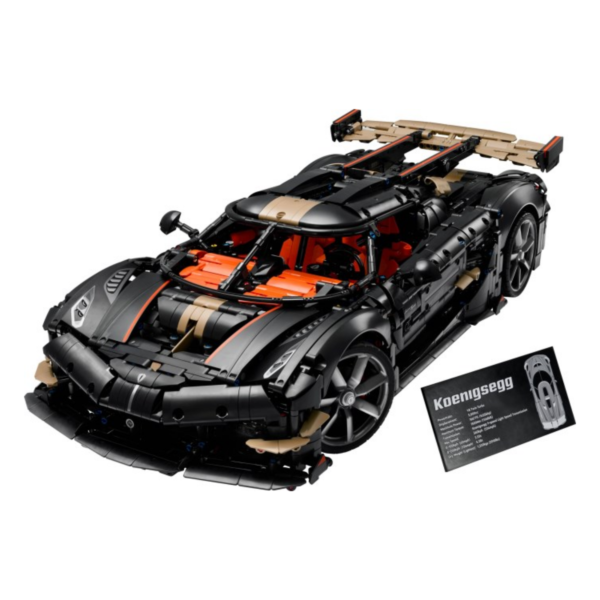
The Koenigsegg Sadair’s Spear is the newest and, at 4,104 pieces, the biggest car we have. Nine-speed gearbox, V8, and that black and gold finish over an exposed orange engine bay. It is the one people have asked about most, and it is now in the library.
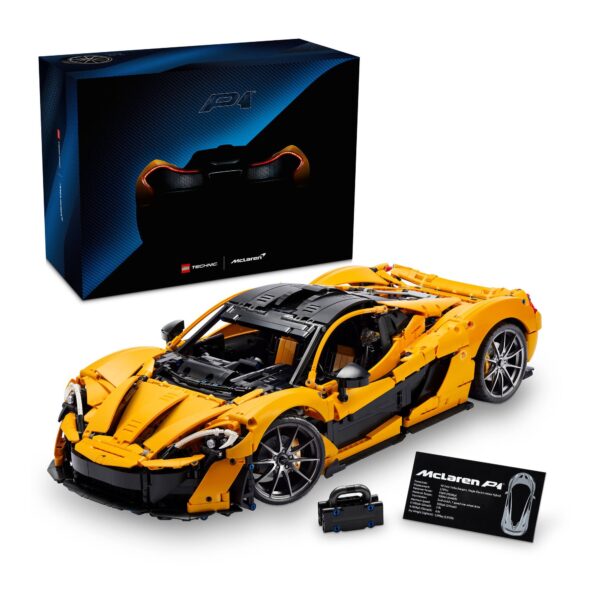
The McLaren P1 at 3,893 pieces is the most modern design of the three and it shows in the assembly order. Seven-speed gearbox off a shifter drum, dihedral doors that are a proper linkage, and a chassis that makes more sense as you build it than the older cars do.
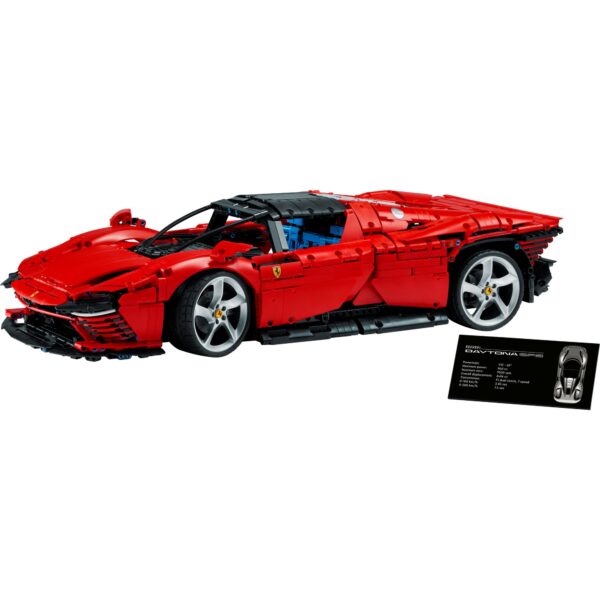
The Ferrari Daytona SP3 is 3,778 pieces and the slowest starter. The red does not arrive until late, so the first two evenings are grey skeleton work. It is also the set that comes back with more finished photographs than anything else in the library, so it clearly pays off.
The pattern across all three: the gearbox goes in early and is buried by the end. Change through every gear and turn the engine over before the bodywork closes, on all of them, every time. That five minutes is the difference between a working model and an evening of unpicking.
The one that beats them all on size
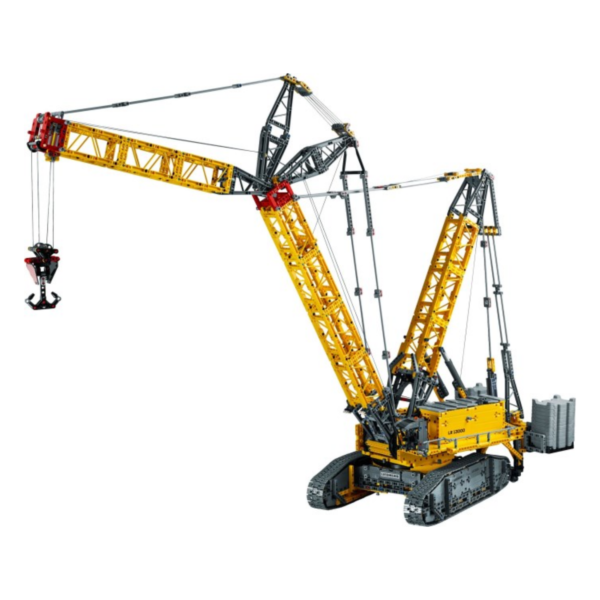
Piece count is a poor guide to how much room something takes up, and the Liebherr Crawler Crane LR 13000 proves it. At 2,883 pieces it does not make the six above, but built it is by some distance the largest thing in the library. The lattice boom alone goes over a metre.
It is also a completely different sort of build. Lattice work is repetitive in a way the cars are not, so it goes quickly once you find the rhythm, and then you look up and there is a crane the size of a coffee table in the front room. Four motors handle the tracks, the slew, the main winch and the luffing jib.
Piece counts come from LEGO’s own pages. Build times are mine, from the bench, so treat them as a guide rather than a promise.
If one of these has landed on you and taken over the dining room, I would like the photograph. The Brick Club Facebook group, or hello@brickclub.uk.
Up to six or twelve kits a year, and you never know which
Every box is a Technic set worth over 100 pounds, chosen at random, and you never get the same kit twice. Postage both ways, a pre-paid return label, a brick separator and the official instructions come with all of them.
Browse subscriptions See what is in the library