

2022 Ford GT (42154): a Technic supercar in one evening
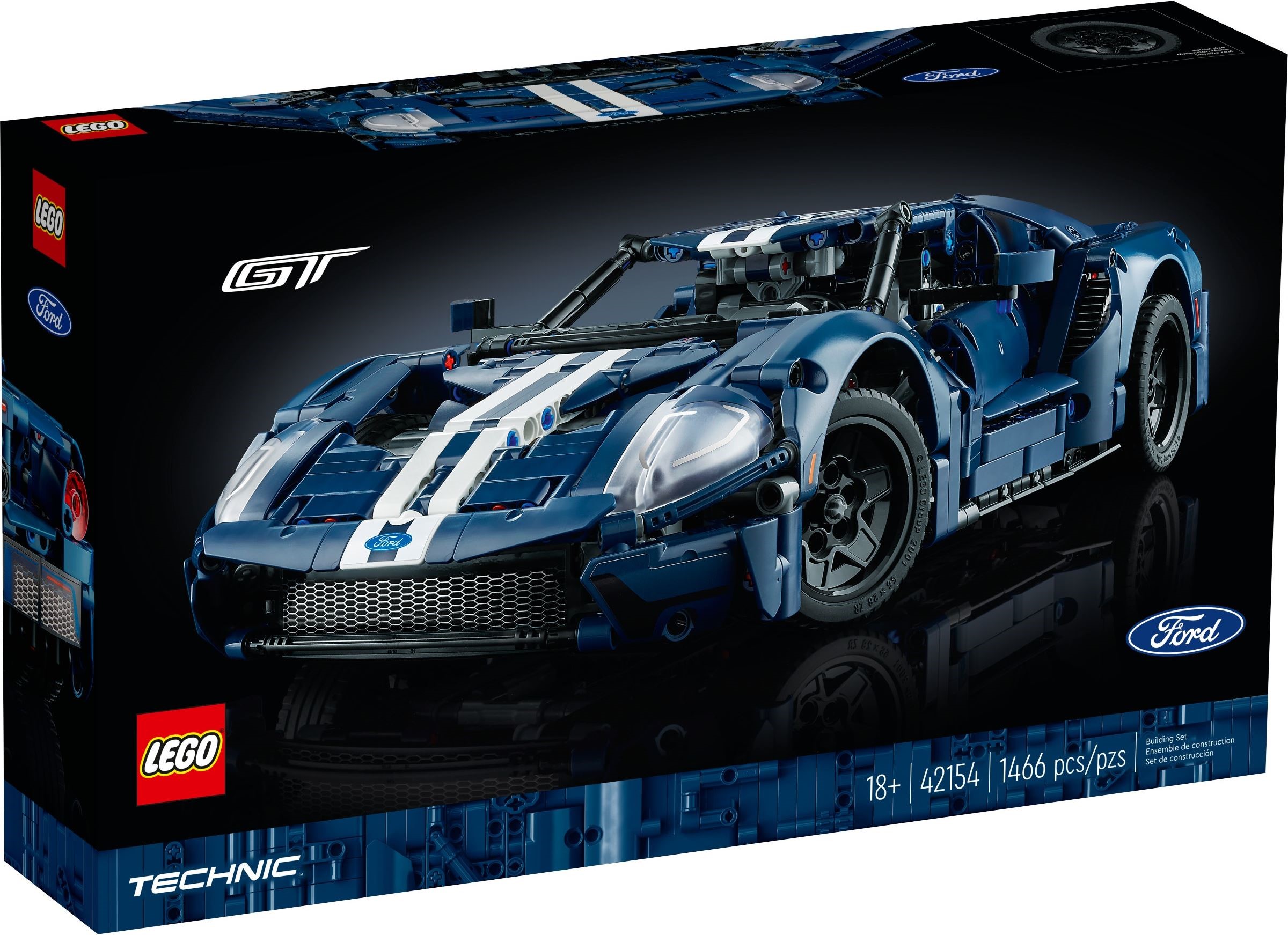
This is the supercar for people who do not have a weekend. It is 1:12 scale rather than 1:8, 1,466 pieces rather than three and a half thousand, and Huw at Brickset put the build at around three hours. For that you get a dark blue car with white stripes, a V6 you can watch working through the rear window, butterfly doors, suspension on all four corners and a rear wing raised from a lever between the seats. It was the third of LEGO’s mid-size licensed cars, after the Porsche 911 RSR (42096) and the Ferrari 488 GTE (42125), and Huw called it the best Technic set Brickset had reviewed so far that year.
It is in the Brick Club library. Below is what it does, how the five bags run, and where it is worth slowing down. One member has sent in a proper set of photos, including the car turned upside down, and they are further down the page.

Why this one matters
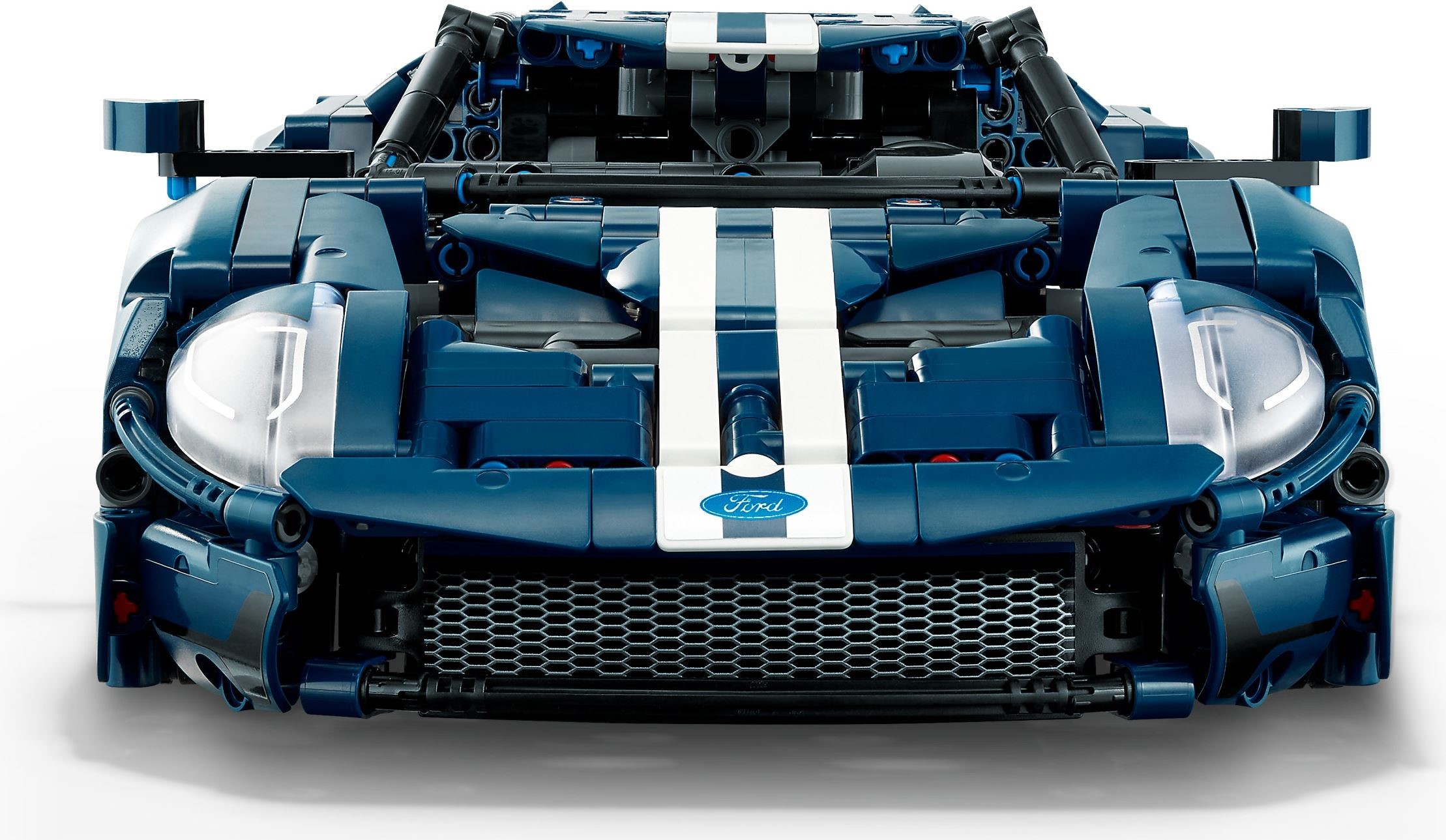
The colour is the first thing. Dark blue is rare in Technic, and Huw’s review says the majority of the pieces in that colour were produced specifically for this set. Some of the panels doing the shaping are new too: a pair of frosted transparent round-corner panels printed with the headlight detail, which New Elementary called the most significant new moulds of the wave, and front wheel arches the Brothers Brick review says were designed with this set in mind. Two parallelogram panels, first seen on the Ferrari Daytona SP3 the year before, form the flying buttresses above and inboard of each rear wheel.
The second thing is the price. It launched at £104.99 against £169.99 for the Porsche and the Ferrari, which have a similar piece count, and Huw called it the best Technic set Brickset had reviewed so far that year. The designer was Milan Reindl. Finished, it is 39 cm long and smaller than the Porsche and Ferrari, which are around 1:10.
One thing to clear up before the mechanisms: there is no gearbox in this car, whatever you may have read elsewhere. New Elementary is explicit that there is no transmission and the engine is connected directly to the rear axle, and at this size that is no loss. Everything that moves is easy to see.
What it actually does
Everything is worked by hand. No motors, no gearbox and no paddles. Three reviews describe this car in detail and one of them built it in order; what follows comes from them, not the box copy.
There is a gear on top of the roof, between the stripes, and turning it steers the front wheels. The steering wheel in the cabin turns, but the Brothers Brick review is plain that it is not connected to anything, and Huw says the same. The lock is modest rather than poor: the reviewer’s words were that the radius is not phenomenal but definitely not garbage.
Roll the car and the rear wheels turn the differential, and the differential turns the V6 behind the seats. There is nothing in between. The cylinders are transparent, a habit Technic dropped after the early 2000s, so you can watch the pistons without opening anything; New Elementary counted this as one of only three sets since 2021 to bring them back. You can see the whole engine through the rear window, which the Brothers Brick review notes you cannot do on the real car.
Each wheel moves on its own once the springs are on. The rear is built first, around the differential, and it carries the one new mechanical part in the set: a 5-stud axle with a CV joint moulded on each end, visible through the light grey rear suspension arms. New Elementary says it saves space, allows the full suspension travel, and makes the rear axle bundle less likely to fall apart in your hands while you build it. The front is built differently to make room for the steering, and Huw found the finished chassis very rigid, with little flex when you twist the bodywork.
Push the red lever in the centre console back and the rear spoiler rises. A long red axle runs from the lever to the lifting mechanism at the back, hidden by the rear bumper. A glow-in-the-dark bar helps hold the lever assembly together; the Brothers Brick reviewer was not sure why LEGO chose that colour. The lever is inside the cabin and a little awkward to reach; the reviewer preferred that to having it stick out of the bodywork.
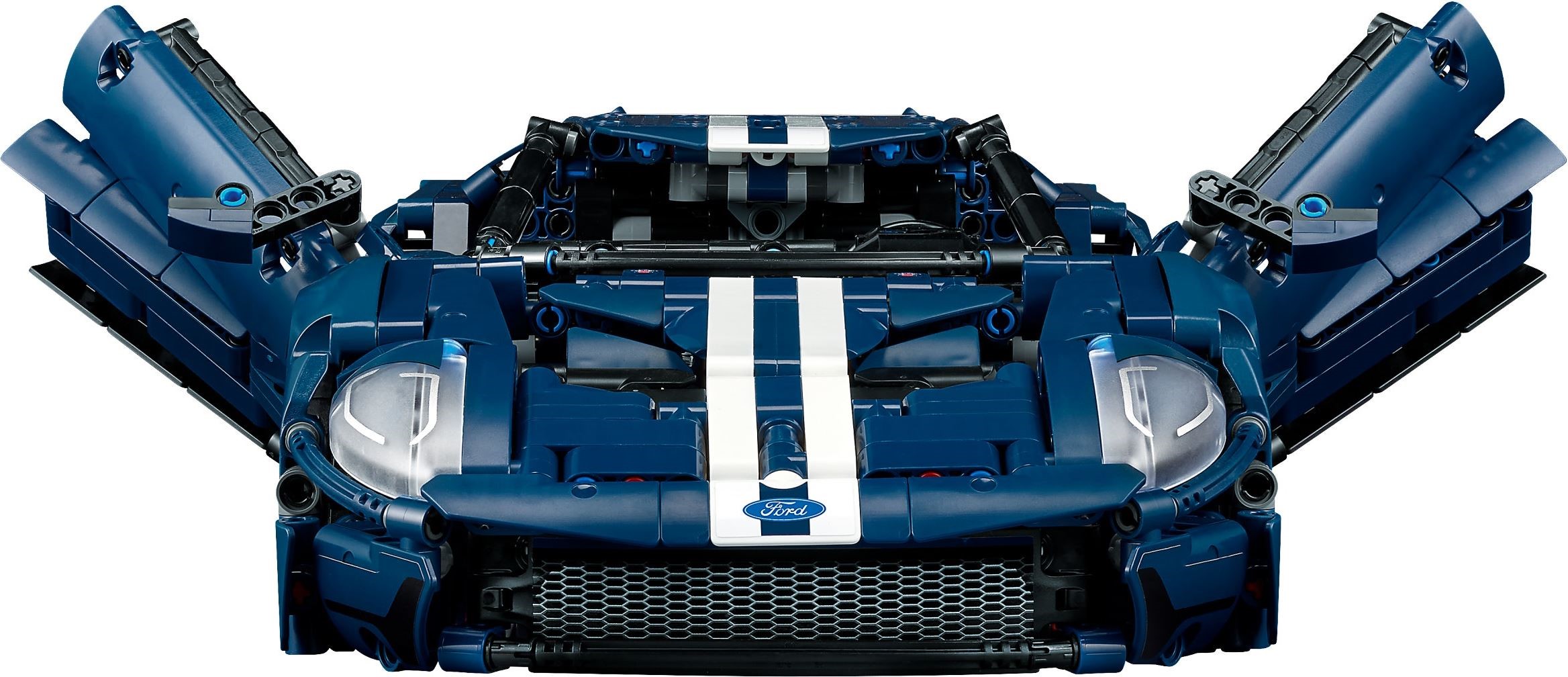
The doors swing out and up on a ball-joint linkage connected to pivoting L-shaped beams, and the door shells are built at odd offset angles so they look right from outside. Open, they stay open. Closed, the Brothers Brick reviewer found them a little loose, Huw found his aligned perfectly with the bodywork, and other builders reported doors that stick. Expect some variation, and check the linkage before you decide anything is wrong.
Both ends open. There is not a great deal to see under the bonnet; the Brothers Brick review calls the front a little lacklustre. The rear cover lifts over the V6, though the same reviewer found you can see nearly all of it through the rear window without opening anything.
How the build goes
Eleven bags numbered 1 to 5, one unnumbered bag and four loose tyres. The Brothers Brick built it in order and Huw put the total at around three hours; members have reported anything from two to five.
Rear differential and the V6
The back differential comes first, with the new double CV axle, then the V6 block is built and joined to it, and a little structure goes on for later attachment points. Before the springs go on the rear wheels move together; that is normal. Roll the rear axle by hand and watch the pistons, because it is the last time the engine will be this easy to get at.
Frame, front suspension and the join
The large bottom frame and the framework for the rear spoiler go on, then the front suspension. The new 3-long connector with two pins turns up here and promptly disappears into the front end. Then the two halves are joined in the middle by a single axle and a central pin, and the seats and bodywork stiffen that later. Huw’s note is that once bag 2 is used up the chassis and mechanisms are complete, so test the steering, the suspension and the engine now.
Seats, dashboard and the spoiler lever
A pair of bucket seats fills the gap between the halves, then the dashboard with its branded steering wheel, which turns but drives nothing. The red lever goes into the centre console and its axle runs back to the spoiler. Huw found little detail inside, and the mostly black seats vanish against the black around them.
Rear bodywork, roof and panels
The tail is a series of small curved panels, the smallest of them new that year, and their orientation looks wrong on the bench until they are on the car. Some are shorter than the rest to clear the spoiler lift, and a printed round GT tile sits under the spoiler, one of only a few printed parts in the set. Then the roof, the body panels, many of them new or rare in dark blue, and the wheel arches, different shapes front and rear to follow the car’s hips.
Headlights, nose, doors and wheels
The frosted headlight panels go in, with small medium blue brackets letting wedge slopes fill the gap to the body, then the grille and the bonnet. The butterfly doors come almost last: build them as drawn, at their odd angles, and seat the ball joints before moving on. Wheels on, and it is done.
Between the three reviews and the member photos, these are the points to slow down for.
- The roof stripe sticker. Huw says it is the only sticker that has to be placed exactly, because it continues the white stripes across a dark blue beam, and his is about half a millimetre out. On a library copy the stickers are already on; if that one is off, tell me rather than lifting it.
- The white stripes generally. They are a mix of white parts and stickers, so the parts have to line up with the stickered panels around them. Look along the car from the front before the last panels go on.
- The doors. Loose when closed for one reviewer, sticking for other builders, perfect for a third. If a door will not sit flush, check the ball-joint linkage before you blame the panels.
- The join between the halves. A single axle and a central pin. Support the chassis with both hands until the seats and the body tie it together.
- The spoiler lever. Inside the cabin and a bit awkward to reach. Go in through an open door rather than forcing it from above.
On the shelf
It is 39 cm long, 18 cm wide and 9 cm high, roughly 1:12, and Huw calls it the perfect size for a shelf or a desk. The visible red axles and bright blue pins stand out against the dark blue; his view is that they are inherent in the system and not worth worrying about. Being a road car it carries fewer stickers than the Porsche and the Ferrari, and the chassis is rigid, so it will not sag.
Display it with the spoiler up. The V6 shows through the rear window whether the cover is open or not, and the transparent cylinders catch the light.
A member who has built it
One member’s Ford GT has come back with the useful kind of photos: the engine through the rear window, the roof gear, and the car turned over so you can see the red axle. The diary is linked under each picture.


It is the one for you if you want a supercar you can finish in one long evening, if you are new to Technic cars and want the working parts without a gearbox, or if you want something short between two big kits. Test the steering and the engine at the end of bag 2, look along the stripes before the last panels go on, and do not force the doors.
If you like this one, try
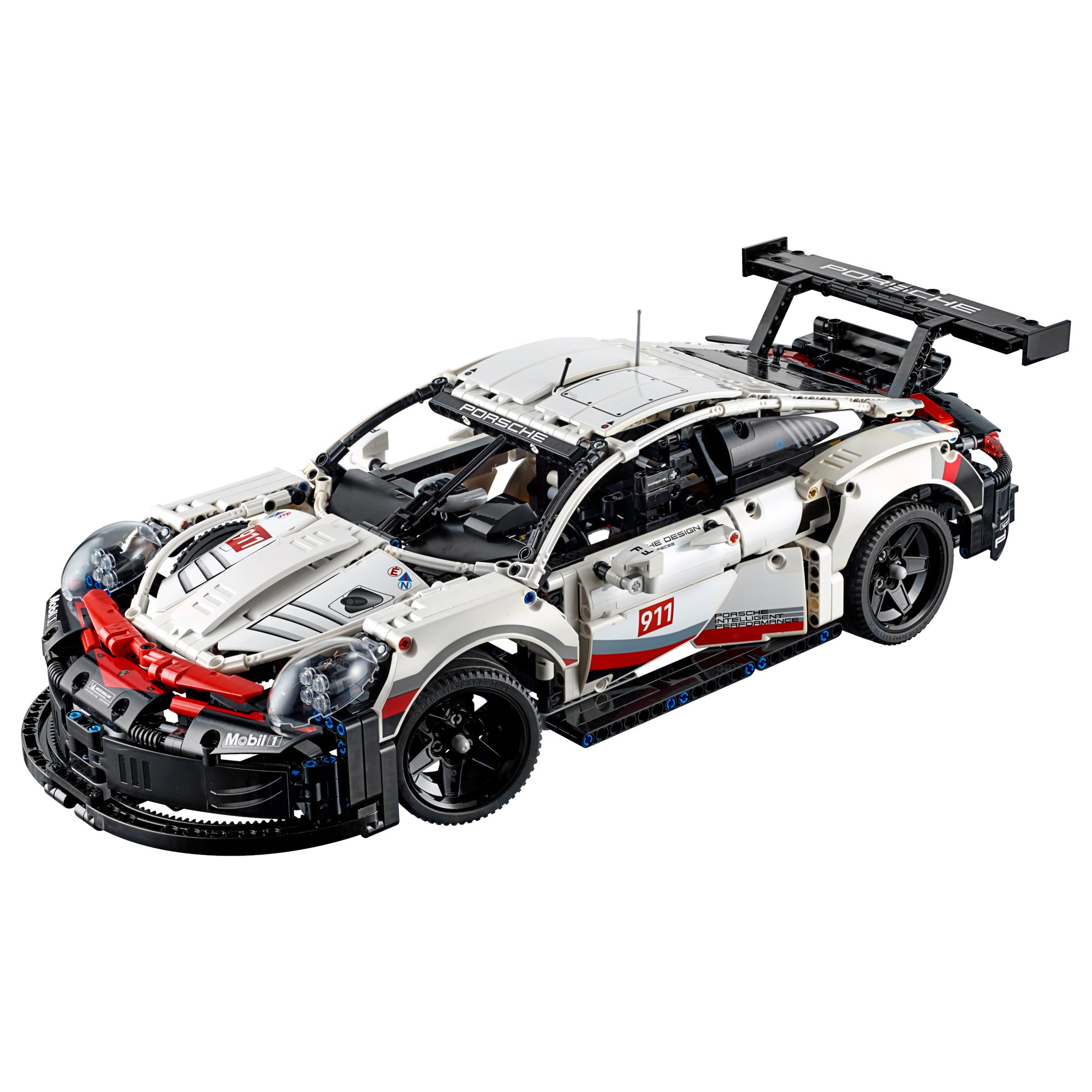
The other mid-size and race cars in the library. The Porsche and the Ferrari are the two that came before this one in the same range; the Peugeot and the GT4 came after.


The 2022 Ford GT is in the library
Technic Fan gets up to 6 kits a year, Master Builder up to 12. Delivery both ways is included and the prepaid return label is in the box.