

Air Race Jet (42066): the Technic jet with a lift fan
Most Technic aircraft give you an undercarriage and something that spins. This one has a lift fan behind the cockpit under a pair of doors, and a nozzle at the tail, and it changes from level flight to hover: the doors above the fan open and the nozzle turns to point at the floor. Siegfried, who built it for Eurobricks in March 2017, said a VTOL change like this had not been done in Technic before, and captioned his last photo The other F-35. It came out in Technic’s 40th anniversary year with the anniversary part in view from the front, and it has a Power Functions motor and battery box inside a fuselage he called relatively narrow.
It is in the Brick Club library and one member has built it. There is only one proper build account on file, so where the copy below leans on LEGO’s own pictures or on Brickset rather than on someone who had the model in their hands, it says so.

Why this one matters
2017 was Technic’s fortieth year and this set carried the anniversary badge: Brickset tags it as an anniversary set, and Siegfried found no unique new parts beyond the double cross connector and the anniversary part, everything else being recolours. On sale from January 2017 to the end of July 2018 at £109.99 for 1,151 pieces, 9.6p a piece by Brickset’s sums. Siegfried’s view of the price was that LEGO uses a motor in the box as an excuse to charge more, and he marked it eight out of ten anyway.
He called it the first set of that year with substantial hidden mechanics, which is why his is the review with build photos. Functions, seven out of ten: the VTOL change was new, it all fits in a narrow fuselage, and he would have liked more, ailerons for instance. Accuracy, seven: the lift fan very close to the real thing, the wings stupidly small. He was not sure why a VTOL aircraft is racing at all and decided to accept it. Overall eight, and a very nice looking aeroplane even for people who do not care about the mechanics.
JANG’s write-up is four sentences because the review is a video, but they are useful sentences. The build took him much longer than the parts count suggests, every moving part seemed tied to at least three others, and most of the mechanisms cannot be tested until the panels go on near the end. Definitely not for novices. Bear that in mind when the box turns out to be thin: 58.2 by 37.8 by 8.7 cm on Brickset.
It is a 2-in-1. Siegfried looked at the second model’s instructions and did not build it: a poor man’s Air Race Jet, in his words, offering nothing special, It is a 2-in-1. Siegfried looked at the second model’s instructions and did not build it: a poor man’s Air Race Jet, in his words, offering nothing special, though it at least has a semi-believable wing size.
What it actually does
One Power Functions Medium motor, a battery box and a reversing gearbox, and then the functions. Siegfried’s captions describe what he built but not which gearbox output drives which function, so the drive paths below are short or missing. Where our own listing or member diary claims more than the reviews do, I have said so rather than repeated it.
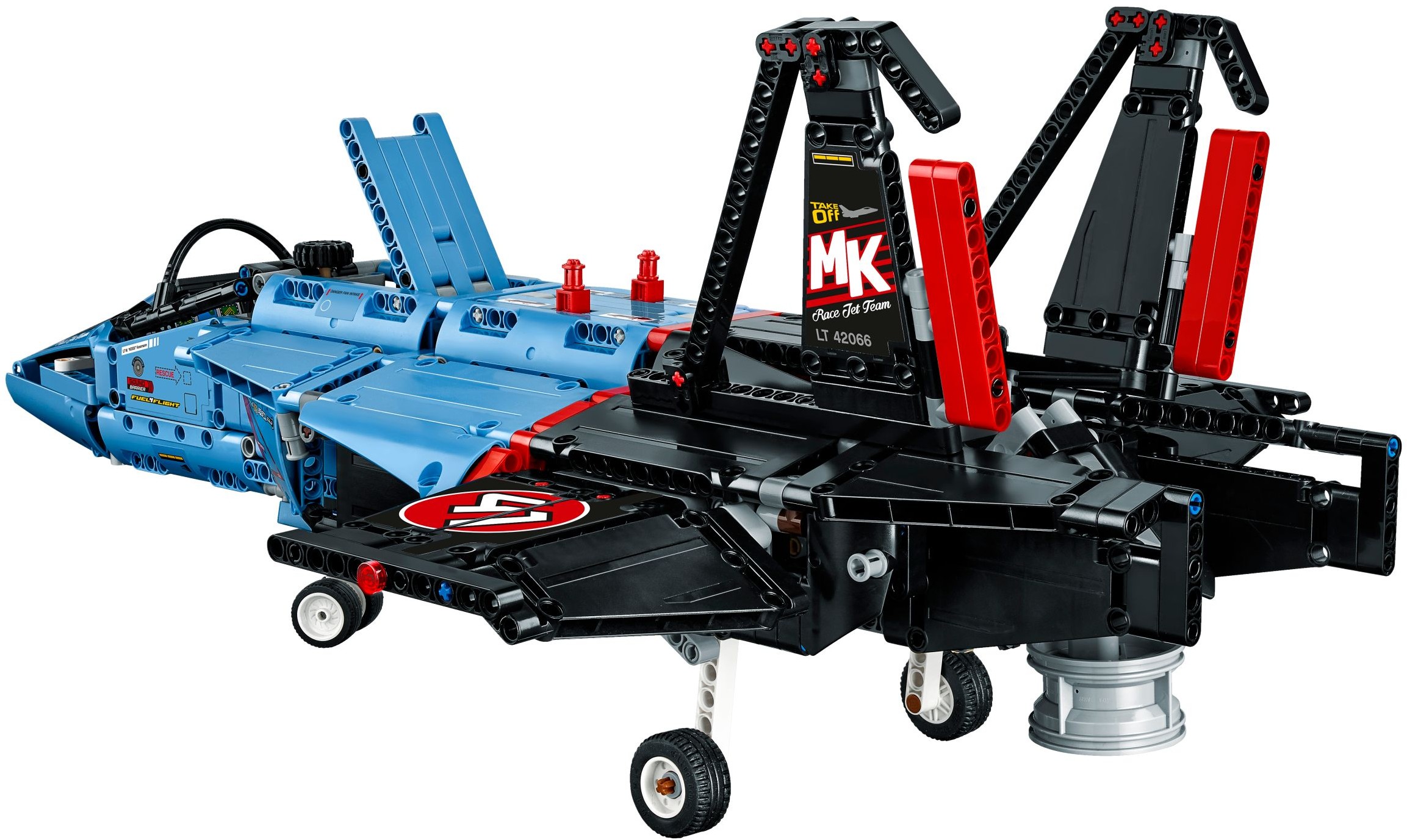
Behind the cockpit sits a lift fan under a pair of blue doors. Siegfried’s caption as the panels went on: opening the top directly opens the bottom, which reads as doors under the fan linked to the ones above, though he does not name the parts. In LEGO’s picture of the hover setting the top doors stand open and the grey nozzle at the tail points at the floor. He rated the lift fan very close to reality (the F-35, hence his caption) and said swivelling engines had been done in Technic before but a change like this had not. Nothing on file says whether the nozzle and the doors move together, so I will not guess.
A nose leg and two main legs, all on white-rimmed wheels. Siegfried photographed his half-built model standing on them and admitted they were supposed to be folded in at that point; he liked it better down, and it was stable that way for the most part. He also picked out the space found for the folded wheel as one of the better bits of parts use in the set. Our listing calls it a retractable undercarriage, and the Power Functions panel on the box shows a wheel with a curved arrow next to it, which is as close as anything on file comes to saying the motor lifts it.
The motor goes in first; Siegfried called it deeply embedded, packed round with thin beams and many different axle lengths. The gearbox comes late, into a gap he had pointed out a few photos earlier: gearbox at the top, battery box at the bottom. It is one of the reversing type that had become common by 2017. Right at the back, with what he calls the yellow beams, two worm gears go in, and then, in his words, you cannot see that now. The box lists a Medium motor and a battery box. Which output turns the nozzle and which lifts the wheels, nobody on file says.
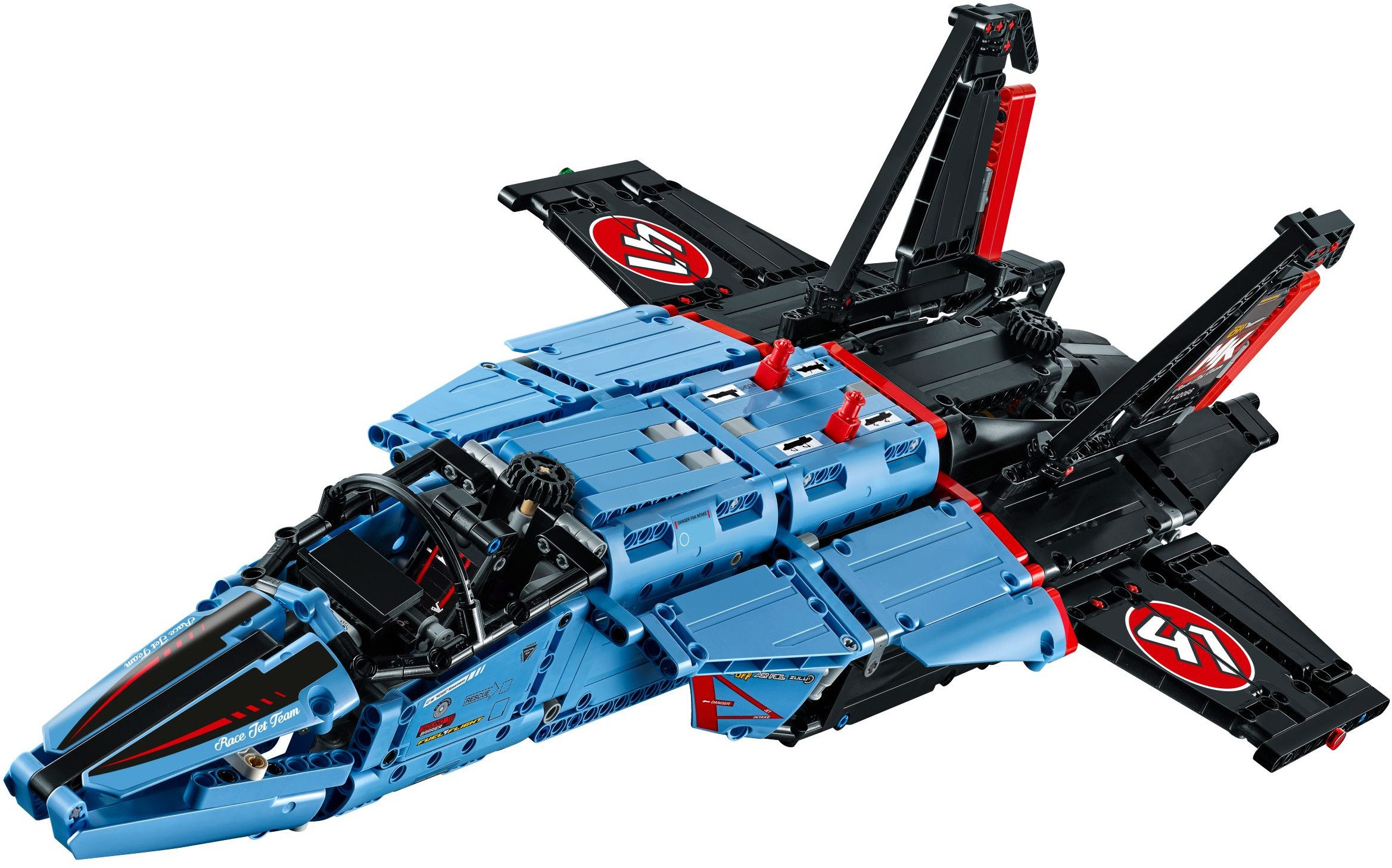
A single seat under a black tube canopy frame with no glazing, and a black knob on the spine just behind the headrest. Siegfried’s only comment on the cockpit is that it is nice, and that from the front you can see where the anniversary part is used. Our member’s nose-on photo below is the angle to look at for that. What the black knob does is not described anywhere on file.
Our listing says moving control surfaces and a working piston engine. Our member diary says working flaps and ailerons, twin turbines with spinning blades, and a hand-powered knob on top. None of that appears in either review. Siegfried, marking the functions seven out of ten, said he would have preferred more, such as ailerons, which reads as the set not having them, and there is no piston engine in a jet. Until a member checks the model in the hand, treat the fan doors, the nozzle and the undercarriage as the functions and the rest as a question.
How the build goes
No numbered bags. Siegfried was pleased it was not a punch box and that the instructions were bagged, but the parts come unsegmented, so the order below is his, from the photos he posted as he went. Nobody on file timed it; JANG says it took much longer than the count suggests, and our member called it a good afternoon.
Motor first
The very first assembly is the motor, deeply embedded, packed round with thin beams to save room and a run of different axle lengths to fill the space. Siegfried called it an excellent start. Sort the parts before you begin; he shifted the big pieces into one box and the small ones into another as he went, and with no numbered bags that is the only structure you get.
Fuselage core and undercarriage
The density carries on. This is where he suspected the set would be very easy to build wrong: plenty of steps need parts aligned and in exactly the right spot or a function will not work later. The undercarriage arrives here, and his photo shows the legs down when the book had them folded. The space found for the folded wheel is worth a look before it is covered.
Panels and the fan doors
Many of the panels are structural rather than decoration, and they use the then-new corner piece. As they go on the functions start to come together; in Siegfried’s words, opening the top directly opens the bottom. There is an obvious empty space at this point. Leave it: gearbox on top, battery box underneath.
Gearbox, worm gears, battery box
A reversing style gearbox goes into the gap, then two worm gears at the back with the yellow beams, and then the tail closes over the lot. JANG’s complaint lands here: A reversing style gearbox goes into the gap, then two worm gears at the back with the yellow beams, and then the tail closes over the lot. JANG’s complaint lands here: each moving part is tied to at least three others through chains of beams and adapters, and most of it cannot be tested until the vanity panels are going on. Run the motor before the last panels close., and most of it cannot be tested until the vanity panels are going on. Run the motor before the last panels close.
Stickers, cockpit, wings
Siegfried thought the sticker sheet less essential than most and the nose stickers not needed at all, though he granted they break up the slabs of blue. The cockpit is nice. Spares are few, so if a small part is left over at the end it probably belongs somewhere.
One member has built this one (member build, January 2026) and sent two photos. The build notes below are Siegfried’s and JANG’s.
- Alignment. Siegfried’s guess before he had finished: this set would be very easy to build wrong, because there are lots of times alignment is needed and parts must be in the right spot or things just will not work. Alignment. Siegfried’s guess before he had finished: this set would be easy to build wrong, because many steps need parts placed exactly or a function will not work later. He hedged that it might be impossible to go wrong.
- You cannot test as you go. JANG found each moving part linked to at least three others through chains of beams and adapters, and could only partly test most mechanisms until the outer panels were going on near the end. His verdict was definitely not for novices.
- No numbered bags. The set is not segmented. Sort first, big parts in one tray and small in another the way Siegfried did, and expect to hunt.
- One book, and it suffers. Only the main instruction book is included, with a cover on better stock than the pages, and Siegfried’s was a bit ratty by the end. Flat table, clean hands, and do not fold it back on itself.
- Few spares. Siegfried called the spares rather low, so a small piece that rolls off the table matters more than usual.
On the shelf
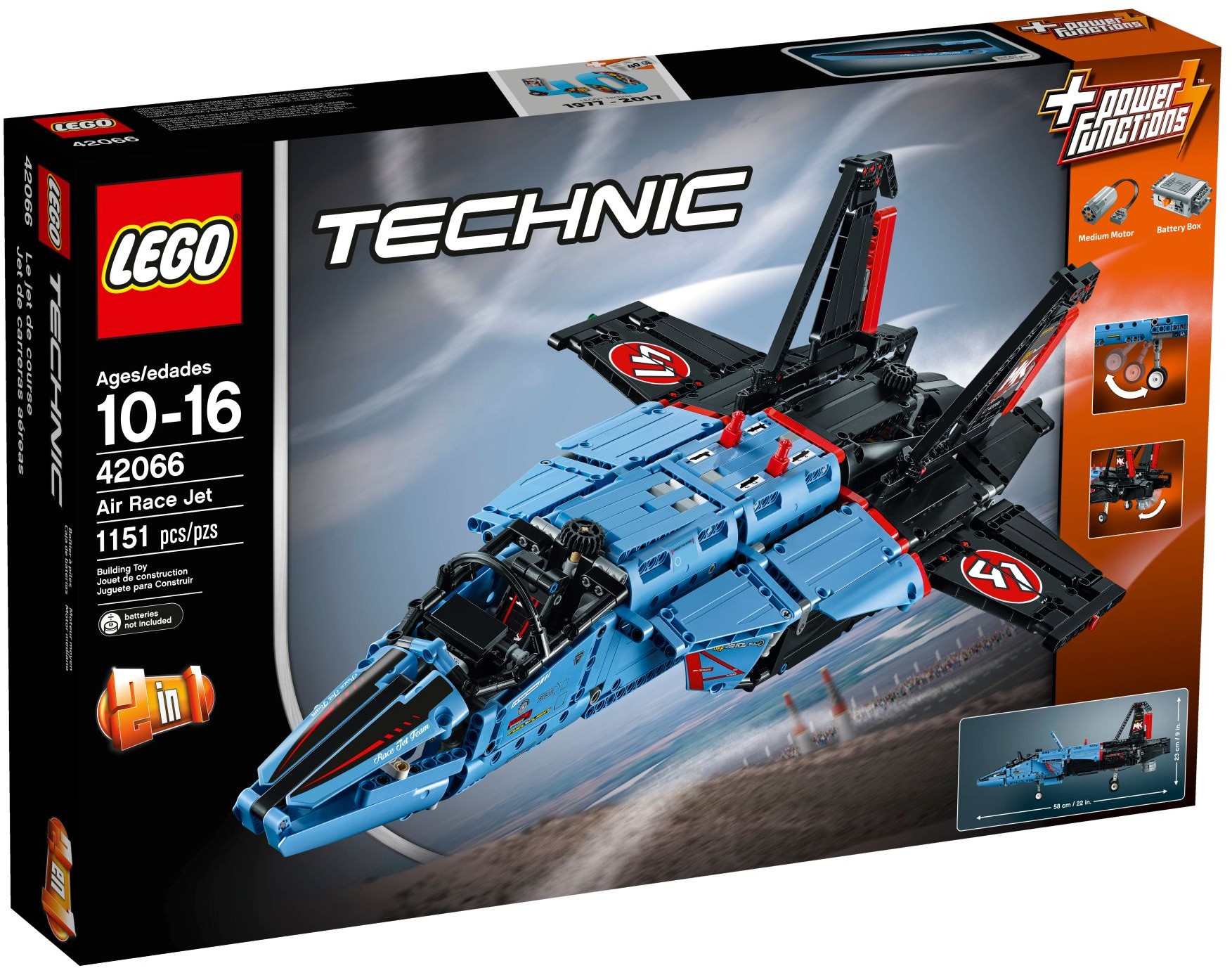
The box art puts it at 58 cm long and 23 cm high, and Brickset lists no model size, so take that from LEGO. The wings are short, which everyone noticed; Siegfried said stupidly small and then argued himself round to a racing jet whose body does the lifting, and a commenter on JANG’s post agreed the wings were too short next to LEGO’s other aircraft. Light blue fuselage, black wings and twin tails with red edging, 41 roundels on the wings, MK Race Jet Team on the fin and LT 42066 under it. Siegfried thought the parts excellent if you want the blue, mostly structure and panel with enough mechanical pieces to be going on with.
It sits on its wheels, which he found stable for the most part, and it has two settings to display it in: fan doors shut for level flight, or doors open and nozzle down for the hover. The stickers are not essential but they do break up the colour slabs.
Members who have built it
One Air Race Jet has come back with photos so far, in January 2026. The diary is linked under each picture.
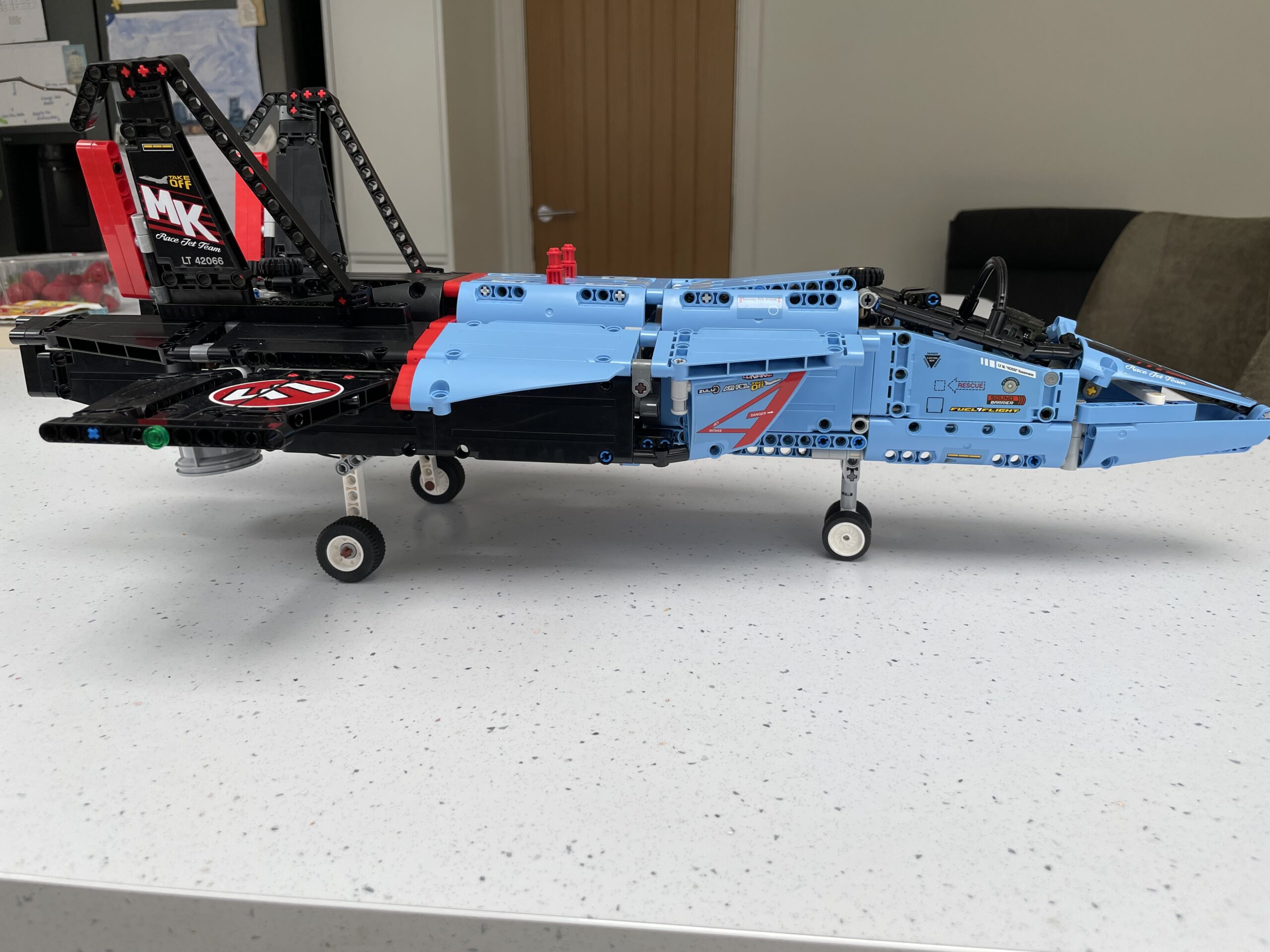

It is the one for you if you want a motorised set that is not a car and you have a few Technic sets behind you. JANG’s not for novices is fair: the mechanisms cannot be checked until late and nobody on file timed it, so allow an evening more than 1,151 pieces would normally take, whatever our member’s good afternoon suggests. Sort the parts first, watch alignment through the middle third, and run the motor before the last panels close. And if you find out what the flaps and the knob do, tell us, because nobody has written it down.
If you like this one, try
The rest of the helicopters and aircraft in the library. The Airbus H175 (42145) and the Heavy Lift Helicopter (42052) are motorised too; the H175 is nearly twice the piece count, and the other three are around a thousand pieces each.



The Air Race Jet is in the library
Technic Fan gets up to 6 kits a year, Master Builder up to 12. Delivery both ways is included and the prepaid return label is in the box.