

The 1:8 car to measure the others against
Five of LEGO’s 1:8 scale Technic cars are in the Brick Club library, and the Chiron is the one members ask about most. It was the second of the line, two years after the Porsche 911 GT3 RS (42056), with nearly 900 more pieces and a set of new gearbox parts made for it. Finished, it is 56 cm long, and the box weighs about six kilos.
This post is for that decision. The full Chiron spotlight already covers every mechanism, all six boxes and the places people slip up, so I will not repeat it. Below is where the Chiron sits against the Porsche before it and the Sián, Daytona and McLaren P1 after it, and how long our own members took.

Where it sits in the line
The Porsche was the first, and the Chiron fixed its two loudest complaints. On the Porsche the paddles were on the steering wheel and the elastic bands got in their way. On the Chiron they sit in front of the seat, under the wheel, on a ratchet. And where the Porsche hid its gearbox and engine completely, the Chiron leaves a gap in the floor so you can watch the lower selector rings move when you shift. Huw at Brickset put it plainly: the new parts make the gearbox work so much better than the one in the Porsche.
Against the cars that came after it, the Chiron is older and it shows. The C-line behind each door is a flex tube, and even in 2018 reviewers doubted it. The front wheels barely turn, and one reviewer lists the steering as a con outright. It uses stickers rather than printed pieces, including all three dashboard gauges. The Bricks vs Blocks review says that next to the Sián and the Daytona the Chiron feels a little older but still foundational, and that is about right.
What the newer cars do not have is this gearbox. Eight forward gears and one reverse, which is one more forward gear than the real car, worked from the paddles and a forward-and-reverse lever on the centre console. Huw’s caveat stands too: once the body is on, the change in engine speed between gears is hard to see, and nothing tells you which gear you are in.
What it does, briefly
Four functions in short form. The full spotlight walks through each one with the drive path and the build order; this is the version for comparing cars.
Push the left paddle and the ratchet turns an axle one way; push the right and it turns the other. That axle runs back to the orange rotary catches, which move the selector rings with a quarter turn rather than a sideways slide. A lever on the centre console picks forward or reverse.
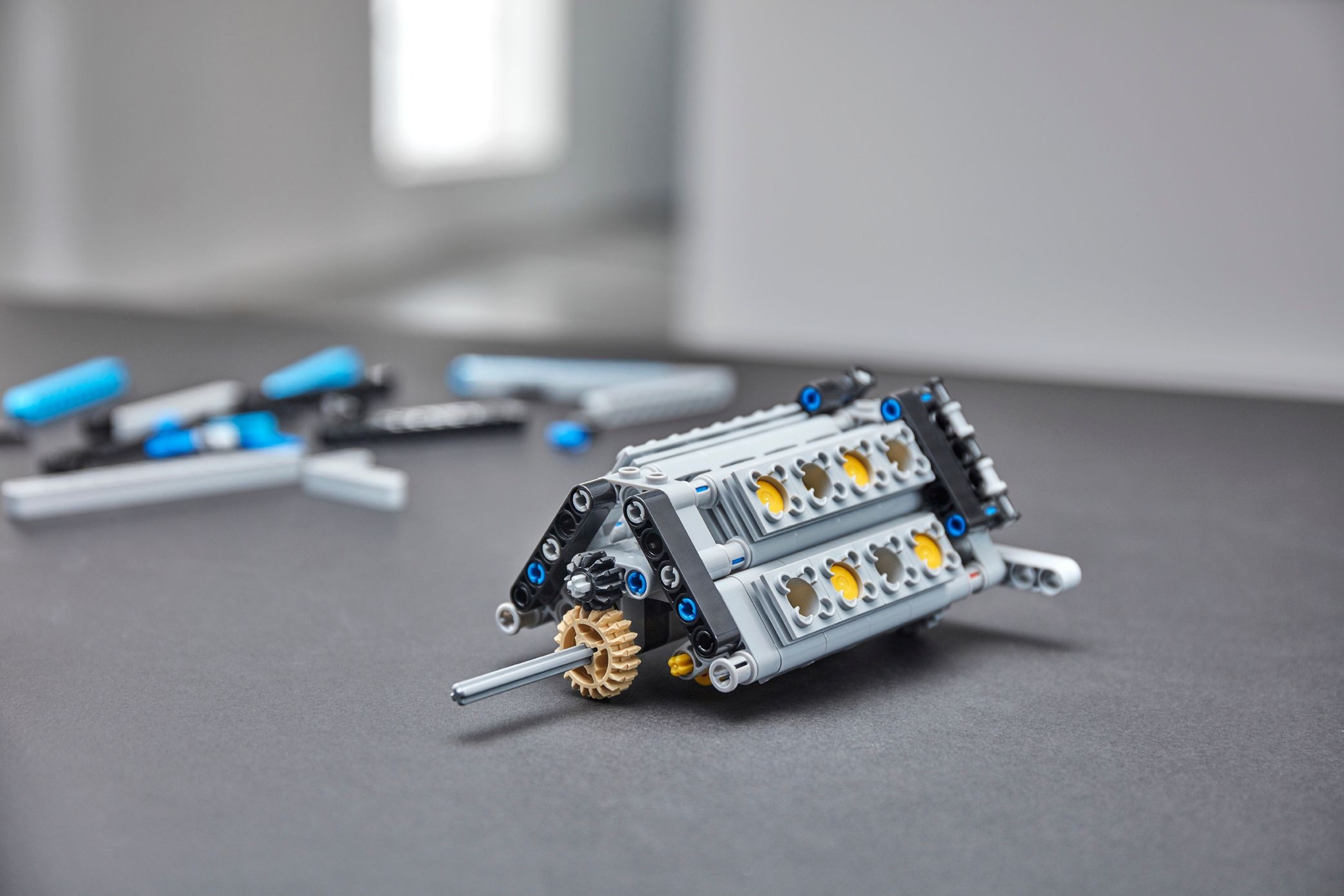
Roll the car and the rear wheels turn the differential, the gearbox and then the engine. There is no single crankshaft: three axles and three 24-tooth gears share the job. It sits directly on top of the gearbox, which is why you test the gears before it goes on.
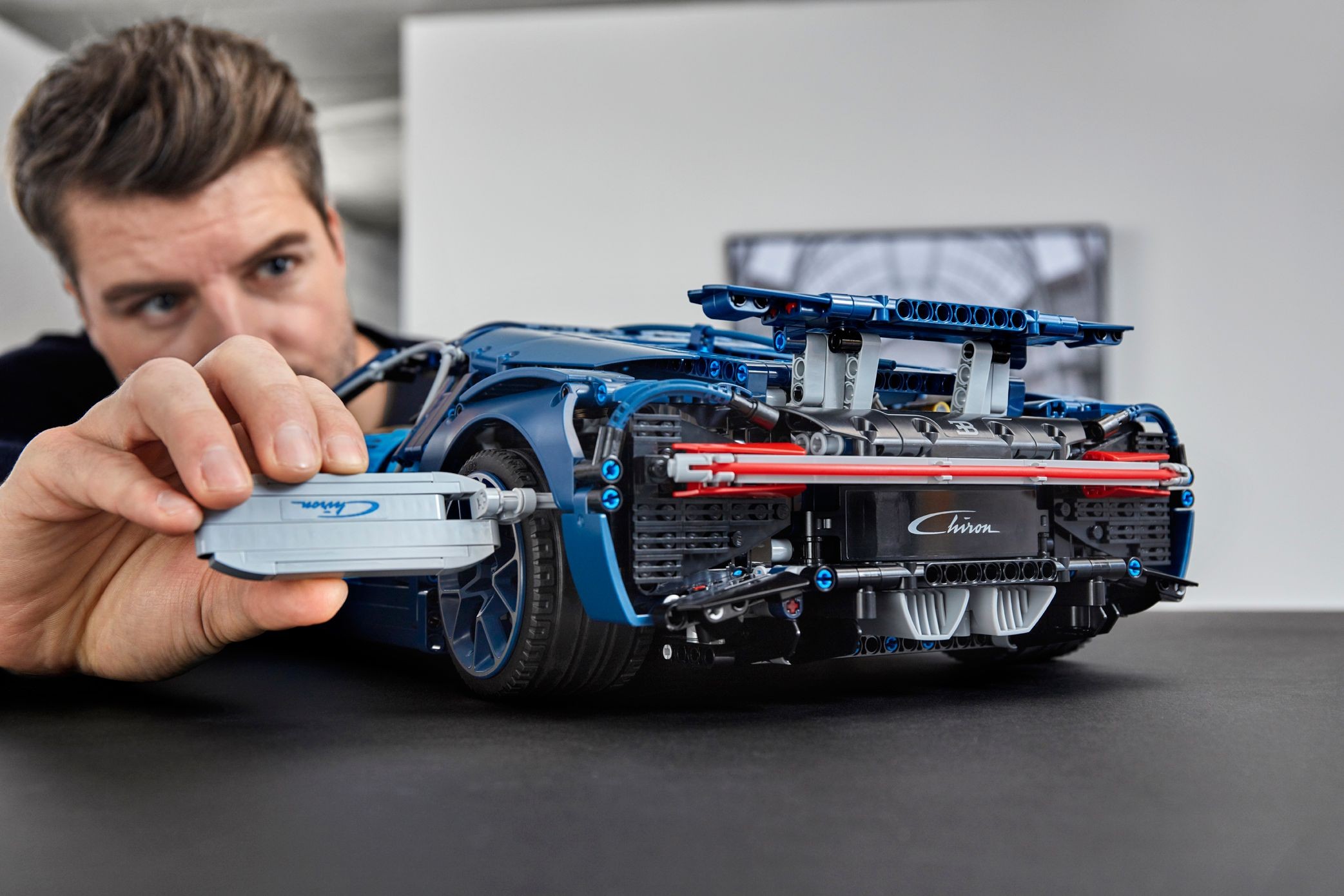
The grey key you build last slots in behind the rear wheel. Turn it and the wing rises; keep turning and it tilts. Huw called it a lot of faffing about and lifted the wing by hand, and a Brickset member said the same.
Two springs a side at every corner, on liftarms stiff enough that they barely move before the springs go on. Steering is from the wheel inside the cabin and the front wheels do not turn far. Press down over a wheel and the chassis does not always come back up; the body is heavy.
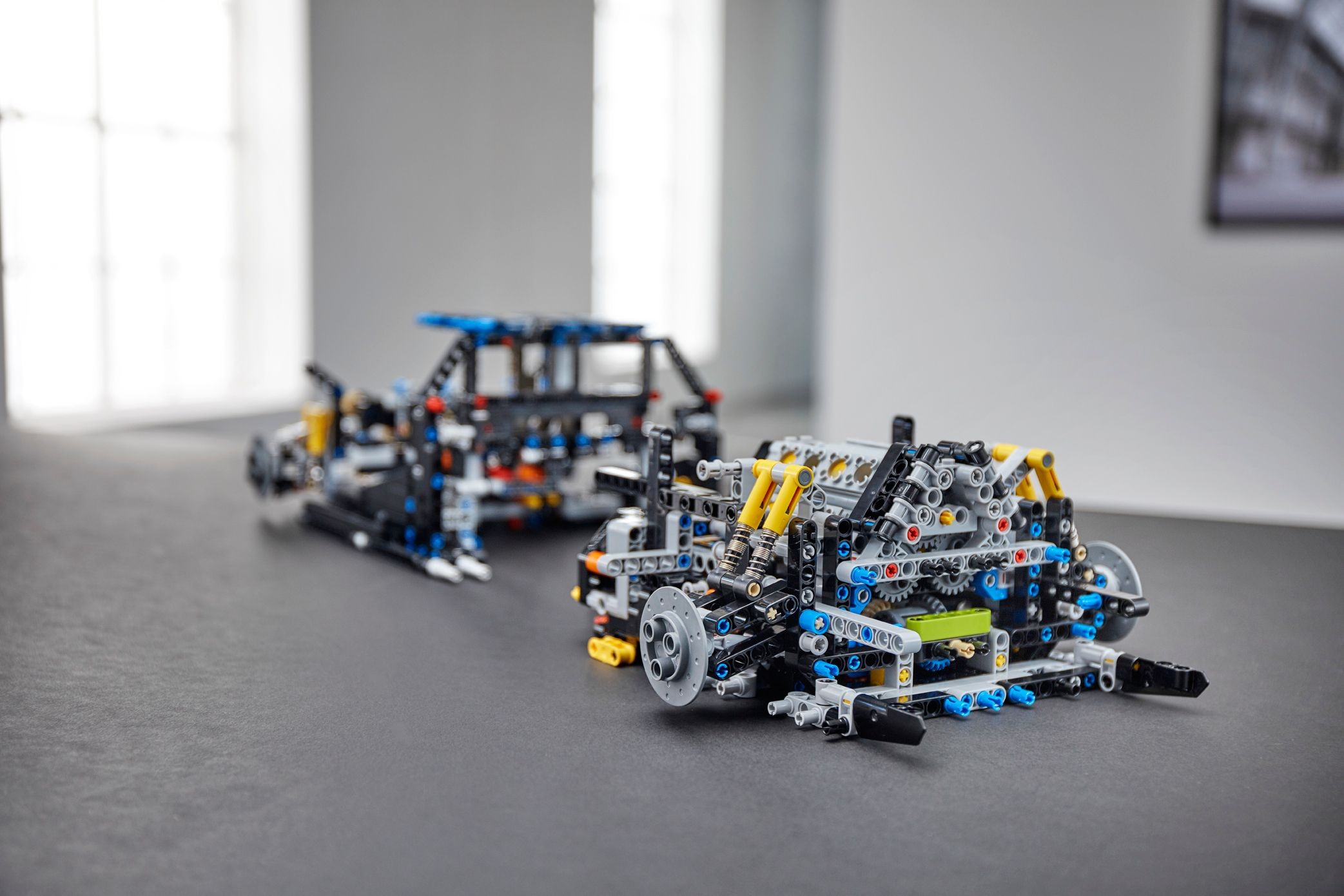
How the build splits
Six numbered boxes and two books, 970 steps in total. Huw took 10 to 12 hours over two days; a Brickset member reviewer took about 18. Our members came in under both.
Rear axle, gearbox and W16
The hardest hour of any of the 1:8 cars. Rear suspension first, then the gearbox as a sub-assembly, then the engine directly above it. Huw’s advice is to turn the axles and click through every gear before moving on, because corrections are virtually impossible later. The Brick Fan reviewer built too fast, missed a piece here and only caught it because he checked early.
Front chassis and the marriage
Steering, the paddle ratchet and the front springs, then the two halves are joined. Jim at Eurobricks tested the shift sequence at this point and found it correct. Because the car is built as two halves, two people can work on it at once, one on each half.
Body, interior, doors and wheels
Book two is the bodywork: dark blue rear and wing, dark tan interior, medium azure doors and nose, then windscreen, C-line tubes, wheels and the key. After the gearbox Huw found it not particularly complicated or taxing, with little repetition beyond left and right hand pairs.
The full spotlight lists five places to slow down. These three matter most when you are weighing this build against the other 1:8 cars.
- Box 1 is unforgiving. A slight mistake early on is very hard to correct later, as one Brickset member put it, because the engine seals the gearbox in. Test the shift, then move on.
- The books will not stay open. Two thick books, 306 pages and either 318 or 322 depending on who counted. One builder weighed them down to stop the pages turning mid-step. Bring a clip.
- Loose bodywork. The front, the doors and parts of the rear are held on lightly, and a Brickset member reviewer wanted them to hold more firmly. Lift the finished car from underneath, not by the panels.
On the shelf
It is a display piece rather than something to push about the floor, and at 56 cm by 25 cm it needs a shelf to itself. There is no case in the box. The finish is dark azure over dark blue, with the dark tan seats showing through the glass.
Members who have built it
Two of the three Chiron diaries are shown here. Alan’s diary puts the build at 7 to 8 hours and the other at 8 to 9, both quicker than the reviewers.


Whichever 1:8 car reaches you first, the Porsche is the shorter build and the Sián the newer one, but the Chiron is the one to measure the others against. Budget three evenings, keep box one for a fresh one, and read the full spotlight before you start the gearbox. If you have already built the Sián or the Daytona, expect an older car in the details and a better gearbox underneath.
The other 1:8 cars in the library
The predecessor and the three that followed. The Porsche is the shortest build of the five; the Sián, Daytona and P1 are newer and tidier, but this is the car that set the pattern.


The Bugatti Chiron is in the library
Technic Fan gets up to 6 kits a year, Master Builder up to 12. Delivery both ways is included and the prepaid return label is in the box.