

Cat D11 Bulldozer (42131): four motors, one gearbox, one job at a time
Two of the four motors in this bulldozer are connected straight to the track hubs with no reduction gearing at all, and a differential between them turns a fake V12 under the bonnet as you drive. The other two sit on a gearbox. One of them chooses a function, the other drives it, so the blade, the ripper and the ladder take turns. That is the whole electrical story: 3,854 pieces, one hub, six AA batteries and the Control+ app, in a black 18+ box that arrived in October 2021.
It is in the Brick Club library. Below is what each motor drives, how the eight building stages split the work, and the points where the only full build review, from The Brothers Brick, slowed down or grumbled. The other write-ups are launch news, so they supply LEGO’s numbers and function list but not build experience.

Why this one matters
It is the Liebherr’s successor in everything but purpose. Same box size as the R 9800, two volumes of instructions again, another Control+ flagship at a flagship price. The difference is in the electrics: the excavator had seven motors and two hubs, the Cat has four motors and one hub, and the review makes a point of it. The parts are where this set scores. The wide 7-stud tracks are new, in yellow, with proportions that finally suit a model this size, and they still mesh with the old 5-stud links. The linear actuators come in black for the first time, and there is a pile of the newer beams with alternating holes, which is why the reviewer calls it a good parts source whether or not you warm to the model.
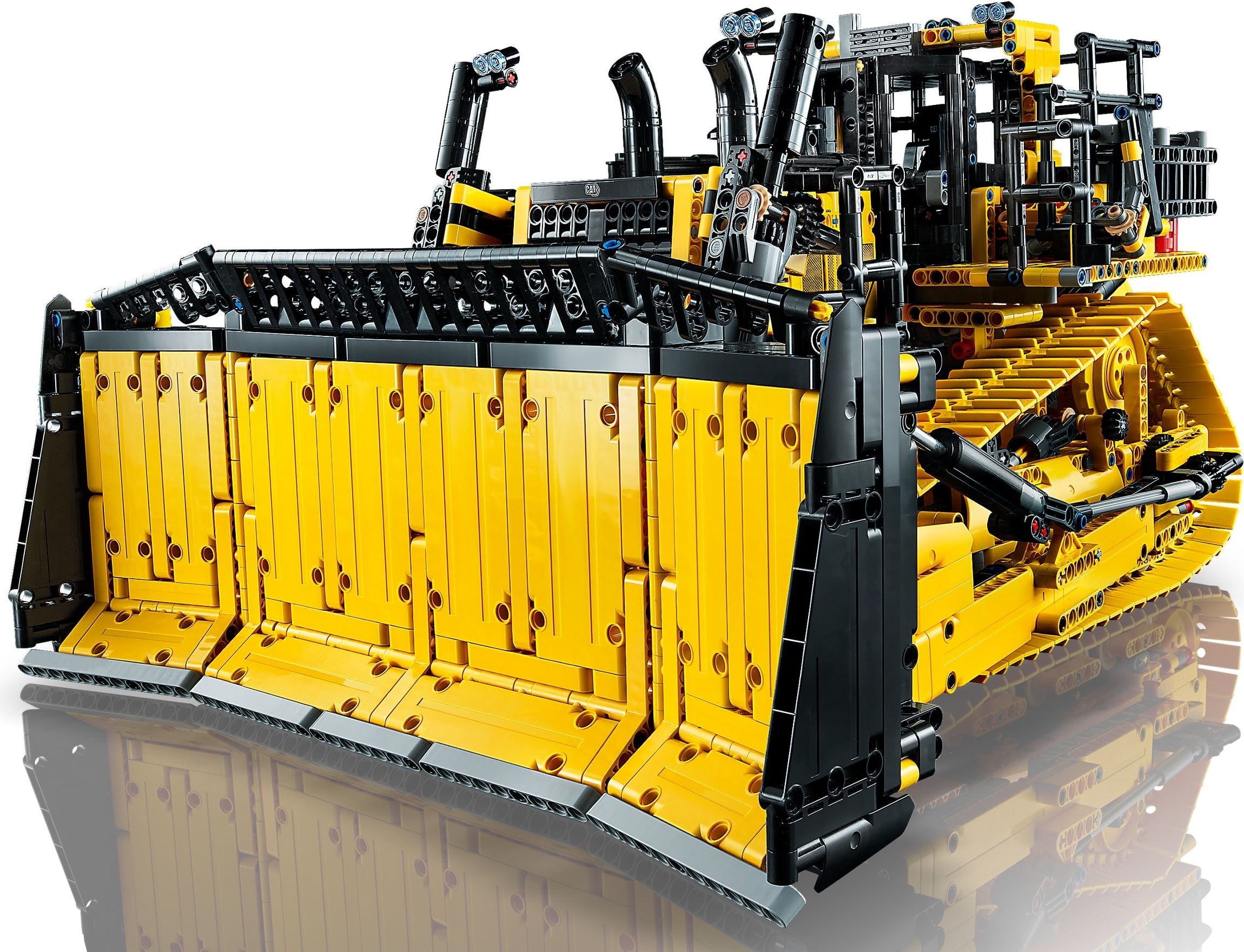
The blade is the other departure. The Liebherr’s bucket was a single moulded piece; the Cat’s blade is built up from big Technic panels, and it is the last thing you assemble. Only 15 stickers in the whole set, and the instruction books include six spreads about the real machine.
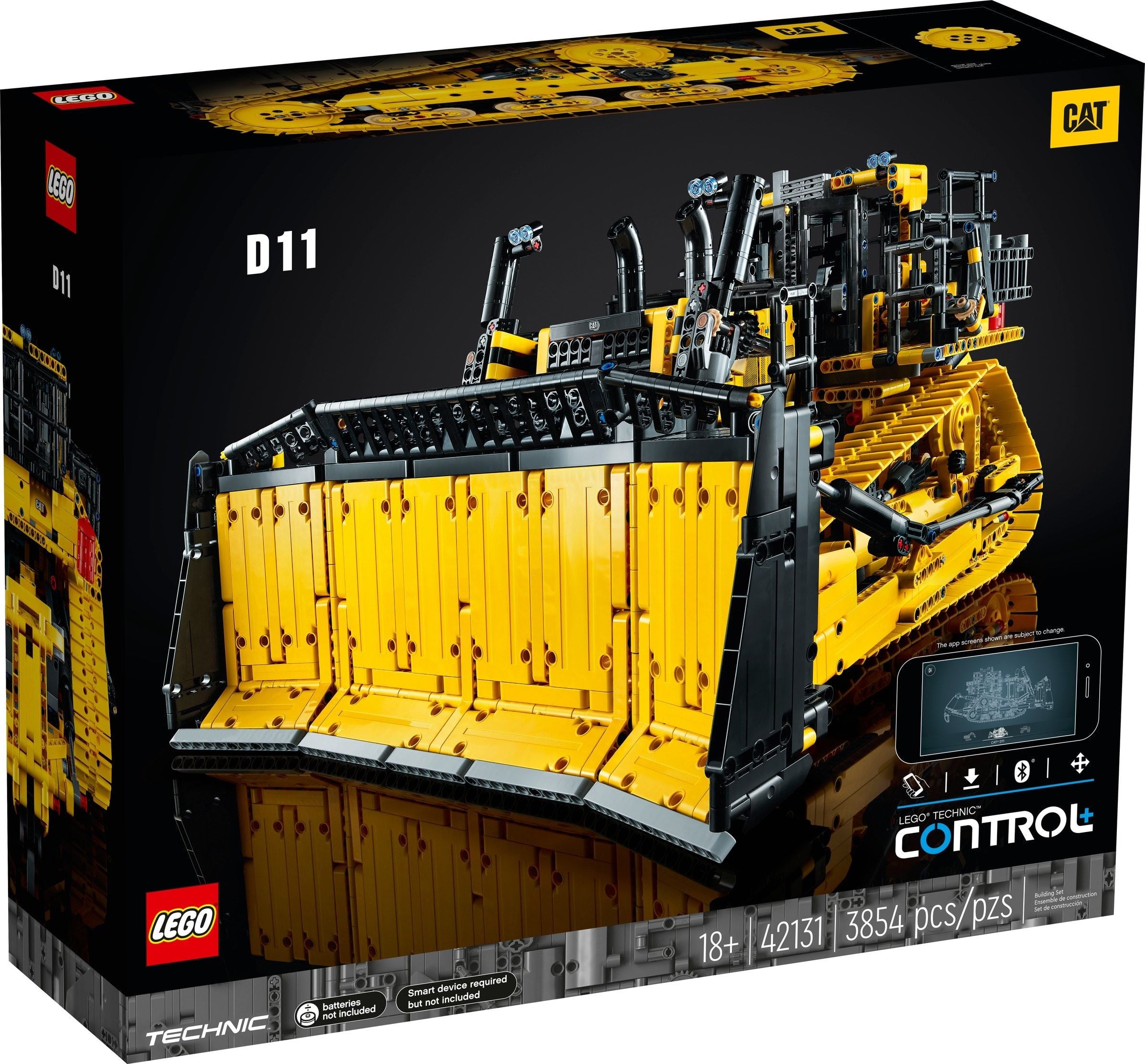
One oddity: the reviewer’s box said D11T on the front, while LEGO’s store lists the set as D11 and LEGO’s box image shows D11, and the back of his box did not match the design on LEGO’s product page. If the box art on a rental copy differs from the pictures here, that is why.
What it actually does
Every function runs from the Control+ app over Bluetooth. Where the review describes how a motor reaches its function I have said so; where it does not, the drive path is left out rather than guessed.
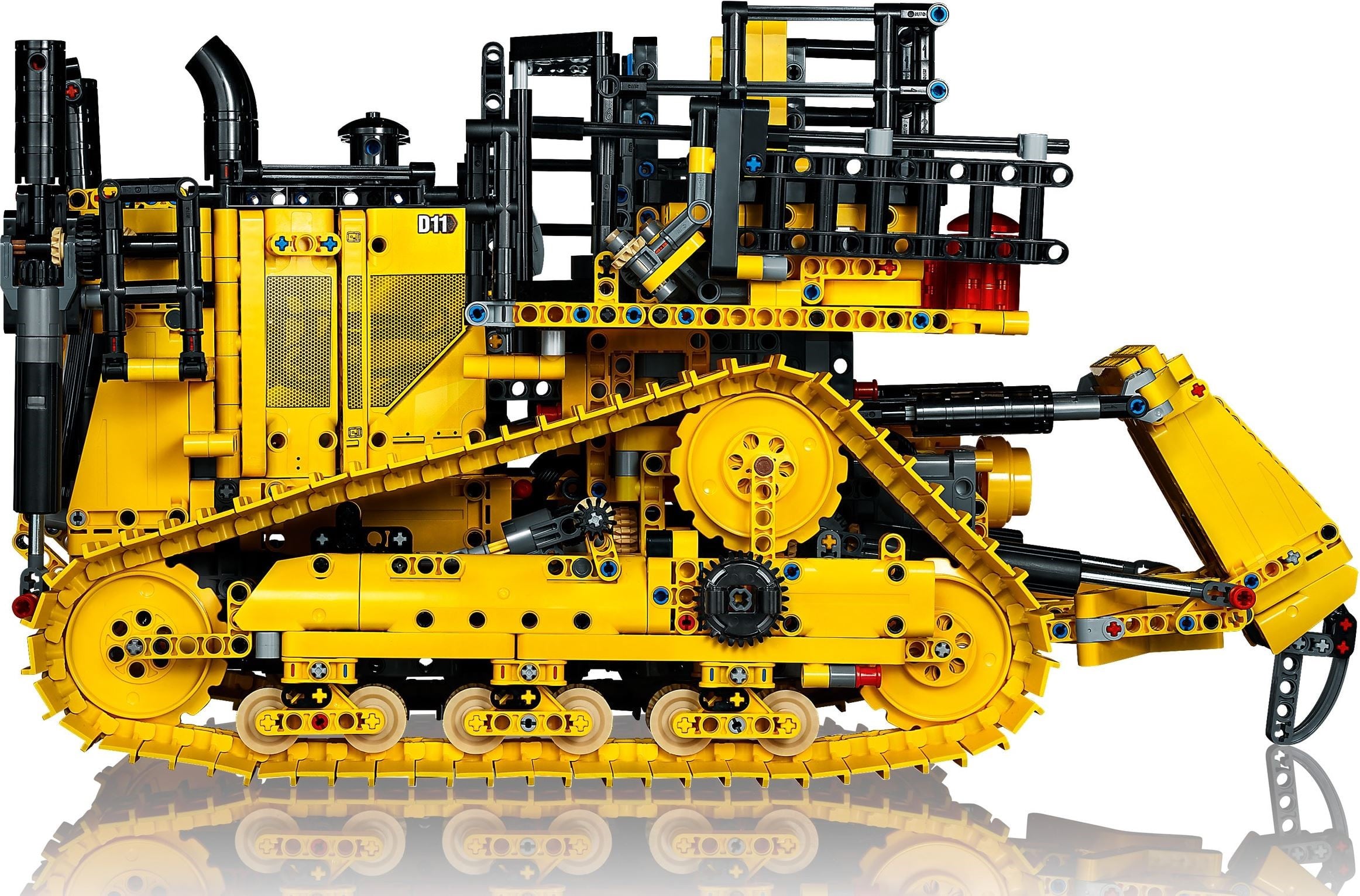
The two angular motors, the type originally made for Mindstorms, are connected directly to the planetary track hubs with no reduction, and a differential between them sends drive on to a fake V12 under the bonnet, so the engine turns when the tracks do. The dozer is slow, which the reviewer expected, but the angular motors give very precise control and driving it was the one part he called fun. The tracks ride on gears of several diameters plus an extension rack that tensions the treads, and that rack is what makes getting the tracks on and off bearable.
The two medium motors arrive attached to a reasonably complicated gearbox. One motor switches the gears, the other drives whatever the gearbox has selected. That is why you cannot lift the blade and move the ladder at the same time: with two motors permanently on the tracks and one on the selector, there is one motor left for everything else. Once you know that, the app’s behaviour makes sense. Until you know it, it feels like something is not responding.
The blade raises, lowers and tilts, and the black linear actuators you can see on the push arms in the pictures are the new colour for this set. It is slow: about 21 seconds from fully lowered to fully raised, so 42 seconds and more for a full cycle, and about 7 seconds to tilt from fully up to fully down. That is how the set is geared, not a fault, but be ready for it.
The ripper at the back raises and lowers from the one free motor, fully raised to fully lowered in about eight seconds. The reviewer calls it purely decorative and points back to the old 8275 Motorized Bulldozer, which had real shove. Treat it as a pose you set for the shelf rather than a function you will use.
This is the part the reviewer did not expect to spend time on. The ladder up to the cab is motorised with an adjustable angle, driven through a neat little train of gears that includes a white clutch gear, there to protect the train when the ladder hits either end stop. The mounting is the clever bit: a simple-looking build that uses the natural tolerance in the parts to hold the ladder at an odd angle, with an angled gear feeding it. He called it one of the most curious structures in a Technic set.
One Smart Hub sits in the front of the chassis and goes in during the first stage. Six AA batteries, not included. The model switches on and off with a red control lever inside the engine bay, which the box does not tell you about, so look for it before you assume the hub is flat. The app’s dozer screen is exactly what you would expect from Control+: controls laid out like a real dozer’s, not the most intuitive at first but quick to learn. The reviewer’s wider complaint is the pairing, updating and calibrating you get through before anything moves.
How the build goes
Eight building stages, most of them big, with a white inner box holding about half the bags. Two books. The stages are far longer than the one-bag-a-night pattern of the other 18+ sets, so do not plan on finishing one in half an hour. No reviewer gives a build time; with 3,854 pieces in eight long stages I would allow two weekends.
Drive motors and hub
The two angular motors go in right at the start, connected straight to the planetary hubs, with the differential between them that will turn the V12. The smart hub takes its place in the front of the chassis. Straightforward building, the reviewer says.
Gearbox and the medium motors
Two medium motors arrive attached to the function gearbox. This is where it becomes clear that only one function can run at a time, so it is worth understanding what the selector does before it is buried. Then the two pre-assembled structures are joined, and with that every motor is in place; no more major mechanisms follow.
Tracks
Tracked running gear instead of another truck chassis, which the reviewer found a relief. Gears of various diameters and the extension rack for tensioning. Fit the treads loose, then tension them; the rack is there to make that easy. Once the track frames are on, the model is at its full width.
Ladder, cab and roll cage
The ladder gear train with its white clutch gear, then the odd-angle mounting. The cab is a separate unit that slips into place smoothly, and the reviewer’s thought at this point was that he hoped he would not need to take the set apart any time soon. With the roll cage on, the structure is rigid enough to lift the whole model one-handed by the cage.
Blade
The blade goes together from big Technic panels and hangs on the push arms last. Adjust the track tension, put six AAs in, find the red lever in the engine bay and pair the app. Then it rolls.
No member diary exists for this one yet, so these come from the Brothers Brick build and from what the set’s structure makes obvious.
- One function at a time. Two motors drive, one selects, one works. If the blade will not move while the ladder is going, nothing is broken. Learn which app control is the selector before the gearbox disappears under the bodywork.
- Track tension. There is an extension rack on the track frame for exactly this. Fit the treads slack and tension afterwards.
- The cab goes in as a finished unit. It slips in smoothly, and the reviewer’s comment at this point was that you hope you will not need to take the set apart. Check everything under and behind it before it goes on.
- The ladder angle. The mounting relies on the give in the parts, not on a square joint. If it looks wrong on the page, it is meant to. Check the angled gear meshes before you move on.
- The on switch is a red lever in the engine bay. The box does not mention it. If the app cannot find the model, that lever is the first thing to check.
On the shelf
It is 57 cm long, 37 cm wide and 26 cm tall, and heavy: the reviewer weighed the full box at 14.6 lb, about 6.6 kg. The yellow and black photograph well, and the mesh grille panels, the D11 marking and the exhaust stacks carry the Caterpillar look with only 15 stickers. The reviewer expects it to end up on a bookshelf after half an hour of driving, so choose a strong one.
Set the blade and ripper where you want them from the app before the phone goes away. The functions only work through the app, so pose it before you put the phone away.
It is the one for you if you want the build more than the play. The reviewer’s split is fair: the concept, the parts and the assembly are the good bits, and the functions are slow and predictable once it is done. The track drive, the gearbox and the ladder mounting are worth the evenings on their own, and driving it about is fun for a while. Allow two weekends, put six AAs on the list, and keep a phone or tablet with room for the app. If you want the same system with more going on, the Liebherr R 9800 Excavator (42100) has seven motors to this one’s four, and the reviewer prefers it.
If you like this one, try
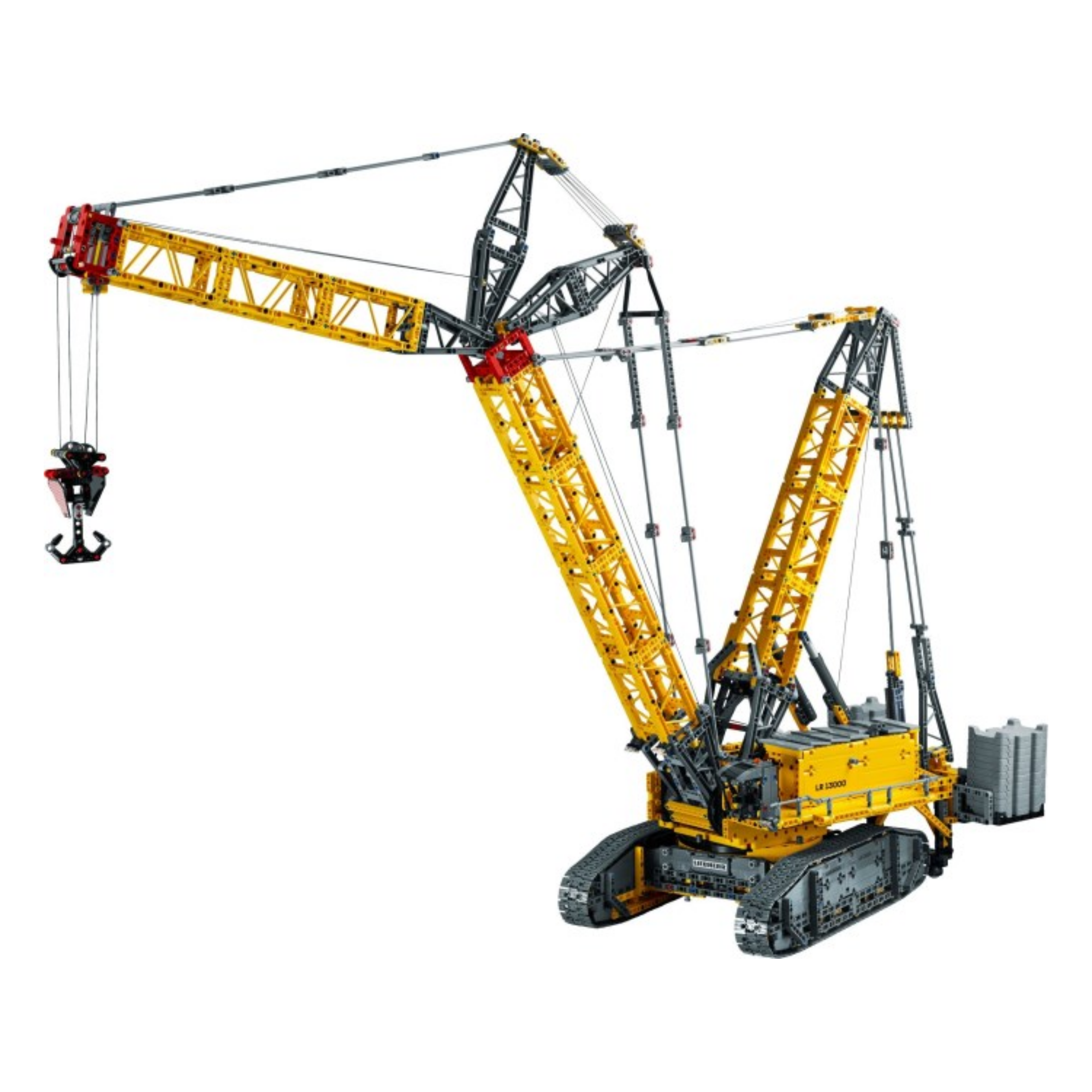
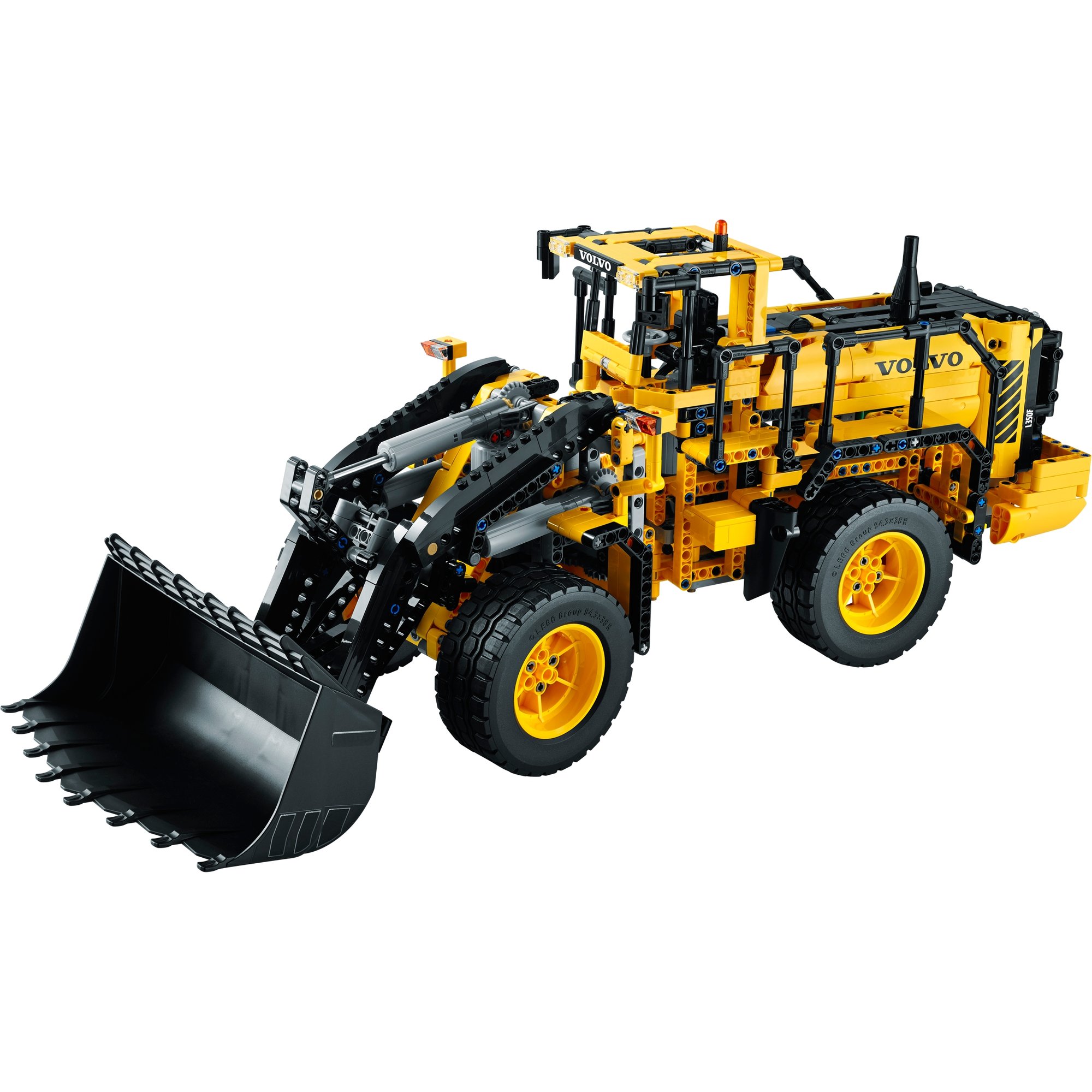
The other big machines on the same shelf of the library. The Liebherr excavator is the Control+ set the review keeps comparing this to; the LR 13000 is the later Control+ crane; the L350F is the older Power Functions loader with a handset; and the small Bulldozer is the same idea in 147 pieces.


The Cat D11 Bulldozer is in the library
Technic Fan gets up to 6 kits a year, Master Builder up to 12. Delivery both ways is included and the prepaid return label is in the box.