

Mack Anthem (42078): a Model Team truck with a Technic trailer behind it
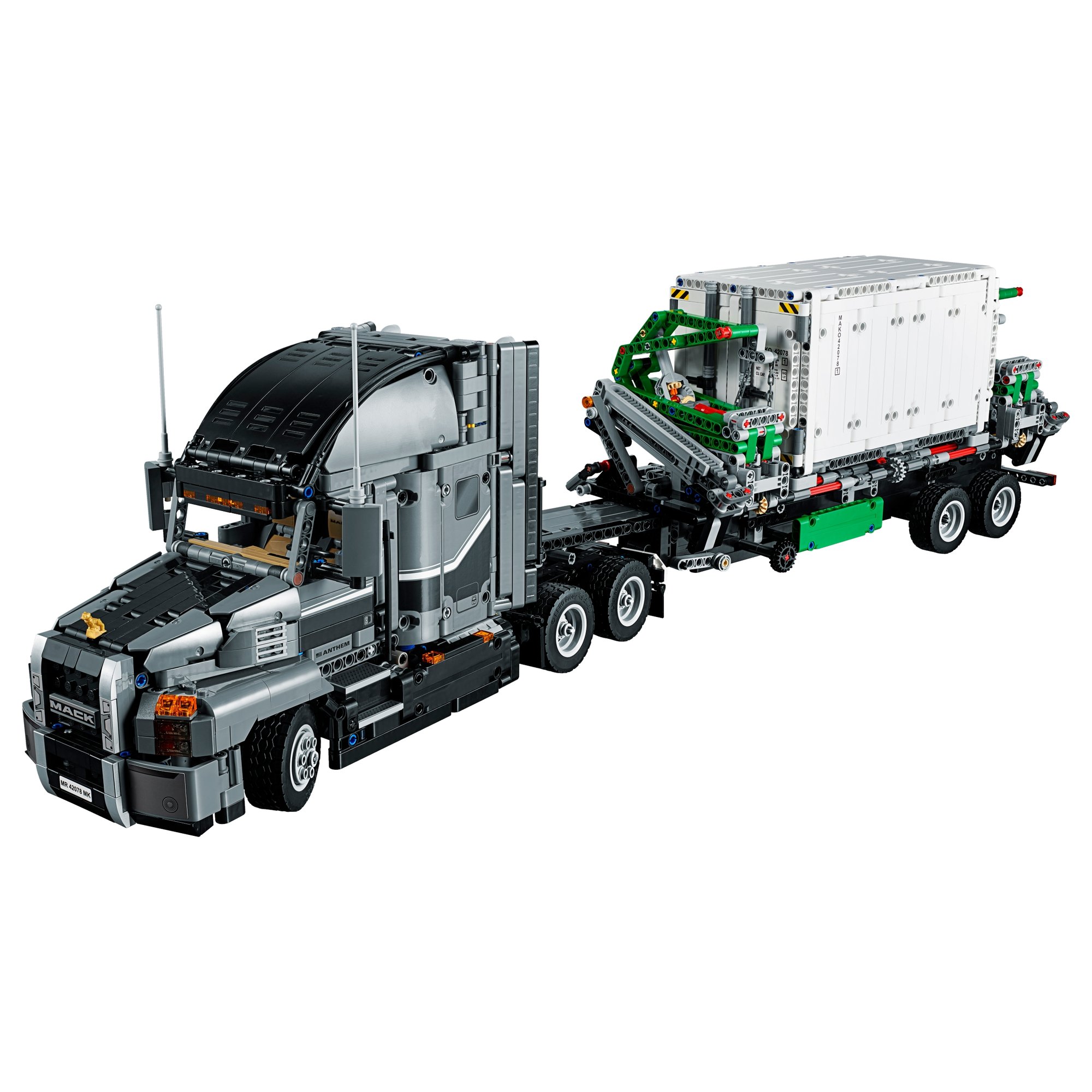
Two different sets in one box, and they do not pretend otherwise. The tractor unit is a licensed Mack Anthem sleeper cab built with so many System tiles and slopes that Huw at Brickset said you would be hard pressed to tell it was Technic at first glance. Behind it is a bare Technic trailer carrying a white container, with two folding lifts that pick the container up on chains and set it down over the side. At 2,595 pieces it was the fifth largest Technic set ever when it arrived in January 2018, and with no motors or pneumatics inside, The Brothers Brick rated it the best value for sheer brick volume among the Technic sets of early 2018.
It is in the Brick Club library. Below is what each control does, how the seven runs of numbered bags split the truck from the trailer, and the points where the launch reviews slowed down or lost patience.

Why this one matters
The truck is the reason people bought it. Mack’s press release said it was the first time a LEGO set had been introduced alongside the launch of the real prototype, and the model follows the real Anthem closely, stand-up sleeper included, with the curves, headlights, steps and grille done in System parts rather than Technic panels. The Brothers Brick read it as the return of Model Team. Hothbricks, who had criticised the Porsche 911 GT3 RS (42056) for gappy bodywork, said the designer here filled every space he could. There is one new mould in the box, the pearl gold bulldog for the bonnet, and no spare. The Mack tile on the nose and the two silver grille tiles are printed; the other 35 decorations are stickers.
It has faults, and the reviews were honest about them. Milan on Eurobricks thought the bonnet two or three studs too long, the wheel arches too sharp and blocky, and the rear mudguards fragile. Hothbricks disliked the blue pins showing through the bodywork. The Brothers Brick thought the parts looked ordinary and dull in the bags after the Porsche. None of it stopped any of them recommending it.
The trailer is where the reviews split. Huw said the unloading mechanism is suitably complex and works well once you have the hang of it. The Lego Car Blog called the two lifts brilliantly engineered but boring to build and glacially slow, and scored the trailer 5 out of 10 against 8 for the truck. Milan found the cranking tiresome but worth it for watching the arms move. They describe the same mechanism and disagree about whether you will want to work it twice. The instructions are one 420-page book that The Brothers Brick found too heavy to use without wearing the spine, and the B-model, a Mack LR front-loading refuse truck with a lifting mechanism and compactor, is online only. Milan noted that some people prefer it.
What it actually does
Nothing is motorised. The truck has four functions and the trailer three, all worked by hand from knobs, gears and levers on the outside of the model.
Lift the bonnet and there is an inline six rather than the regular V engine almost every other Technic vehicle gets. There was no room for the normal cylinder parts, so the pistons are axles with bushes on top, pushed up by a camshaft made from six 2-stud beams with an axle hole. The Brothers Brick called the shaft one of the oddest things they had built for an official set. The cam offsets are 90 degrees, so it fires two, two, one, one rather than one at a time, which Huw noticed and decided did not matter. It runs from the rear wheels through the two differentials and a driveshaft, and the fan spins with it.
The knob is on the back wall of the cab so it does not spoil the look. Turn it and the front wheels steer, and the steering wheel in the cab turns with them, because the wheel is coupled to the same mechanism. Huw, The Brothers Brick and The Lego Car Blog all picked this out; The Brothers Brick said official sets had not had it for many years. The Lego Car Blog’s only complaint was that the steering wheel does not turn much. The inner frame is five studs wide, so the turning circle is small, and Milan found the action smooth with an excellent range.
Push and pull the grey axle behind the cab and the coupling locks or releases the trailer. It also pivots up and down. The Lego Car Blog lists it as the last of the truck’s four functions and then says, and that’s it, which is fair.
This is the set’s big function and its slowest. At the back of the trailer are two black double bevel gears, one per lift. Each lift is in two sections: a large linear actuator pushes out the lower section and a small one the upper, so as you wind, the arm unfolds outwards and over the side of the trailer. Chains hang from the arms and hook to the bottom of the container. Turn both gears together and the container lifts, swings out past the edge and lowers to the ground, or the reverse to load it without an overhead crane. Huw’s description is a bit of trial and error and a lot of knob twisting, and because the container is heavy the knobs need real force, so once the novelty has gone you will not do it often. The Lego Car Blog said it takes seven years.
Before you lift anything, the two stabiliser legs come out. Each is a gear rack in a housing, driven by a lever on the leg itself rather than a gear. Flick the lever and the leg extends and locks at the end of its travel so it cannot creep back while the container hangs off the side. Reviewers liked how they work more than how they look: Milan called them very cleverly designed, Hothbricks simple and efficient, The Lego Car Blog horrendously ugly. Hothbricks points out you can fill the container to make it heavier and the legs still do their job.
A gear on the side of the trailer winds the front support wheels down for when the trailer is unhitched and up again for towing. Milan found it smooth and said it easily carries the whole weight of the loaded trailer, which matters because Milan found the trailer neck can bend.
The cab doors open with their mirrors and aerials attached, the bonnet lifts to show the engine, and inside there are two seats and a bed in the sleeper behind them, which The Brothers Brick loved and Huw pointed out you cannot really see once the cab is closed up. The container’s twin doors open on two levers and lock the way real container doors do. It is almost entirely 5×11 and 3×11 panels, and Huw reckoned it is perhaps a fifth of the cost of the set.
How the build goes
Seven runs of numbered bags, 21 bags in all, one 420-page book. Bags 1 to 4 build the truck and come in their own white box with the book and stickers; bags 5 to 7 are the trailer and container. RacingBrick built it in around six hours. The Brothers Brick’s advice was several evenings over a week or two.
Rear chassis and fifth wheel
The build opens at the back: two rear axles joined through differentials, the driveshaft running forward, and the plate for the trailer above the wheels. No suspension. The fifth wheel goes in here with the grey axle that locks it. It is a modest chassis; The Brothers Brick’s point was that nothing about it yet suggests one of the largest Technic sets ever made.
Engine, steering and the join
The front half is the interesting one. The camshaft and six bush-topped pistons go into a tight frame, then the steering, with its coupling to the wheel in the cab squeezed alongside. Join the halves and the driveshaft meets the engine; Milan called it the most satisfying part so far. Test now: roll it and watch the pistons, turn the knob and watch both the wheels and the steering wheel, because once the panels are on you will not see any of it again.
Cab, interior and bonnet
Bodywork. The interior first, seats and the bed behind them, then the side panels and doors, and the truck takes its shape quickly. The bonnet is a mixture of Technic frames and System tiles and slopes, with the headlights on inverted slopes between mudguard and grille. The big window stickers on the sleeper go on here.
Trailer chassis
A straightforward frame of 3×11 panels, with the first drive axles for the lifts laid in from the very start. The side gear for the support wheels goes in here. Huw found it rigid; Milan found it much simpler and weaker than the truck’s chassis and warned that the neck can bend when it is coupled up.
The two lifts and the outriggers
The lifts are built as separate sub-assemblies and attached once complete, each with a large and a small linear actuator and the rack-and-housing outrigger alongside. They are complex and slow, and the second is the mirror image of the first, so Huw’s advice was not to build both in one sitting.
The container
The last bags are mostly white panels, and the container is almost nothing but 5×11 and 3×11 panels, so it goes together quickly. The doors and their locking levers finish it. Then couple up, lower the outriggers, hook the chains under the container and try the lift.
No member has written this one up yet, so these come from the launch reviews.
- Only four tyres in the white box. The other six are packed in bags 5 to 7. The Brothers Brick went through every bag looking for them. Nothing is missing.
- Six wheels on, then the body. The book fits all the wheels before the cab, so the chassis rolls while you work on it. Expect it to move under your hands.
- The stickers. 35 of them, from 1×13 strips to 1×1 dots, including the very big window stickers on the sleeper that Milan did not like. Tweezers help. Huw’s view is you could skip them, but they break up a lot of flat grey.
- The second lift. It mirrors the first, step for step. Do the two in separate sittings; it is the part of the build reviewers found hardest to concentrate through.
- Unloading order. Outriggers out and locked first, chains on, then both rear gears together. The container swings on the chains, so watch the side of the trailer as it comes down, and expect the knobs to be stiff under the weight.
On the shelf
Coupled up it is 83 cm long by LEGO’s own box graphic; the tractor alone is 40 by 13 by about 20 cm and the trailer about 50 cm. It is heavy for a Technic set because of the System parts in the bonnet and cab, so lift it by the truck rather than the trailer neck, which Milan found flexes. The rear mudguards are the fragile spot.
Dark bluish grey over black with light grey trim. For display, leave the container on and the outriggers in. The steering knob is on the back of the cab where it cannot be seen, which is the point.
This is the one for you if you want a truck that looks finished from across the room and a trailer that makes you work for it. The truck is clear, logical building with a real straight-six and steering that turns the wheel in the cab; the trailer is two hard sub-assemblies and one very slow party trick. Six hours if you push, a week of evenings if you do not. Check bags 5 to 7 for the other tyres before you tell us any are missing, test the engine and steering before the panels go on, and get the outriggers out before you lift. Milan called it one of the nicest official Technic trucks ever made, and I would not argue.
If you like this one, try
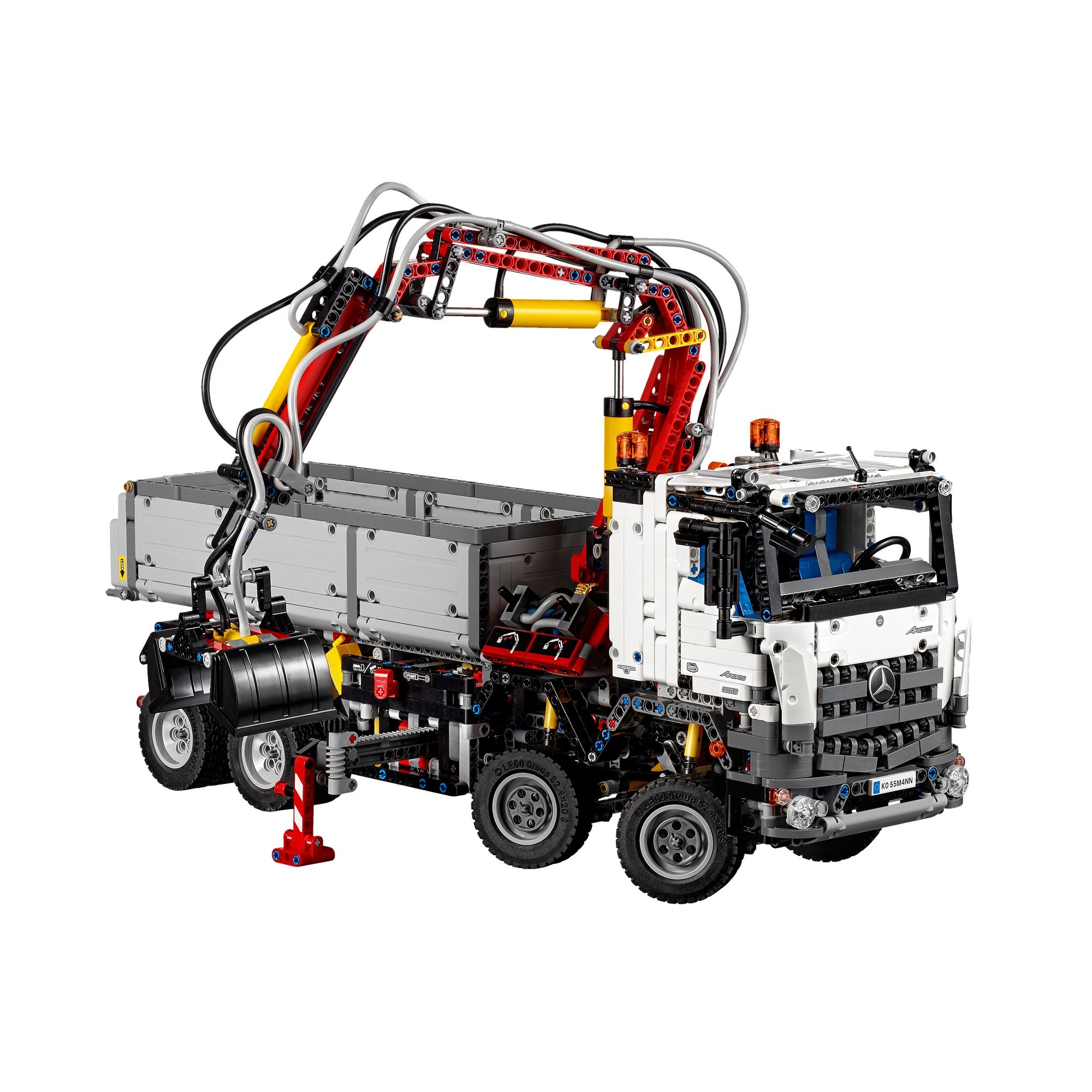
The other big trucks in the library. The Car Transporter (42098) is the nearest thing to it, another long, unmotorised truck and trailer; the Arocs (42043) is the one with motors and pneumatics; and the Container Truck (42024) is the small version of the same idea.



The Mack Anthem is in the library
Technic Fan gets up to 6 kits a year, Master Builder up to 12. Delivery both ways is included and the prepaid return label is in the box.