

Car Transporter (42098): three builds and one very long shelf
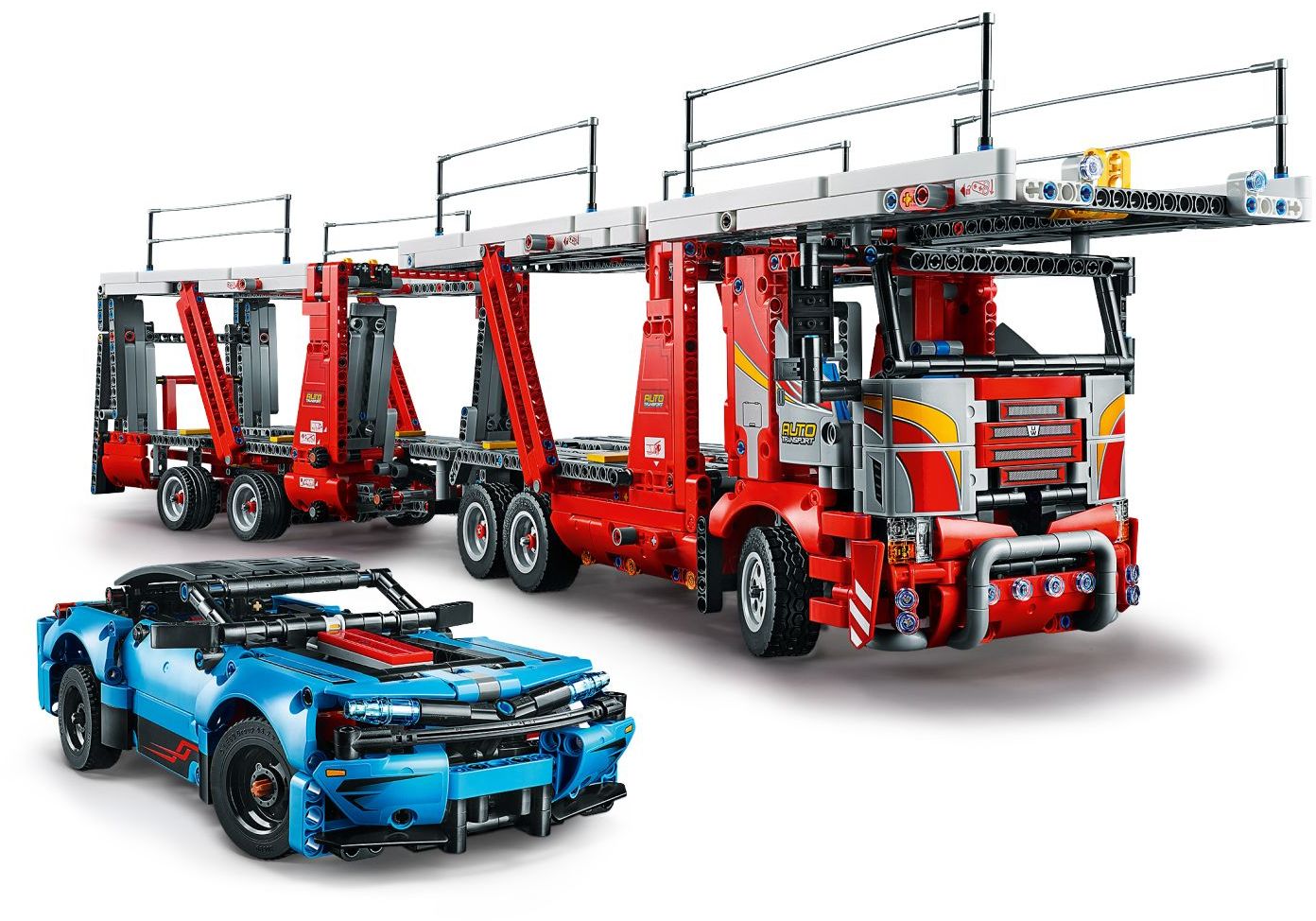
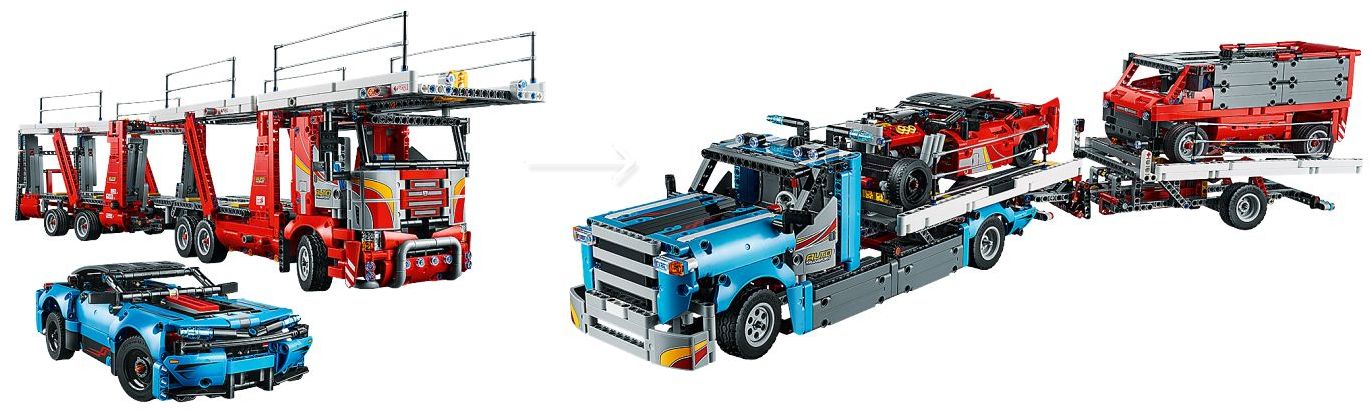
Nobody had done a Technic car transporter since the B-model of the 8872 Forklift Transporter in 1993, so when this one arrived in August 2019 it had the field to itself. It is three builds in one box: a dark azure car with a V8 and rear-knob steering, a truck with an upper deck that lowers and a cab that tilts underneath it, and a trailer whose rear ramps unfold from a knob at the front. With the ramps down it runs past a metre, which The Brothers Brick reckoned made it the longest LEGO vehicle released up to then.
It is in the Brick Club library and one member has built it and sent photos. Below is what each control does, how the three runs of numbered bags split the build, and where the launch reviews and our member found the awkward bits.

Why this one matters
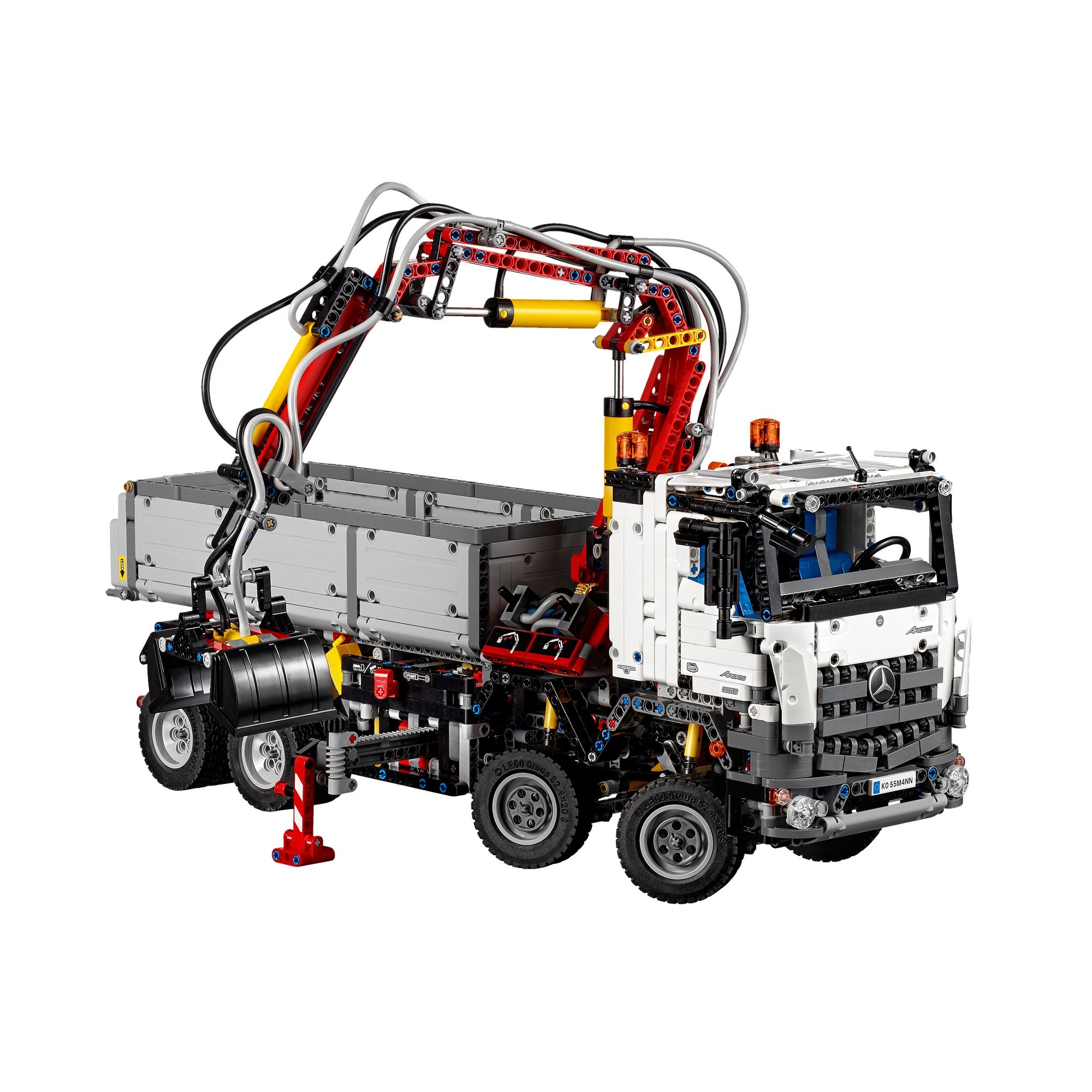
Two things. First, there is no gearbox and nothing is hidden. The Brothers Brick made the point that the structure is not covered in panels and every mechanism can be seen from the outside, so you learn how the deck lowers by watching it rather than by taking it apart. Second, the deck mechanism is borrowed from the Arocs (42043). The rack and housing that debuted there sits in the back of the truck’s chassis, and instead of lifting the deck directly it slides the feet of the rear support arms forward and back. Alexandre Campos at New Elementary called it an indirect way of doing it, and it is, but one gear on the side of the truck moves something the size of a shelf.
The set was designed by Uwe Wabra, known for several Technic flagships since 2008, and the headlights and mirrors are done the way he always does them. There are no new moulds. What you get instead is quantity in useful colours: 24 dark grey 3×11 panels, a dozen silver flex tubes for the railings plus two spares, and the narrow 43 mm tyres that had only been in the Corvette and the London Bus before.
The instructions are one 552-page book covering all three models, and the B-model, a blue pickup with a car trailer, is online only. New Elementary’s complaint was that three books would have let three people build at once, which is fair when the models are as independent as these.
What it actually does
Nothing is motorised and there is no gearbox. Each function has its own gear or knob on the outside of the body, and the trailer’s controls are doubled so you can reach them from either side.
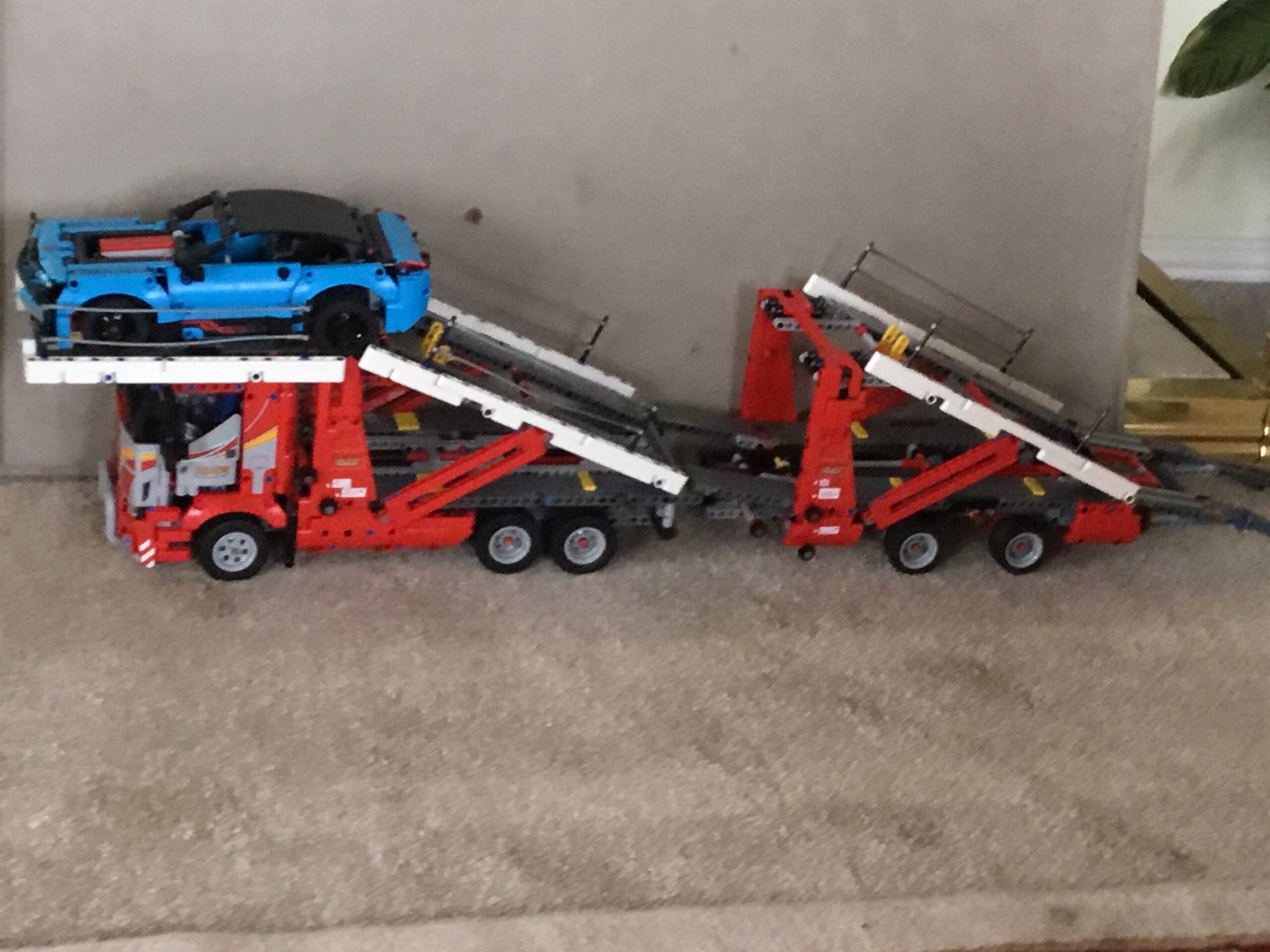
Turn the gear on the side of the truck and a rack in the rear of the chassis slides back and forth. The rack does not lift the deck; it moves the feet of the two red rear arms, and as they travel the arms lean and the deck comes down. It is slow. The Brothers Brick said it takes some time to lower completely and that watching it fold down is the satisfying part, with nothing loose once it is there. The catch is that the truck has no ramp of its own, so a car cannot go straight onto it. You load through the trailer.
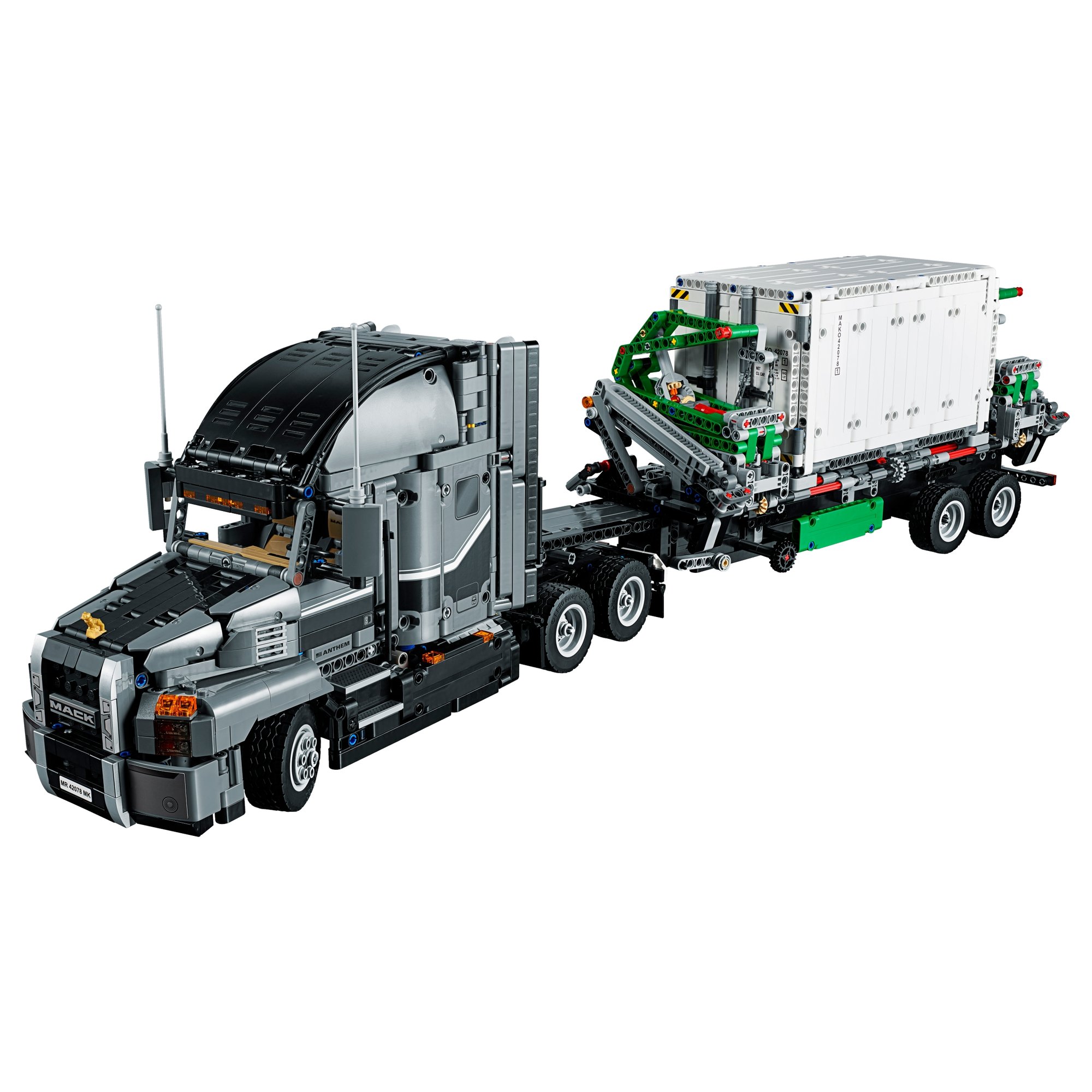
Every Technic truck tilts its cab to show the engine, but this one has a loading deck sitting over the cab. Wind the crank on the opposite side of the truck and the cab tilts forward, and a pair of beams attached to the deck lift it as the cab rises. The Brothers Brick’s line was that you have no idea how it works until the model is finished. Under the cab is a small V6 built from beams and axles rather than the old cylinder parts, the trick LEGO first used on the Mack Anthem (42078). Use the tilt and the deck gear together and the truck’s two levels line up with the trailer’s.
Two steering controls on the truck, one on the roof of the cab and one on its side, both working the front wheels. The Brothers Brick took a moment to work out why, and it is obvious once a car is parked on the deck above the cab: you cannot get at the roof gear.
The trailer’s rear ramps are the best piece of linkage in the set. A knob near the front turns a worm gear, which pushes a set of long black, yellow and red links the full length of the trailer, and the two rear ramps unfold to the floor. New Elementary thought the complexity was not strictly necessary but liked that it keeps the controls together. The trailer’s upper deck lowers on the same rack mechanism as the truck’s, except its gears are on both sides, and The Brothers Brick noticed the trailer is light enough to roll back and forth while you wind it. Two short ramps at the front bridge the gap to the truck, and that is the whole loading path: up the rear ramps, along the trailer, over the bridge, onto the truck.
The dark azure car is the same size and format as the Corvette ZR1 (42093) from earlier in 2019. Steering is from a knob at the back, but instead of the Corvette’s gears behind the seats it runs a long yellow axle under the roof to a CV joint. The V8 is driven from the rear wheels through a differential, and The Brothers Brick liked the soft rattle it makes when you roll the car. Their reviewer preferred it to the Corvette and wished it were a set on its own.
Easy to miss in the pictures: the yellow stoppers on each deck are L-shaped half-beams on axles with rubber connectors, so they stand up to hold a parked car and fold down to let it roll off. The Brothers Brick counted the truck alone as good for up to three vehicles, with a couple more on the trailer. The box comes with one car, so the other bays are an invitation to build more.
How the build goes
Three models, each with its own run of numbered bags, in one book. Neither launch review gave a time; our member put it at five to six hours across the three. The order is car, truck, trailer.
The blue car
The car comes first, from the bags marked 1: chassis, differential and V8, the long steering axle under the roof, then the dark azure panels and the narrow tyres. The two stickers on the engine head are identical and off-centre, so they end up mirrored rather than aligned; New Elementary called it a design defect, a commenter called it realistic. Do not fight them. Set the car aside when it is done. You will want it to test the decks later.
Truck chassis
Steering, the cab tilt linkage, the V6 and the deck rack all go into the chassis before any panels. One step asks you to slot a yellow 3M axle into a space so tight the assembly goes in at an angle, which is not normal for an official set; it does fit. Before the panels go on, wind the side gear and check the rack travels its full length both ways.
Cab, decks and railings
The cab panels and their stickers come next, then the two decks and the railings. The stripes across the front of the cab are five stickers on four pieces, and the book has you apply them mid-build; The Brothers Brick suggests finishing the cab first so you can line the pattern up, and was not quite happy with the left side of theirs. The railings are silver flex tubes pushed onto flanged sticks with no marks for spacing, so New Elementary used a spare pin as a gauge.
Trailer and ramps
The trailer repeats the truck’s deck mechanism with gears on both sides, then adds the worm-gear linkage for the rear ramps and the short bridging ramps at the front. New Elementary found the arms, deck and railings very similar to the truck’s. Couple it up, drop the rear ramps, and roll the car through to the top deck of the truck.
One member has built this one and written it up. Between that diary and the two launch reviews, these are the points to slow down for.
- Cab stripes. Five stickers over four parts, applied during the build. Dry-fit the cab, work out the line, then apply. This is the one that shows from across the room.
- Two stickers per angled panel. The angled panels at the front of the cab each take two small stickers rather than one, and they sit right on the nose. Get the first one square or the second cannot follow it.
- The angled axle in the truck chassis. The yellow 3M axle assembly only goes in at an angle. It is meant to. Do not force it straight.
- Railing spacing. No marks on the sticks for where the flex tube attaches. Use a spare pin as a gauge, and note there are only two spare tubes.
- Loading needs the trailer. The truck has no ramp of its own, so if you cannot get a car onto it from the floor, nothing is wrong. Cars go in over the trailer’s rear ramps and across the bridging ramps.
On the shelf
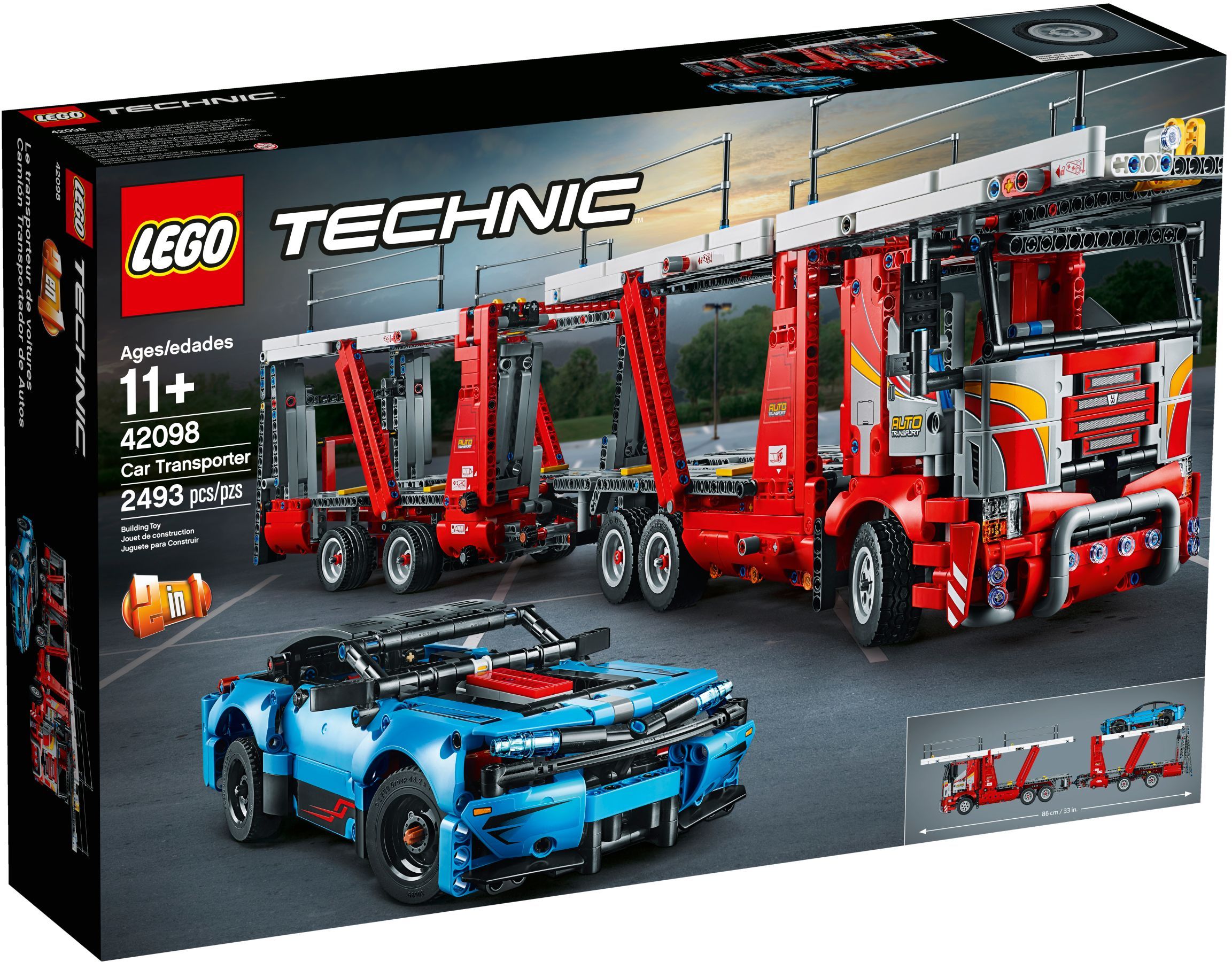
This is the length problem. Coupled up with the decks level it is a long model, and with the rear ramps down it passes a metre. Our member’s note was to check you have a run of table or shelf before you start. The blue car parks on the top deck over the cab, which is what the second steering gear is for.
Almost 40 stickers. The Auto Transport logos and the stripes do a lot of work on a model that is mostly open frame, so on this one I would apply them. Leave the decks level for display and the cab down. The Brothers Brick found nothing loose in the deck structure once it was lowered, so it will sit where you leave it.
Members who have built it
One Car Transporter build has come back through the door with photos, written up in January 2026. The diary is linked under each picture.


This is the one for you if you want a long, open, mechanical build where nothing is buried, or if you have a few Technic cars of your own and want something to put them on. It is three builds in one, five to six hours by our member’s count, and it takes a full table. Take the cab stickers slowly, gauge the railing spacing, and load through the trailer. If what you want is a gearbox, this is not that set.
If you like this one, try
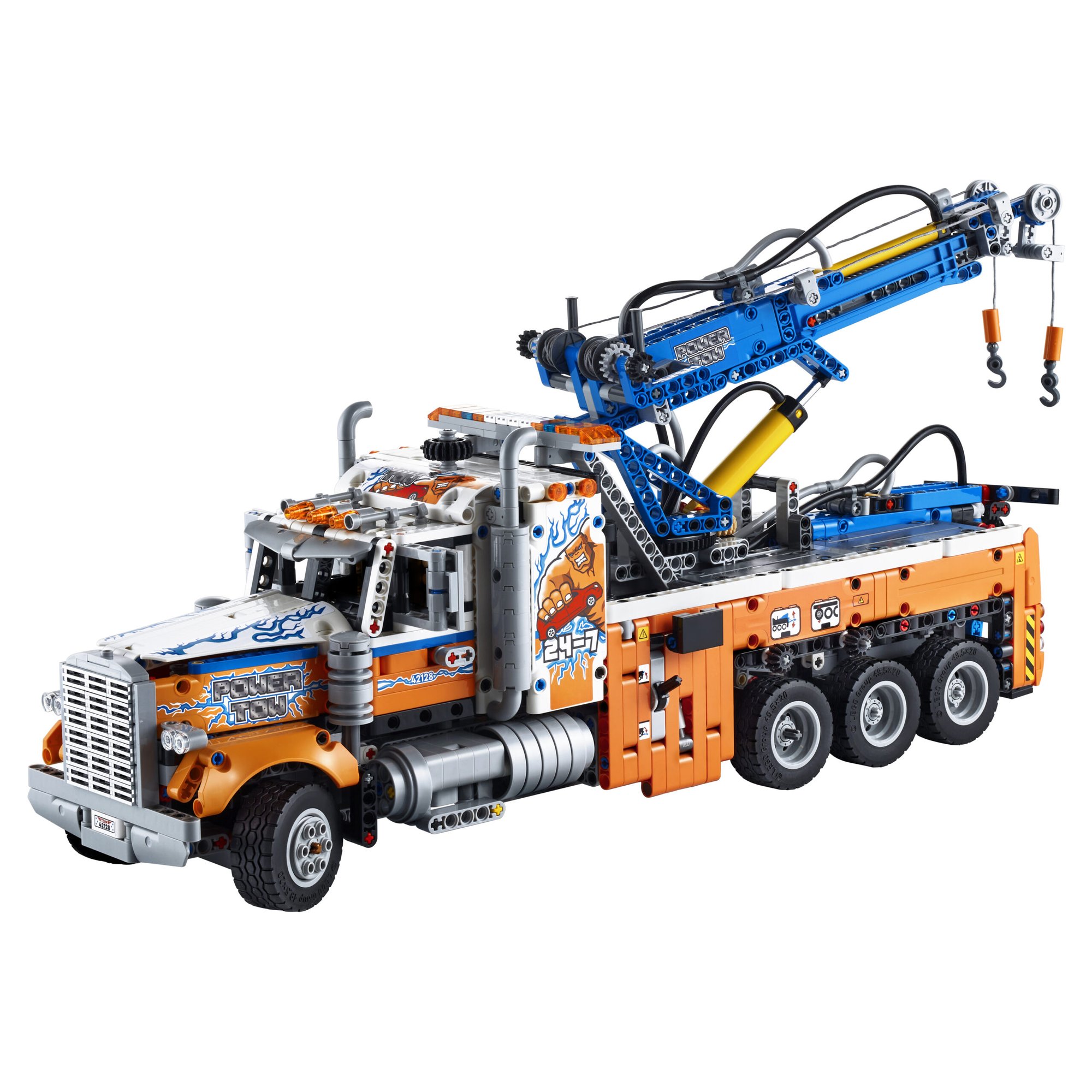
The other big trucks in the library. The Arocs (42043) is where the deck rack came from, the Mack Anthem (42078) is the truck that first used the beam-built engine, and the Heavy-Duty Tow Truck (42128) is the natural partner for it.

The Car Transporter is in the library
Technic Fan gets up to 6 kits a year, Master Builder up to 12. Delivery both ways is included and the prepaid return label is in the box.