

Lamborghini Sián FKP 37 (42115): the first Ultimate car with no stickers, and five parts groups of 700-plus pieces
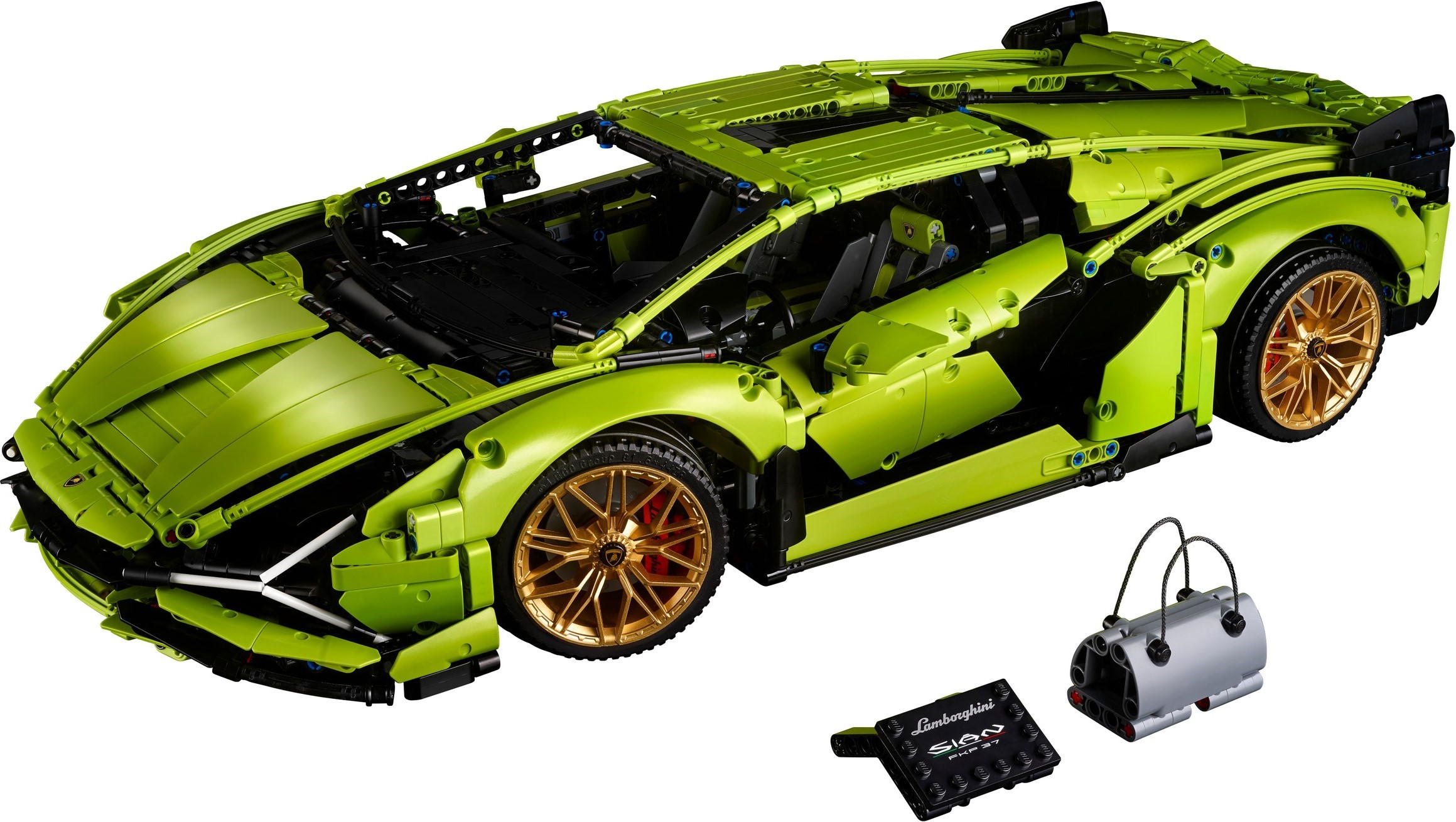
The Sián was the third of LEGO’s 1:8 Technic cars, after the Porsche 911 GT3 RS (42056) and the Bugatti Chiron (42083), and the first to arrive without a sticker sheet. Thirty printed elements across eleven prints, from the carbon-fibre tiles on the engine to the brake calipers, the fuel cap and the display plate. The real car is Lamborghini’s first hybrid and only 63 were made; the 63 printed inside the box lid stands for that and for 1963, the year Lamborghini was founded.
It is in the Brick Club library and one member, Chris, has built it and sent progress photos of the chassis before the green went on. Below is what it does, how the six inner boxes split the build, and where to slow down. Know this before you start: the 3,696 pieces come in just five parts groups, so every new box means digging through more than 700 pieces.
Why this one matters
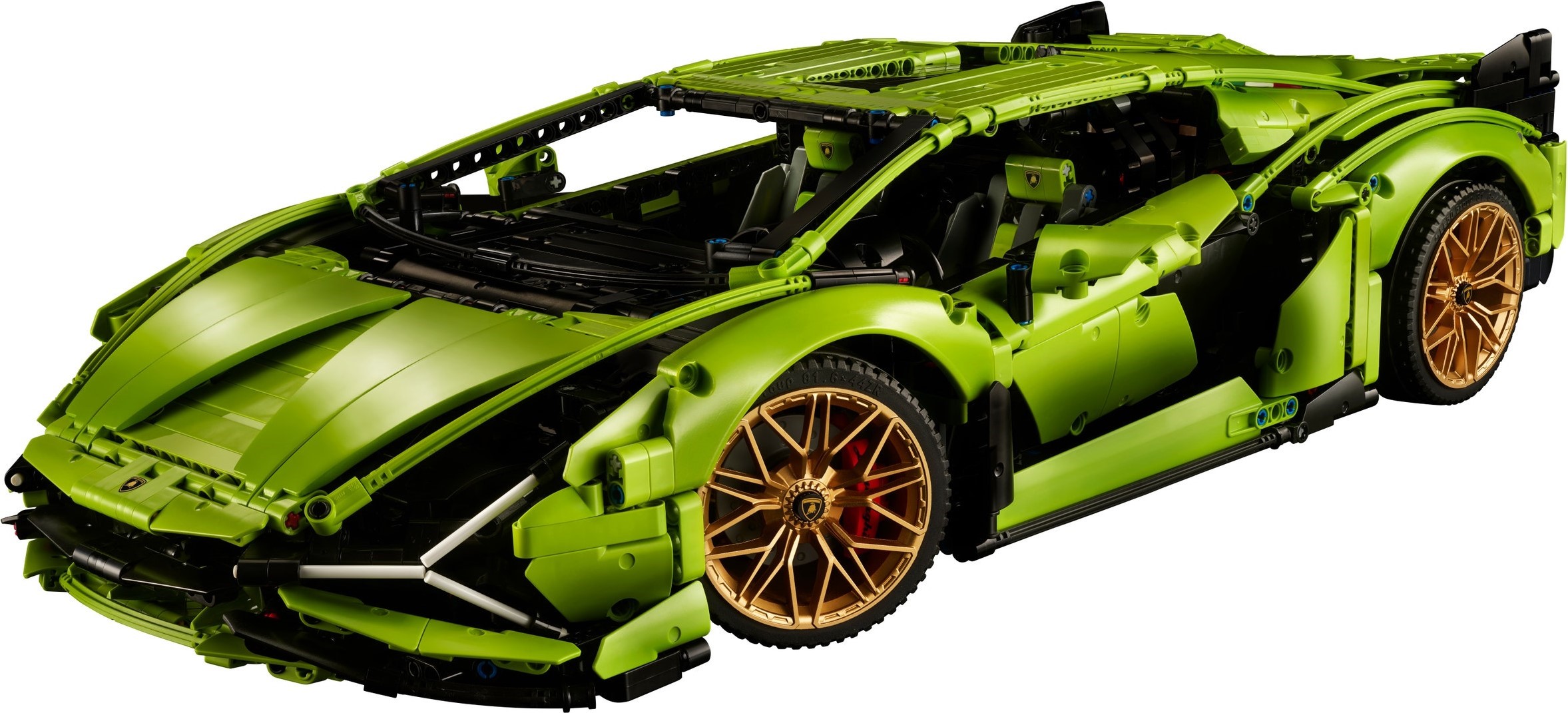
Start with the parts. Sixty elements appear in lime green here, many for the first time, and five moulds were new: wheel arches like the Porsche and Chiron ones but with curved tops, a left and right pair of trapezoid panels for the bonnet, a set of helicopter rotor blades that form the lower door sills, and the gold hubs. The hubs are drum-lacquered gold, individually bagged, on the same 81.6 x 44 tyre as the two earlier cars. Under the bonnet a white tile is laser-etched with a code unique to each copy of the set.
Then the printing. The Brothers Brick’s complaint about the Porsche and Chiron was that a premium set should not come with do-it-yourself stickers. Here they are gone: 30 printed elements plus two spares. That matters more on a rental copy than on one you own, because there is nothing to peel and nothing for the next member to inherit crooked.
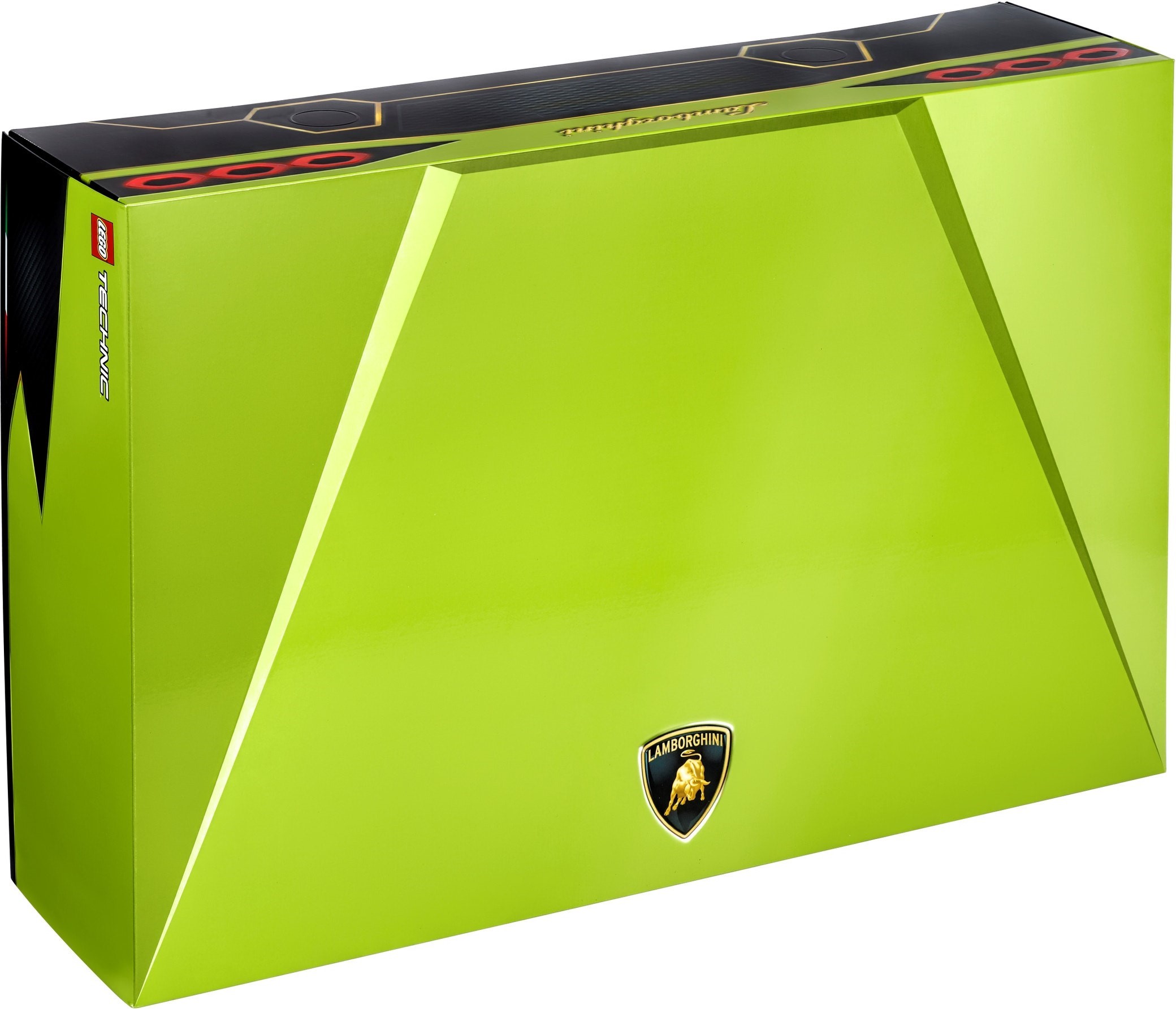
The packaging earns a paragraph. The front of the box is a stylised picture of the bonnet and badge and nothing else. Inside, six boxes are arranged to imitate the carbon-fibre engine cover, the middle four overlapping like scales, with two manuals below them, 656 pages in all, and a QR code at the start of each parts group linking to a short video. The Brothers Brick weighed it at 13.6 pounds unopened (Brickset lists 7.18 kg, nearer 16 pounds). It launched at £349.99 in June 2020, rose to £389.99 during its life, and LEGO retired it at the end of 2025.
What it actually does
Everything below is worked by hand. There are no motors. The build notes come from The Brothers Brick’s full review, the function list from LEGO’s launch release, the rest from Chris’s diary. Where nobody describes how a function is routed, I have said what it does and stopped.
Tap a paddle on either side of the steering wheel and The Brothers Brick describes a satisfying ka-chunk as the gearbox drops into a new ratio. A small forward, neutral and reverse shifter sits in the centre console. It is an 8-speed, it takes up a lot of the car’s bulk, and it is built in box one, straight after the rear suspension. The reviewer’s verdict was that it brings little new over the Porsche and the Chiron. The best part is underneath: the floor has several intentional windows into the gearbox, so turn the car over, pull a paddle and watch the clutches engage and disengage.
The V12 is built from the piston and cylinder pair LEGO introduced in 1990, yellow pistons and all, so it is the same engine as every other Technic set, just a dozen of them. It slots into the chassis after the gearbox and before the front suspension. The exhaust on top is a tangle of round and macaroni bricks with printed carbon-fibre tiles, a welcome change from beams and gears at that point. Chris’s build diary notes that the V12 sub-assembly is where most of the time goes and that access gets tight once the rear panels are on. Seeing it later means lifting the engine cover off completely, because it does not hinge.
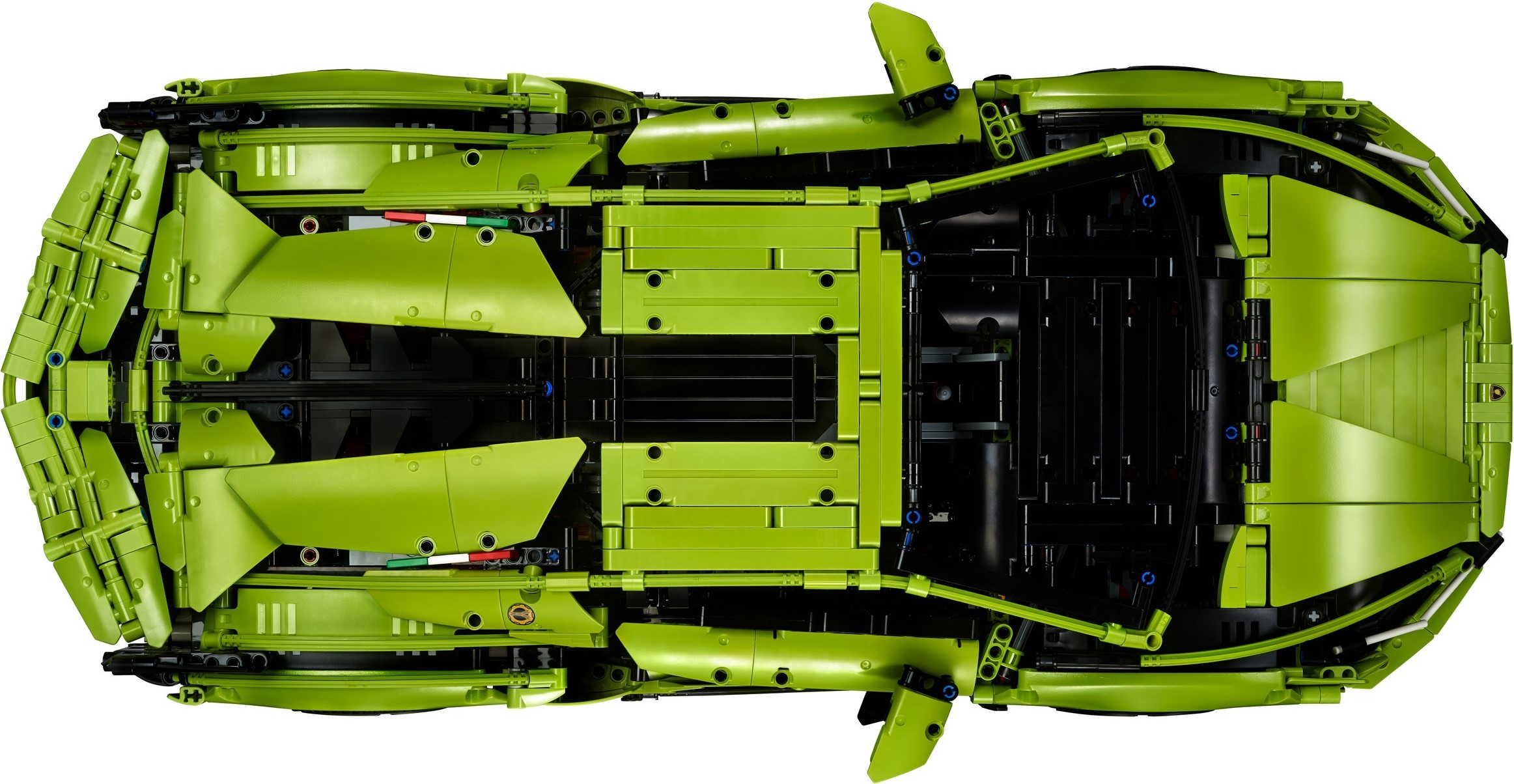
Press down on a panel just behind and above each seat and the door opens with a surprisingly swift motion. You close them by hand. The mechanism is a pair of long beams running in channels along the sides of the cockpit, built in box three, well before the doors go on in box five. The doors hang on a long axle that gives them a little movement as they rise. Chris’s build diary says they open at the correct angle; his photo with both doors up is below.
A lever in the passenger footwell pulls a linkage that runs just inside the passenger door, and a centre pylon lifts the wing. The wing is a weave of Technic connectors and small panels to get the compound angles of the delta.
Double-wishbone suspension at both ends, familiar if you have built the Chiron. Four stiff springs sit on top of the rear assembly and the front is largely the same unit again with the differential. LEGO lists steering from a wheel carrying the Lamborghini badge. None of the write-ups we hold describes how the steering is linked through the chassis, so I will leave it there.
The bonnet pops open to show a small grey overnight bag, as the Porsche and the Chiron had, plus the laser-etched serial tile. New for this set is a display plate: a 4 x 6 tile printed with the car’s logo, on a small frame that sits it at an angle beside the car.
How the build goes
The six inner boxes match the numbered parts groups, and box six holds only the tyres and gold rims, so the build is really five stages. This follows The Brothers Brick’s box-by-box review. Chris put it at seven to eight hours; the reviewer called it one of the longest construction times you will meet in a set.
Gearbox and rear suspension
The rear suspension goes down first, then it is set aside for the gearbox, which takes up a lot of the car’s bulk. At the end of box one the gearbox is mated to the beginnings of the frame and synced to the rear suspension, with the paddle shifters already visible. Click through the gears by hand before you go on.
V12 and the front end
The engine is built and slotted into the chassis, then the front suspension and differential. Mating the front unit to the chassis is the tricky moment: a handful of pins and axles have to line up at once. It takes a minute, then goes together smoothly. Then the exhaust, and some framing that looks odd until you remember it disappears under the panels. By the end of box two you are three quarters through the first manual.
Interior, door and spoiler mechanisms
The seats are racing buckets with a printed crest on the headrest. This box lays the groundwork for the two functions people notice, the long beams for the scissor doors and the spoiler linkage. It also builds the handle, nearly invisible and more important than anything else in the box: the roof is reinforced so the finished car can be lifted from the windscreen area. Remember where it is.
Rear spoiler and rear bodywork
Called the Rear Spoiler box, but most of the rear half of the body is in here. The three hexagonal tail lights each side are new 1 x 1 tent slopes, in red for the first time. The engine lid slots on with a pair of long axle pins rather than hinging. The rest goes quickly: green panels, a few long flexible axles to smooth the edges, and the car finally has its sharp lines.
Nose, doors, wheels and the leftovers
The splitter first, then the headlights, which the reviewer called one of the oddest constructions he had met for a part that does not move, all to hold three white blades at exactly the right angles. Then the doors. Box six is the wheels: press the printed crest tile into each hub straight the first time, because you will struggle to get it out again. A handful of pieces from box five remain when the wheels are on: the bag for the front boot and the display plate.
Four of these are about the build. The fifth is LEGO’s, and worth knowing before you open the box.
- Five parts groups of 700-plus pieces. The bags inside each group are split into sensible sub-groups, but every numbered group is still more than 700 pieces, and The Brothers Brick counted that as one reason the build takes so long. Tip each box into trays and sort by colour before you start the stage.
- Mating the front suspension to the chassis. A handful of pins and axles have to align at the same time. Do not force it. Line them up one at a time and it goes together smoothly.
- Lifting it. The reinforced handle is at the windscreen, not the back, and the roof panels are a bit larger than the handle, so check you are holding the reinforced part. The reviewer picked the Porsche up the wrong way once and calls it a catastrophic failure.
- The wheel crest tiles. Each hub takes a printed 1 x 1 round tile. Get it straight the first time; the rim shape means you will be hard pressed to ever remove it.
- Lime green that is not quite one lime green. Elements wander across the yellow-green spectrum. The small connectors are several shades darker, and the two big panels either side of the engine cover can be markedly different. LEGO replaced some for buyers. If our copy shows it, that is the set, not your build.
On the shelf
It is 60 cm long, 25 cm wide and 13 cm high, just shy of two feet, and flat. The colour is bright. The real launch car was a darker green Lamborghini calls Verde Gea, closer to LEGO’s olive; The Brothers Brick’s guess is that the Land Rover had just taken olive and the earlier cars had azure and orange, so lime it was. Jay’s Brick Blog, from the press photos, liked the low nose and thought the tail looked messy, too much green and not enough black. Chris’s rear-on photo below lets you judge that.
Display it with the doors up and the plate at the front. The engine cover comes off entirely to show the V12; it does not sit half open, so decide on or off.
Members who have built it
Chris built the Sián mid-subscription and photographed it as it went together, so you can see the gearbox, engine and suspension before the panels hide them. His build took seven to eight hours. The diary is linked under each picture.


It is the one for you if you have not built one of the 1:8 cars before: the reviewer’s line was that newcomers will find this one of the most engaging builds going, while anyone who has done the Porsche or the Chiron will find fewer surprises. It is still the one for you if you want the one with no stickers, gold wheels and the doors. Allow three evenings and table space for each 700-piece box. Test the gearbox before the engine goes on, find the handle before you lift it, and press the wheel crests in straight.
If you like this one, try
The other 1:8 cars in the library. The Chiron is the one the Sián borrows most from, and the Daytona is the one that came next.


The Lamborghini Sián FKP 37 is in the library
Technic Fan gets up to 6 kits a year, Master Builder up to 12. Delivery both ways is included and the prepaid return label is in the box.